Thursday, January 24, 2013

Proximity to China won’t hurt relations with India: Lankan Foreign Minister

India, Sri Lanka relations should not be seen through the prism of Sri Lanka-China relationship, Prof GL Peiris, Sri Lanka's foreign minister tells me in an exclusive interview.
 
He also talks in detail about the 13th amendment and how only a Parliament Select Committee can change the provisions!
 
Speaks about fishermen's issue, the range and depth of Indo-Sri Lankan relationship and invites political leaders from Tamil Nadu to visit Sri Lanka's North to see for themselves the progress made in those areas.
 
Watch if you have 23 minutes to spare.
 
Its not scintillating but a conversation that brings out different facets


Tuesday, January 22, 2013

The LoC incident: The back story

The recent incidents on the Line of Control between Indian and Pakistani army troops has predictably generated a lot of heat and has taken up oodles of air and print space in the media on both sides of the border. 

It is a familiar pattern. An incident takes place, it gets reported. The other side reacts. There is a counter-reaction. Allegations are made. Counter-allegations are flung. TV News Studios get busy with retired diplomats and generals on either side getting their 15 seconds of fame. So what's new?

As someone who was involved from Day I in not only reporting the incident but also monitoring the subsequent developments, it is important for me to recall the facts, the chain of events and the reaction of all stake-holders (a term I recently came across at a South Asia 2020 Conference) during the entire episode lest fiction as conceived by different players gets accepted as the absolute truth.

To begin at the beginning.

Sunday 6 January, 9.39 am:

My colleague Zaffar Iqbal sends an email to me and the NDTV Newsdesk which reads: "Ceasefire violation in Uri sector of Kashmir. Pakistan army resorted to unprovoked firing on Indian posts near village CHURUNDA close to LoC. Pak fired mortar shells and illumination shots. Many shells landed close to the village. Panic has gripped the villagers who fear casualties and damage to property. Firing started at 3.30 am and possibly to help infiltration. Alert troops retaliated and forced Pakistani troops to stop firing."

The newsdesk asks me for more details which are difficult to come by in the initial hours. But Army's Public Information setup in Delhi confirm Zaffar's inputs around 11.30. 

In the overall news rundown, the incident finds a routine mention.

Monday 7 January: 

Zaffar sends photographs of damage to villagers' houses in Churunda village because of the cross-border firing.

Tuesday 8 January, 1.15 pm or thereabouts:

On my facebook page and twitter timeline, queries start appearing: Have you heard of beheading of one of the two soldiers killed?

By 2 pm I am bombarded by faujis, fauji wives and others with information that one soldier is indeed beheaded. They were incredulous why I and other mainstream media guys were fighting shy of mentioning the barbaric act.

3 pm: Northern Command PRO, Lt. Col Rajesh Kalia continues to maintain that 2 soldiers have been killed and he has no more information at that point.

4 pm: Zaffar calls up and sends a mail saying he is pretty sure of the beheading but no one in the Army was reachable.

I again call up the usual contacts in Northern Command, the Army HQ and whoever I can reach in the fauj but no confirmation yet.

I and Zaffar in any case go on air saying two soldiers have indeed been killed after a suspected cross-border raid, their weapons snatched.

6.30 pm:

Finally, a senior officer at the  Army HQ reluctantly admits that one body is muitilated
without confirming if it was beheaded. So we stick to 'muitilation,' in absence of official admission.

6.30 to 8 pm:

Classic reporter's dilemma continues to dog us: Despite being aware of what had happened, lack of official confirmation means I am only circling around the fact by saying we have heard of this but no confirmation officially!

8.05: A senior officer in Northern Command finally confirms beheading. That's the time we go on air confirming beheading as fact!

9 January, Wednesday 

The Hindu's Praveen Swami reports of a grandmother's crossing the LoC and an aggressive commander on the LoC having sparked off the latest confrontation.

8 am: I call up the commander in question and ask him, half in jest: "So you have riled the Pakistanis so much." He laughs and says: "I wish I had that kind of power. In any case, I was on leave till yesterday (8th January)." We exchange further notes.

Zaffar in the meantime has reached Rajouri and is outside the Military Hospital there. The autopsy of the two killed soldiers is being carried out there.

At 11.45 am, Brig JK Tiwari, the No. 2 man in the 25 Infantry Division (which guards the LoC at Mendhar and Poonch among other places) goes on record, on camera to confirm the beheading.

1.58 pm: Zaffar says bodies flown out to Delhi.

2.20: We are told in the Defence Ministry the bodies are going to Agra since easier to send one to Mathura (Hemraj's).

5 pm: Defence Ministry issues clarification on a couple of stories, including The Hindu's.

Prime Time: Most TV Channels discuss the incident. Some project this as an act of war.

10 January, Thursday

5 pm: Zaffar says from Poonch cross-LoC trade halted. But trade is normal at Uri!

7.30 pm: Zaffar reprts fresh firing in Poonch, Mendhar etc.

post-8.30 pm: Lance Naik Hemraj's cremation takes place.

11 January, Friday 

Occasional exchange of firing from both sides.  Zaffar hangs on around the Poonch area. India asks for a flag meeting. Pakistan hasn't responded.

12 January, Saturday

Air Chief, ACM, NAK 'Charlie" Browne is visiting the NCC Cadets' camp in New Delhi. Reporters confront him there. As Chairman Chiefs of Staff Committee, he is forceful and candid, without sounding like a war monger.

"We have a Line of Control, we have a ceasefire agreement, we have certain structures and mechanisms which are sacrosanct and any violation of these with impunity especially what has been happening in the last few months is totally unacceptable.

"We are monitoring the situation carefully because if these things continue to be the way they are and these violations continue to take place, then perhaps we may have to look at some other options for compliance," he says.


7 pm: Zaffar says an infiltration attempt foiled at Mendhar.

The Air Chief's statement sets off another round of heated and in many cases hysterical discussions on TV programmes.

13 January, Sunday

Relatively quiet day.

14 January, Monday: 

Army Chief Gen Bikram Singh in the course of his annual Press Conference gives out the details and warns Pakistan. Says I expect my commanders on LoC to be aggressive and offensive.

He also admits that in July 2011 a similar incident of beheading of 2 soldiers from 20 Kumaon battalion had taken place but denies Army had tried to suppress it.


(Technically  Gen Bikram Singh was right since our own reporter in Uttarakhand, Dinesh Mansera had reported about the matter but only in an oblique manner since apparently at that time the family did not want this to come out. Whether the Army prevailed over the family not to speak about it or they did not want to let this fact come out because of some other reason is not yet clear).

At that time, some of us who came to know of the incident almost 10 days after it had happened could not pursue it since neither the Army nor the family would confirm it.

Later, there were unconfirmed and unsubstantiated reports about the Pakistani government having lodged a protest against beheading of three of their soldiers. But in my limited capacity of research, I have not come across any official report about this in 2011 in either Indian or Pakistani media. 

The gossip is however persistent and continues to this day. 

Last Saturday (19th January, 2013) however wife of one of the Kumaoni soldiers has told my colleague Dinesh Mansera: "hemraj ke sath jo hua wo hamare sath bhi hua per hamen sarkar ne sammaan nahi diya(what happened with Hemraj also happened with us)"

 At the moment it is not clear how this seemingly new development is being tackled by the Army. 

But to get back to the recent LoC incident.

The Army Chief's tough language was expected after the Air Chief had set the ball rolling.

The MEA in the meantime was trying to downplay the incident through "safe" and conciliatory statements.

15 January, Tuesday

Forenoon: Northern Army Commander Lt. Gen KT Parnaik holds his traditional press conference at Akhnoor after taking salute at the Army Day parade and reiterates the tough message that India reserved the right to retaliate at the place and time of its own choosing.

Later in the evening, he gives a lengthy interview to Times Now's Arnab Goswami and recounts in some details the entire incident.

Post-lunch: Annual Reception at Army House, 3 pm

Prime Minister Manmohan Singh and his senior Cabinet colleagues arrive 10 minutes before President Pranab Mukherjee is to arrive.

My colleague Barkha Dutt is among a handful of journalists and Editors at the reception.

Seeing the Prime Minister, she walks towards him and tosses a question: How do you read the situation at the LoC?

After a pause, he replies: "It can't be business  as usual."

Barkha rushes out of the Army House, starts reporting. Other reporters too gherao the PM and get the same response.

External Affairs Minister Salman Khurshid holds a hurriedly convened press conference a couple of hours later and says: "It should not be felt that the brazen denial and a lack of proper response from the government of Pakistan to our repeated demarches on this incident will be ignored and that bilateral relations could be unaffected or that there will be 'business as usual'.

Indian political leadership has finally in sync with the military's stand!

That night fresh exchange of firing happens, one Pakistani soldier is apparently killed.

16 January, Wednesday 

10 am:Pakistan Army Director General of Military Operations (DGMO) calls up his Indian counterpart and protests over the killing but more importantly the Pakistani officer says orders have been passed to the troops on their side of the LoC to exercise restraint and observe the ceasefire strictly. Both reached an understanding that situation should not be allowed to escalate!

So ended the latest flashpoint between India and Pakistan, at least temporarily.

Over the weekend, many write up have appeared questioning how and why the story acquired the salience it did.

My simple take is: In today's world of easy communications, nothing remains hidden. 

There are no conspiracies in the way the story unfolded. Even from two years ago, situation has changed.

Soldiers posses mobile phones. Officers and their wives are on twitter timelines and facebook pages. They talk, they gossip and they bristle in anger at the "soft" line taken by sections of the government. Details of incidents get out in flash, as they did on 6th and 8th January. No one is able to control the information flow. Mainstream Media waits for official confirmation, the social media has no such compulsion. So the mainstream media gets abused and reviled. It comes under pressure.

The responses are conditioned by this pressure. 

So decisions oscillate between one extreme and the other both in the MSM and the government.

It is this challenge that governments and media outlets will have to confront NOW.

Friday, January 11, 2013

Kashmir: The endless war. From my archives

In July-August 2011, I spent a week in Kashmir valley, living with the troops on the Line of Control, observing and recording their daily routine, the endless tension and drudgery. The thankless job they our soldiers do come sun, rain or snow. 

Recent incidents on the LoC reminded me once again how little we ordinary Indians know how risky the task is toi guard the LoC and how brave our soldiers are. Take a look at the documentary which admittedly captures only a fraction of the selfless service our Army renders.

Salute!

http://www.ndtv.com/video/player/prime-shows/jammu-and-kashmir-the-endless-war/207885

Wednesday, January 2, 2013

Rendezvous with a rebel: From the archives


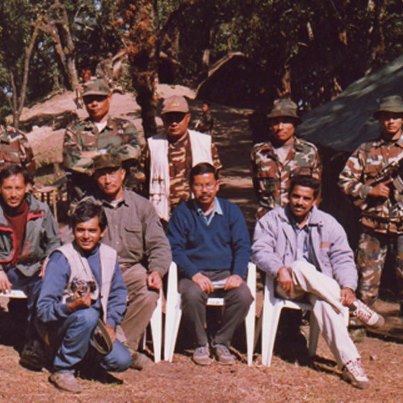
Early today, photographer friend Nilayan Dutta posted on Facebook a long forgotten picture(from November 200) of us in the jungles along the India-Myanmar border to meet a reclusive insurgent leader. That photograph kindled a lot of old memories. Here’s the description of sojourn where the journey itself was an adventure.

Then, looking for some old photographs came across memories of some more unusual journeys in India's north-east. So sharing them with friends.

Have a GREAT 2013.

WHAT IS LIFE AFTER ALL IF NOT AN ADVENTURE

 Circa 2000:
From the moment it was planned, I knew the risks involved.
Reaching the United National Liberation Front guerrillas in Manipur was tough for two reasons.
One, the sheer physical labour involved. Braving intense cold, we had to walk, climb and wade through jungles for two days.
Then, the security forces. Our visit coincided with the UNLF's 36th foundation day, when government troops were on extra alert to prevent any celebration.
Fortunately, we survived our adventure.
A decade ago in the jungles on the Indo-Myanmar border with UNLF chief Sanayaima, his colleagues and friends Rupachandra and Khelen. Memorable visit. Photographer Nilayan is sitting 
And when we reached the hideout somewhere deep in the forests bordering Burma, we had a pleasant surprise -- UNLF chairman R K Meghen.
Better known as Sana Yaima, this is the first time the elusive insurgent leader is coming out in the open.
Make your own way!
The planning was done well in advance, after a lot of homework.
The first approach, through a friend and newsman, was followed up by email.
The mid- and late 1990s: Various exciting assignment:
Clockwise from top left: Travelling a goods train in North Cachar Hills with fellow journalists; On the fast-flowing Lohit river in Eastern Arunachal Pradesh; Trekking in the jungles of North-east and Myanmar to meet a rebel leader RK Meghen alias Sanayaima, now in jail.
Nearly a fortnight went for logistics. But by the time I landed in Imphal, Manipur's capital, everything had been arranged.
Our haversacks full of essentials for the next few days, Photographer Nilayan Dutta and I waited for the morrow with apprehension...

Day 1
YUMNAM Rupachandra, correspondent of The Statesman, arrives with four others -- Khelen Thokchom, editor of Sangai Express, a local English daily, two photographers, and an ANI correspondent -- at 0600 hours IST. We set off in a Tata Sumo.
An hour reaches us to a small town. After a bit of breakfast, we turn off the highway, onto a dirt track. We arrive at a village and are told to unload our rucksacks and wait.
Ten minutes later, a man in a heavy jacket rides up on a bicycle. He could have been one of the several onlookers gathered around us but for one thing: a small Kenwood two-way radio around his neck.
He is Inga, and chats animatedly with our local friends in Manipuri. Rupachandra translates for our benefit: "An armed posse will escort us from this point."
Half an hour later, guerrillas arrive. In jungle fatigues, armed with AK-56s, the band of 11 boys, all of them in their early 20s, march into the village in a single file.
The leader, also carrying a radio, is a lance corporal in the UNLF hierarchy. He instructs his boys to pick up our luggage. I gather we are VIPs to them, so we are exempted from carrying our own bags.
With two 'scouts' in front, the procession begins. We march in single file. The pace, as it happens in the beginning of any journey on foot, is brisk. Soon we begin to sweat -- and off come our sweaters and heavy jackets.
After an hour or so, the water bottles come out. So do biscuits and chocolates. We city-types are beginning to tire and wonder what we have got ourselves into.
On the way, villagers stare at us, as if watching an exotic species. They are used to armed men walking through, but not 'civilians' like us.
After two-and-a-half hours, we reach the village where we are to have lunch. All of us lie down on the cool grass. Lunch is rice and dal. It has never tasted so great anywhere before!
CHAIREN is checking the route ahead for enemy movement.
"I am not so much worried about the security forces. What I am concerned about is our rivals attacking unexpectedly," he says.
Apparently, other groups such as the Issac-Muivah faction of the National Socialist Council of Nagaland -- bitter enemies of the UNLF -- control some areas en route.
We begin walking again, this time silently. As dusk dissolves into darkness, the fear in my mind accentuates. Everyone is quiet. What if there is an attack? Are these guys capable of warding it off?
The walk continues for the next four hours with little or no banter among us. Around 2000 hours, we reach a riverbank.
Chairen is constantly in touch with his base on radio. We wait. A vehicle is supposed to pick us up here.
After 30 minutes a Shaktiman truck wades through the waist-deep water and comes to our side. We clamber on to the open truck, grateful that we don't have to walk anymore.
The exciting 1990s and 2000s that took me and fellow photographers to mountains, rivers and jungles of the north-east. Clockwise from top left:
With then Outlook colleague Swapan Nayak at an NSCN camp; in the jungles of Manipur; On a ferry on the River Brahmaputra; at Walong with Swapan and at the Sela Pass with another Outlook photographer Jitendra Gupta
But 10 minutes on, we are all wishing that we had continued walking. The Shaktiman is lurching violently as it cuts through the jungle. Branches hit us from both sides.
My thoughts go back to the Tata Safari ad that says, 'Make your own way.' If the makers of Shaktiman could see us now, I think they would just film our journey and use it as promo!
An hour later we reach a village, gorge the simple fare of rice, tinned fish and dal and crash out on the wooden floor of a safe house.
Chairen's men, showing no signs of exhaustion despite the long day, stand guard. It is cold, but I drop off immediately into an exhausted slumber.

DAY 2

And tonight the password is 'Topi'

UP at 0530 hours IST. We brush our teeth. After a quick change of clothes, we are off to another house to avoid the prying eyes of the villagers.
A meal is being prepared. All of us go down to the river for our morning ablutions, shivering in the cold. The water is ice-cold but refreshing.
At 0830 hours we have our breakfast of rice and board our "luxury coach". The Shaktiman is now stacked with hay to make us comfortable!
Within 20 minutes, the semblance of road that existed vanishes. We are now going through a river -- through a river, mind you, not by its side.
The driver is least bothered about the pebbles and rocks on the riverbed or the steep inclines that he has to climb at times. All we can do is marvel at his skill and the Shaktiman's power. The manufacturers have not correctly gauged its capacity, I tell myself.
We halt after six torturous hours. Chairen hands us over to another platoon, led by a tough but smiling corporal, Sajong.
How much longer, we ask.
"Oh, just another hour," he replies.
He could not have been more wrong in gauging our strength -- or the lack of it. It took us three-and-a-half hours to reach our destination.
But I am jumping the gun. Before we begin the steepest climb in our journey, we walk/wade through 22 streams! Our shoes in our hands, the trousers rolled up above the knee, we cross these, wincing every time we put our feet in the bitingly cold water.
At a place called Rest Point, Sajong says it is only a 30-minute climb now. It takes us another two hours.
As we puff our way up the mountain, darkness descends. The track is too narrow. Our legs keep buckling under. My old knee injury starts aching.
Halfway up, Chinglen, staff officer of UNLF headquarters, meets us with steaming coffee and biscuits. The break is welcome.
The guerrillas, for their part, are amused at our plight. For them, climbing is as easy is as falling off to sleep.
AFTER a prolonged break, we arrive on the top. There is a fire burning. The warmth is welcome and so are the moulded plastic chairs. This is a transit camp, explains Chinglen.
Another round of coffee and we start talking. We are shown the hut where we would be sleeping for the next two nights. I look around, trying to soak in the ambience.
A diesel generator is on. Boys, young men and women in jungle fatigues, all armed, are bustling about the hillock. There are several huts scattered around. And guards at all strategic points.
As we apply Iodex to our aching feet, a senior man, flanked by tough-looking guards, walks across to us. He introduces himself as acting chief of staff, UNLF, and welcomes us formally. Then he gives us the biggest news we could have hoped for.
"Our chairman will meet you tomorrow," he announces without preamble.
Those of us who know how media-shy R K Meghen alias Sana Yaima is are elated. The tough journey suddenly seems worth all the trouble. A legend, who has avoided meeting the media so far, is ready to talk to us. It would be scoop!
A quick dinner and we are all ready for bed. We sleep like logs. Before we drop off, Chinglen gives us the password for the night, just in case any of us ventures out of the hut. It is 'Topi'.
"Topi, topi," I mutter as sleep overpowers me.

Day 3

The man they call Sana Yaima

COLD and stiff, we wake up to mugs of hot tea. No sooner is breakfast dispensed with, the man we are all waiting for walks across.
Tall and erect, his gait confident, Sana Yaima, dressed in jungle fatigues and surrounded by armed men, stops in front of us.
"Hello. Welcome to our makeshift camp," are his first words.
We introduce ourselves and sit around the fire. But for his olive green fatigues, Meghen could easily be mistaken for an academician.
Soft-spoken, erudite and impeccably mannered, he assumed the ancient Meitei name Sana Yaima in his avatar as an insurgent leader. He is far removed from the image of a gun-totting, fiery revolutionary.
Sana Yaima is extremely articulate, his reasoning convincing, his facts solid. A post-graduate in international relations from Calcutta's Jadavpur University, he had graduated from the Scottish Church College in the same city.
He brings a scholar's approach to insurgency. Also sophistication. His cadres have the best of weapons and equipment, which include laptop computers.
For a quarter of century, he had shunned the media. Now, after over 36 years of its existence (of which he has been associated for 31 years), the UNLF is ready to let the world know what it is all about.
Sana Yaima's upbringing and education in the late 1960s in Calcutta, during the run-up to the Naxalite uprising, have had a lasting affect on his outlook. I know that he is liberal, given to respect other ethnic groups and their distinct identities.
No wonder, I say to myself, that he has been leading the UNLF for the past 16 years, first in the capacity of general secretary between 1984 and 1998 and now as chairman. I try to recollect what I know of him.
IF I am not mistaken, he returned to Manipur in the early 1970s and got married.
In 1975, having become an important member of the outfit's think tank, he went underground. Since then, he has remained in the jungles, away from family, meeting them occasionally in hiding.
Sana Yaima's wife and two children have taken his absence in their stride. His wife, he is to tell us later, "keeps busy by teaching in a school while both my sons are pursuing higher studies".
The elder is doing his doctorate in remote sensing application in Manipur University and the younger is in Pune, studying computer science.
Twenty-five years in the jungles have kept the 55-year-old leader fighting fit. For him, this has become a way of life.
Except for making brief forays to Geneva to make a representation on the UNLF's behalf to the UN Sub-Commission on Indigenous People, and an occasional trip to South-East Asian countries, Sana Yaima has stayed with his 1,000-strong army, which comprises 100-odd women.
And now, after preliminary pleasantries are over, Sana Yaima is saying, "Let's have the interviews one by one."

And so it begins.

Saturday, December 29, 2012

A women and children Help desk in each Police Station:An Idea whose time has come


Note: We often tend to think that civil servants are an insensitive lot, unable to emphatise with the plight of the ordinary citizen. There are of course always exceptions to the rule.

SB Agnihotri, an IAS officer currently working with the defence ministry, has specialised in women and child development issues and has worked on them in Orissa, his original cadre. Moved by the plight of the 23-year old gang rape victim, he has penned down some suggestions which are worth considering. He has allowed me to share the thoughts here.

I am departing from this blog's normal inclination to dwell mainly only security & strategic issues (apart from cinema and cricket), as a tribute to the woman who has awakened the nation's conscience. Read on 

By Satish B. Agnihotri

The recent incident of brutality and rape of a brave 23 year old has shocked the
conscience of the entire society. There is anger, helplessness, shrill cries for
summary retribution and knee jerk reaction. The overwhelming demand is for
more severe punishment and speedier process of trial. Some saner elements
have emphasized the point that it is the speed and certainty of punishment that
is an effective deterrent rather than the severity of the punishment. There is also
the oft repeated` demand for the all-women police station. All these ‘instant’
solutions are very tempting, but do these provide lasting solutions? Hardly so.

We have heard much of this debate before. Experience tells us that this anger
will also dissipate if we do not channelize it into lasting institutional solution to the
problem of unsafe Delhi or for that matter, increasingly unsafe urban India for its
women.

No society is crime free. But a mature society learns from incidents of this
type and sets up anti-dotes that are both preventative and those who deal with
incidents when unfortunately, they happen. Nor are the social attitudes going to
change overnight, but a systemic effort in that direction has to begin somewhere!
We can enact any number of laws, but the devil truly hides in implementation as
the Delhi and similar such incidents have shown us in the past. Can we create a
functional, robust and helpful structure? The answer is a simple YES!

What does a rape victim, or for that matter a female victim of violence need
the most and need immediately? A trust that she will be heard and helped;
not scorned, shoed away or worst, made to suffer more ignominy. Given the
structure of our social and criminal justice system, the woman and especially the
child does not dare to approach a police station. Sympathy is the last thing they
expect there, and this is precisely where the first dent has to be made.

Women’s issues suffer from one more dilemma. We often set up exclusive
solutions for them. All women’s police stations are no exception. The unintended
side effect of it is that the mainstream police stations conveniently wash their
hands off the complainant sending her to the ‘exclusive’ thana. The all women
police station always remains a ‘second class citizen’ and, in an ironical case that
the writer is aware of, a Mahila Thana was itself asking for protection against
local ruffians – who after all have to be handled by the local ‘mainstream’ police
station. An added nuance that is ignored by all is that untrained women police
can be equally insensitive or even more insensitive, compared to their male
counterpart while dealing with women who have faced violence.

Why can’t we mainstream the component of assisting women and children as
part of the regular criminal justice and police system? It is feasible, cost effective
and can increase the quality of policing. More important, it has been tried out in
Odisha and there is no reason why it cannot work in, say, Delhi immediately.

Imagine a traumatized victim of violence walking into a police station. How
reassuring will the person feel if she finds a Women and Child desk manned
by a woman who is not intimidating in her manners? How reassuring if there a
sliding partition of the type we use in hospitals which give a patient privacy? How
reassuring indeed if the desk personnel;

  • Listen to the complainant with patience and compassion
  •  If required,provide her facilities such as drinking water and use of toilet.
  • Ensure that the details are kept confidential and facilitate to lodge the complaint or the FIR.
  • Help the complainant to access the services such as health, counseling,legal aid, short-stay home.
  • Provide services without being judgmental and biased due caste, creed, current situation, family background or past history of the client.
  • Uphold the dignity and respect of the client and
  • Do not give any wrong hopes and information to the client

Is it a tall order to expect the Help Desk to be open 24 hours and on all days just
as the police station is? Certainly not.

Every district has requisite support system in terms of hospital, short stay home,
legal aid cell etc. But one important missing link is the service of a councilor. It is
quite possible to have a panel of two to three professional and trained councilors
for every police stations who can be remunerated on the case attendance basis.

Are such solutions not very costly? Not at all. A proposal submitted to the
Women and Child Department in the Centre in 2005-06 for a support to about
460 police stations to set up the Women and Children help desk with support for
training, councelling, help line, mobility, communication, transport, stay at Short
stay home, sensitization workshops and monitoring and evaluation together cost
just about 4 crores of rupees. It could at best be 10 crores to-day – a cost the
society can certainly afford.

Many persons had argued for setting up a women’s desk and a children’s desk
separately. A simple ‘thought experiment’ was enough to dissuade them from
such idea. The thought experiment was to imagine the plight of a 12 year old girl
child who comes to the police station and is tossed between the two desks! We
often forget the simple wisdom of ‘united we stand’!

Training, sensitisation and capacity building of the police personnel is a big
task and has to be sustained over a long time. But wherever it has been done
properly it has been a rewarding experience. Sunita Krishnan, the brave and
now famous ‘rape survivor’ from Hyderabad who is currently working for rescue
and rehabilitation of trafficked girls, had been part of such training of Police
personnel. A week after one of her training sessions, she received a phone call
from a Police Inspector who told her that he had carried out a raid for rescue of
some girls in which he followed her instructions to the last detail. When he told
her that he found it to be the most rewarding day of his three decades service
in Police, Sunita was overwhelmed. She told this writer that it was the biggest
certificate that she ever got as a trainer.

There you are. With a little addition to the existing infrastructure, we can set
up a mainstream institutional structure to which a traumatized victim can turn
for help and support without fearing to encounter insensitivity or ridicule. It is a
place that would treat her with dignity. A desk that will connect her to the support
services rather than leaving her to fend for herself. It will be a place where not
withstanding her trauma her ‘mind will be without fear’.

It is time Delhi sheds its image as the rape capital of the country and sets up
structures that make violence against women a thing of the past. It is quite
feasible to set up such help desks in all the police stations by 8th March 2013.

This is the most constructive tribute we can pay to the 23 year old brave heart who died early on Saturday morning in Singapore.

 The time for the idea is now!


Satish B Agnihotri (sbagnihotri@gmail.com) The writer is a civil servant and currently working in the Ministry of Defence. The views are personal. 

Saturday, December 22, 2012

Triumph and tragedy of an Air Force cadet

Its a case that highlights tragedy as well as triumph. 

Tragic because a young man will have to spend rest of his life bound to a wheel chair following an accident. Triumph because of the exceptional willpower shown by the young man.

In an unprecedented decision, the Defence Ministry has allowed a flight cadet suffering from paraplegia (paralysed waist downward because of an accident during training) to continue in the Indian Air Force as a ground duty officer.

The cadet from Manipur, RK Herojit Singh, an achiever in the National Defence Academy and in the Air Force Academy, Dundigal where he was training to fly fighter jets till August 28 last year was found unfit to fly, even unfit for many ground duties after the accident which broke his spinal chord.


Indian Air Force sources said Defence Minister AK Antony, after consulting officials in the ministry, has acceded to a special request made by Chief of the Air Staff, Air Chief Marshal NAK Browne to commission Flight Cadet Herojit in Ground Duties,Accounts Branch.

Herojit, currently undergoing treatment at the Military Hospital, Kirkee, near Pune, will be imparted a further training of six months at Dundigal and then commissioned in the IAF's accounts branch.

Doctors have said that Herojit is likely to be confined to a wheel chair for life, his intellectual and motor capabilities are fully intact.

The Air Force, while reviewing his case after the unfortunate accident last year found that Herojit not only had a meritorious record, with exceptional performance in all fields during service training of four years( three at NDA and one at Air force Academy), but was also adjudged ‘The Most Accomplished Flight Cadet’ of his course. 

When the case was brought to the Air Chief's notice, he decided to walk up to the Defence minister and request him to treat Herojit as a special case. After due deliberation, the MoD has now granted the permission to grant commission to Flight Cadet Herojit Singh in Ground Duties branch. 

Herojit, will now undergo a further six months of training in Accounts Branch at Air Force Academy, Dundigal, Hyderabad starting 9 Jan 2013.

Allowing him to join work from wheelchair, IAF believes Herojit is fully fit, highly motivated and competent and his present condition or his likely future condition will not impede efficient functioning as an officer in the recommended branch.  Herojit's unfortunate case however also highlighted the shortcomings in the IAF's basic training facilities.
Cadets at the Air Force Academy have been training without a basic trainer after the three-decade old aircraft, HPT-32 was grounded in 2010 following a spate of accidents.
In the absence of basic trainers, cadets like Herojit had to start flying the Kiran Mark II, a jet aircraft, faster and more demanding than the basic trainers. 
Herojit in fact had to eject from a Kiran when it caught fire mid-air 20 minutes after he took off last August.
The first of the Kiran aircraft, such as the one that Herojit was flying, was inducted into the air force 40 years back. For the last 15 years, the defence public sector Hindustan Aeronautics has been at work on an intermediate jet trainer (IJT) to replace the Kiran. Herojit was on stage II training, the second six-month period in which cadets selected for fighter flying should have been flying the IJT before moving on to the Advanced Jet Trainer (ACT) Hawk.
However, after the Air Force flagged the urgency of having a new basic trainer, the government fast-tracked the purchase of 75 Swiss-made Pilatus PC-7s. The first few of these aircraft will be inducted next month.
This, the IAF is hoping, will bring its pilot training programme for rookies back on track.