Wednesday, January 2, 2013

Rendezvous with a rebel: From the archives


Early today, photographer friend Nilayan Dutta posted on Facebook a long forgotten picture(from November 200) of us in the jungles along the India-Myanmar border to meet a reclusive insurgent leader. That photograph kindled a lot of old memories. Here’s the description of sojourn where the journey itself was an adventure.

Then, looking for some old photographs came across memories of some more unusual journeys in India's north-east. So sharing them with friends.

Have a GREAT 2013.

WHAT IS LIFE AFTER ALL IF NOT AN ADVENTURE

 Circa 2000:
From the moment it was planned, I knew the risks involved.
Reaching the United National Liberation Front guerrillas in Manipur was tough for two reasons.
One, the sheer physical labour involved. Braving intense cold, we had to walk, climb and wade through jungles for two days.
Then, the security forces. Our visit coincided with the UNLF's 36th foundation day, when government troops were on extra alert to prevent any celebration.
Fortunately, we survived our adventure.
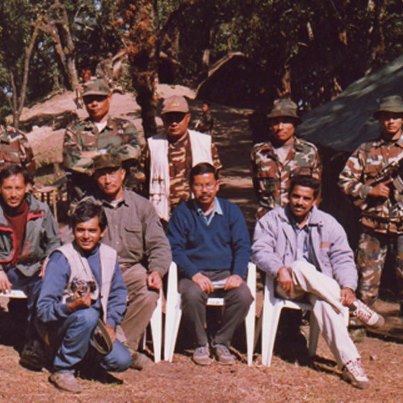
A decade ago in the jungles on the Indo-Myanmar border with UNLF chief Sanayaima, his colleagues and friends Rupachandra and Khelen. Memorable visit. Photographer Nilayan is sitting 
And when we reached the hideout somewhere deep in the forests bordering Burma, we had a pleasant surprise -- UNLF chairman R K Meghen.
Better known as Sana Yaima, this is the first time the elusive insurgent leader is coming out in the open.
Make your own way!
The planning was done well in advance, after a lot of homework.
The first approach, through a friend and newsman, was followed up by email.
The mid- and late 1990s: Various exciting assignment:
Clockwise from top left: Travelling a goods train in North Cachar Hills with fellow journalists; On the fast-flowing Lohit river in Eastern Arunachal Pradesh; Trekking in the jungles of North-east and Myanmar to meet a rebel leader RK Meghen alias Sanayaima, now in jail.
Nearly a fortnight went for logistics. But by the time I landed in Imphal, Manipur's capital, everything had been arranged.
Our haversacks full of essentials for the next few days, Photographer Nilayan Dutta and I waited for the morrow with apprehension...

Day 1
YUMNAM Rupachandra, correspondent of The Statesman, arrives with four others -- Khelen Thokchom, editor of Sangai Express, a local English daily, two photographers, and an ANI correspondent -- at 0600 hours IST. We set off in a Tata Sumo.
An hour reaches us to a small town. After a bit of breakfast, we turn off the highway, onto a dirt track. We arrive at a village and are told to unload our rucksacks and wait.
Ten minutes later, a man in a heavy jacket rides up on a bicycle. He could have been one of the several onlookers gathered around us but for one thing: a small Kenwood two-way radio around his neck.
He is Inga, and chats animatedly with our local friends in Manipuri. Rupachandra translates for our benefit: "An armed posse will escort us from this point."
Half an hour later, guerrillas arrive. In jungle fatigues, armed with AK-56s, the band of 11 boys, all of them in their early 20s, march into the village in a single file.
The leader, also carrying a radio, is a lance corporal in the UNLF hierarchy. He instructs his boys to pick up our luggage. I gather we are VIPs to them, so we are exempted from carrying our own bags.
With two 'scouts' in front, the procession begins. We march in single file. The pace, as it happens in the beginning of any journey on foot, is brisk. Soon we begin to sweat -- and off come our sweaters and heavy jackets.
After an hour or so, the water bottles come out. So do biscuits and chocolates. We city-types are beginning to tire and wonder what we have got ourselves into.
On the way, villagers stare at us, as if watching an exotic species. They are used to armed men walking through, but not 'civilians' like us.
After two-and-a-half hours, we reach the village where we are to have lunch. All of us lie down on the cool grass. Lunch is rice and dal. It has never tasted so great anywhere before!
CHAIREN is checking the route ahead for enemy movement.
"I am not so much worried about the security forces. What I am concerned about is our rivals attacking unexpectedly," he says.
Apparently, other groups such as the Issac-Muivah faction of the National Socialist Council of Nagaland -- bitter enemies of the UNLF -- control some areas en route.
We begin walking again, this time silently. As dusk dissolves into darkness, the fear in my mind accentuates. Everyone is quiet. What if there is an attack? Are these guys capable of warding it off?
The walk continues for the next four hours with little or no banter among us. Around 2000 hours, we reach a riverbank.
Chairen is constantly in touch with his base on radio. We wait. A vehicle is supposed to pick us up here.
After 30 minutes a Shaktiman truck wades through the waist-deep water and comes to our side. We clamber on to the open truck, grateful that we don't have to walk anymore.
The exciting 1990s and 2000s that took me and fellow photographers to mountains, rivers and jungles of the north-east. Clockwise from top left:
With then Outlook colleague Swapan Nayak at an NSCN camp; in the jungles of Manipur; On a ferry on the River Brahmaputra; at Walong with Swapan and at the Sela Pass with another Outlook photographer Jitendra Gupta
But 10 minutes on, we are all wishing that we had continued walking. The Shaktiman is lurching violently as it cuts through the jungle. Branches hit us from both sides.
My thoughts go back to the Tata Safari ad that says, 'Make your own way.' If the makers of Shaktiman could see us now, I think they would just film our journey and use it as promo!
An hour later we reach a village, gorge the simple fare of rice, tinned fish and dal and crash out on the wooden floor of a safe house.
Chairen's men, showing no signs of exhaustion despite the long day, stand guard. It is cold, but I drop off immediately into an exhausted slumber.

DAY 2

And tonight the password is 'Topi'

UP at 0530 hours IST. We brush our teeth. After a quick change of clothes, we are off to another house to avoid the prying eyes of the villagers.
A meal is being prepared. All of us go down to the river for our morning ablutions, shivering in the cold. The water is ice-cold but refreshing.
At 0830 hours we have our breakfast of rice and board our "luxury coach". The Shaktiman is now stacked with hay to make us comfortable!
Within 20 minutes, the semblance of road that existed vanishes. We are now going through a river -- through a river, mind you, not by its side.
The driver is least bothered about the pebbles and rocks on the riverbed or the steep inclines that he has to climb at times. All we can do is marvel at his skill and the Shaktiman's power. The manufacturers have not correctly gauged its capacity, I tell myself.
We halt after six torturous hours. Chairen hands us over to another platoon, led by a tough but smiling corporal, Sajong.
How much longer, we ask.
"Oh, just another hour," he replies.
He could not have been more wrong in gauging our strength -- or the lack of it. It took us three-and-a-half hours to reach our destination.
But I am jumping the gun. Before we begin the steepest climb in our journey, we walk/wade through 22 streams! Our shoes in our hands, the trousers rolled up above the knee, we cross these, wincing every time we put our feet in the bitingly cold water.
At a place called Rest Point, Sajong says it is only a 30-minute climb now. It takes us another two hours.
As we puff our way up the mountain, darkness descends. The track is too narrow. Our legs keep buckling under. My old knee injury starts aching.
Halfway up, Chinglen, staff officer of UNLF headquarters, meets us with steaming coffee and biscuits. The break is welcome.
The guerrillas, for their part, are amused at our plight. For them, climbing is as easy is as falling off to sleep.
AFTER a prolonged break, we arrive on the top. There is a fire burning. The warmth is welcome and so are the moulded plastic chairs. This is a transit camp, explains Chinglen.
Another round of coffee and we start talking. We are shown the hut where we would be sleeping for the next two nights. I look around, trying to soak in the ambience.
A diesel generator is on. Boys, young men and women in jungle fatigues, all armed, are bustling about the hillock. There are several huts scattered around. And guards at all strategic points.
As we apply Iodex to our aching feet, a senior man, flanked by tough-looking guards, walks across to us. He introduces himself as acting chief of staff, UNLF, and welcomes us formally. Then he gives us the biggest news we could have hoped for.
"Our chairman will meet you tomorrow," he announces without preamble.
Those of us who know how media-shy R K Meghen alias Sana Yaima is are elated. The tough journey suddenly seems worth all the trouble. A legend, who has avoided meeting the media so far, is ready to talk to us. It would be scoop!
A quick dinner and we are all ready for bed. We sleep like logs. Before we drop off, Chinglen gives us the password for the night, just in case any of us ventures out of the hut. It is 'Topi'.
"Topi, topi," I mutter as sleep overpowers me.

Day 3

The man they call Sana Yaima

COLD and stiff, we wake up to mugs of hot tea. No sooner is breakfast dispensed with, the man we are all waiting for walks across.
Tall and erect, his gait confident, Sana Yaima, dressed in jungle fatigues and surrounded by armed men, stops in front of us.
"Hello. Welcome to our makeshift camp," are his first words.
We introduce ourselves and sit around the fire. But for his olive green fatigues, Meghen could easily be mistaken for an academician.
Soft-spoken, erudite and impeccably mannered, he assumed the ancient Meitei name Sana Yaima in his avatar as an insurgent leader. He is far removed from the image of a gun-totting, fiery revolutionary.
Sana Yaima is extremely articulate, his reasoning convincing, his facts solid. A post-graduate in international relations from Calcutta's Jadavpur University, he had graduated from the Scottish Church College in the same city.
He brings a scholar's approach to insurgency. Also sophistication. His cadres have the best of weapons and equipment, which include laptop computers.
For a quarter of century, he had shunned the media. Now, after over 36 years of its existence (of which he has been associated for 31 years), the UNLF is ready to let the world know what it is all about.
Sana Yaima's upbringing and education in the late 1960s in Calcutta, during the run-up to the Naxalite uprising, have had a lasting affect on his outlook. I know that he is liberal, given to respect other ethnic groups and their distinct identities.
No wonder, I say to myself, that he has been leading the UNLF for the past 16 years, first in the capacity of general secretary between 1984 and 1998 and now as chairman. I try to recollect what I know of him.
IF I am not mistaken, he returned to Manipur in the early 1970s and got married.
In 1975, having become an important member of the outfit's think tank, he went underground. Since then, he has remained in the jungles, away from family, meeting them occasionally in hiding.
Sana Yaima's wife and two children have taken his absence in their stride. His wife, he is to tell us later, "keeps busy by teaching in a school while both my sons are pursuing higher studies".
The elder is doing his doctorate in remote sensing application in Manipur University and the younger is in Pune, studying computer science.
Twenty-five years in the jungles have kept the 55-year-old leader fighting fit. For him, this has become a way of life.
Except for making brief forays to Geneva to make a representation on the UNLF's behalf to the UN Sub-Commission on Indigenous People, and an occasional trip to South-East Asian countries, Sana Yaima has stayed with his 1,000-strong army, which comprises 100-odd women.
And now, after preliminary pleasantries are over, Sana Yaima is saying, "Let's have the interviews one by one."

And so it begins.

Saturday, December 29, 2012

A women and children Help desk in each Police Station:An Idea whose time has come


Note: We often tend to think that civil servants are an insensitive lot, unable to emphatise with the plight of the ordinary citizen. There are of course always exceptions to the rule.

SB Agnihotri, an IAS officer currently working with the defence ministry, has specialised in women and child development issues and has worked on them in Orissa, his original cadre. Moved by the plight of the 23-year old gang rape victim, he has penned down some suggestions which are worth considering. He has allowed me to share the thoughts here.

I am departing from this blog's normal inclination to dwell mainly only security & strategic issues (apart from cinema and cricket), as a tribute to the woman who has awakened the nation's conscience. Read on 

By Satish B. Agnihotri

The recent incident of brutality and rape of a brave 23 year old has shocked the
conscience of the entire society. There is anger, helplessness, shrill cries for
summary retribution and knee jerk reaction. The overwhelming demand is for
more severe punishment and speedier process of trial. Some saner elements
have emphasized the point that it is the speed and certainty of punishment that
is an effective deterrent rather than the severity of the punishment. There is also
the oft repeated` demand for the all-women police station. All these ‘instant’
solutions are very tempting, but do these provide lasting solutions? Hardly so.

We have heard much of this debate before. Experience tells us that this anger
will also dissipate if we do not channelize it into lasting institutional solution to the
problem of unsafe Delhi or for that matter, increasingly unsafe urban India for its
women.

No society is crime free. But a mature society learns from incidents of this
type and sets up anti-dotes that are both preventative and those who deal with
incidents when unfortunately, they happen. Nor are the social attitudes going to
change overnight, but a systemic effort in that direction has to begin somewhere!
We can enact any number of laws, but the devil truly hides in implementation as
the Delhi and similar such incidents have shown us in the past. Can we create a
functional, robust and helpful structure? The answer is a simple YES!

What does a rape victim, or for that matter a female victim of violence need
the most and need immediately? A trust that she will be heard and helped;
not scorned, shoed away or worst, made to suffer more ignominy. Given the
structure of our social and criminal justice system, the woman and especially the
child does not dare to approach a police station. Sympathy is the last thing they
expect there, and this is precisely where the first dent has to be made.

Women’s issues suffer from one more dilemma. We often set up exclusive
solutions for them. All women’s police stations are no exception. The unintended
side effect of it is that the mainstream police stations conveniently wash their
hands off the complainant sending her to the ‘exclusive’ thana. The all women
police station always remains a ‘second class citizen’ and, in an ironical case that
the writer is aware of, a Mahila Thana was itself asking for protection against
local ruffians – who after all have to be handled by the local ‘mainstream’ police
station. An added nuance that is ignored by all is that untrained women police
can be equally insensitive or even more insensitive, compared to their male
counterpart while dealing with women who have faced violence.

Why can’t we mainstream the component of assisting women and children as
part of the regular criminal justice and police system? It is feasible, cost effective
and can increase the quality of policing. More important, it has been tried out in
Odisha and there is no reason why it cannot work in, say, Delhi immediately.

Imagine a traumatized victim of violence walking into a police station. How
reassuring will the person feel if she finds a Women and Child desk manned
by a woman who is not intimidating in her manners? How reassuring if there a
sliding partition of the type we use in hospitals which give a patient privacy? How
reassuring indeed if the desk personnel;

  • Listen to the complainant with patience and compassion
  •  If required,provide her facilities such as drinking water and use of toilet.
  • Ensure that the details are kept confidential and facilitate to lodge the complaint or the FIR.
  • Help the complainant to access the services such as health, counseling,legal aid, short-stay home.
  • Provide services without being judgmental and biased due caste, creed, current situation, family background or past history of the client.
  • Uphold the dignity and respect of the client and
  • Do not give any wrong hopes and information to the client

Is it a tall order to expect the Help Desk to be open 24 hours and on all days just
as the police station is? Certainly not.

Every district has requisite support system in terms of hospital, short stay home,
legal aid cell etc. But one important missing link is the service of a councilor. It is
quite possible to have a panel of two to three professional and trained councilors
for every police stations who can be remunerated on the case attendance basis.

Are such solutions not very costly? Not at all. A proposal submitted to the
Women and Child Department in the Centre in 2005-06 for a support to about
460 police stations to set up the Women and Children help desk with support for
training, councelling, help line, mobility, communication, transport, stay at Short
stay home, sensitization workshops and monitoring and evaluation together cost
just about 4 crores of rupees. It could at best be 10 crores to-day – a cost the
society can certainly afford.

Many persons had argued for setting up a women’s desk and a children’s desk
separately. A simple ‘thought experiment’ was enough to dissuade them from
such idea. The thought experiment was to imagine the plight of a 12 year old girl
child who comes to the police station and is tossed between the two desks! We
often forget the simple wisdom of ‘united we stand’!

Training, sensitisation and capacity building of the police personnel is a big
task and has to be sustained over a long time. But wherever it has been done
properly it has been a rewarding experience. Sunita Krishnan, the brave and
now famous ‘rape survivor’ from Hyderabad who is currently working for rescue
and rehabilitation of trafficked girls, had been part of such training of Police
personnel. A week after one of her training sessions, she received a phone call
from a Police Inspector who told her that he had carried out a raid for rescue of
some girls in which he followed her instructions to the last detail. When he told
her that he found it to be the most rewarding day of his three decades service
in Police, Sunita was overwhelmed. She told this writer that it was the biggest
certificate that she ever got as a trainer.

There you are. With a little addition to the existing infrastructure, we can set
up a mainstream institutional structure to which a traumatized victim can turn
for help and support without fearing to encounter insensitivity or ridicule. It is a
place that would treat her with dignity. A desk that will connect her to the support
services rather than leaving her to fend for herself. It will be a place where not
withstanding her trauma her ‘mind will be without fear’.

It is time Delhi sheds its image as the rape capital of the country and sets up
structures that make violence against women a thing of the past. It is quite
feasible to set up such help desks in all the police stations by 8th March 2013.

This is the most constructive tribute we can pay to the 23 year old brave heart who died early on Saturday morning in Singapore.

 The time for the idea is now!


Satish B Agnihotri (sbagnihotri@gmail.com) The writer is a civil servant and currently working in the Ministry of Defence. The views are personal. 

Saturday, December 22, 2012

Triumph and tragedy of an Air Force cadet

Its a case that highlights tragedy as well as triumph. 

Tragic because a young man will have to spend rest of his life bound to a wheel chair following an accident. Triumph because of the exceptional willpower shown by the young man.

In an unprecedented decision, the Defence Ministry has allowed a flight cadet suffering from paraplegia (paralysed waist downward because of an accident during training) to continue in the Indian Air Force as a ground duty officer.

The cadet from Manipur, RK Herojit Singh, an achiever in the National Defence Academy and in the Air Force Academy, Dundigal where he was training to fly fighter jets till August 28 last year was found unfit to fly, even unfit for many ground duties after the accident which broke his spinal chord.


Indian Air Force sources said Defence Minister AK Antony, after consulting officials in the ministry, has acceded to a special request made by Chief of the Air Staff, Air Chief Marshal NAK Browne to commission Flight Cadet Herojit in Ground Duties,Accounts Branch.

Herojit, currently undergoing treatment at the Military Hospital, Kirkee, near Pune, will be imparted a further training of six months at Dundigal and then commissioned in the IAF's accounts branch.

Doctors have said that Herojit is likely to be confined to a wheel chair for life, his intellectual and motor capabilities are fully intact.

The Air Force, while reviewing his case after the unfortunate accident last year found that Herojit not only had a meritorious record, with exceptional performance in all fields during service training of four years( three at NDA and one at Air force Academy), but was also adjudged ‘The Most Accomplished Flight Cadet’ of his course. 

When the case was brought to the Air Chief's notice, he decided to walk up to the Defence minister and request him to treat Herojit as a special case. After due deliberation, the MoD has now granted the permission to grant commission to Flight Cadet Herojit Singh in Ground Duties branch. 

Herojit, will now undergo a further six months of training in Accounts Branch at Air Force Academy, Dundigal, Hyderabad starting 9 Jan 2013.

Allowing him to join work from wheelchair, IAF believes Herojit is fully fit, highly motivated and competent and his present condition or his likely future condition will not impede efficient functioning as an officer in the recommended branch.  Herojit's unfortunate case however also highlighted the shortcomings in the IAF's basic training facilities.
Cadets at the Air Force Academy have been training without a basic trainer after the three-decade old aircraft, HPT-32 was grounded in 2010 following a spate of accidents.
In the absence of basic trainers, cadets like Herojit had to start flying the Kiran Mark II, a jet aircraft, faster and more demanding than the basic trainers. 
Herojit in fact had to eject from a Kiran when it caught fire mid-air 20 minutes after he took off last August.
The first of the Kiran aircraft, such as the one that Herojit was flying, was inducted into the air force 40 years back. For the last 15 years, the defence public sector Hindustan Aeronautics has been at work on an intermediate jet trainer (IJT) to replace the Kiran. Herojit was on stage II training, the second six-month period in which cadets selected for fighter flying should have been flying the IJT before moving on to the Advanced Jet Trainer (ACT) Hawk.
However, after the Air Force flagged the urgency of having a new basic trainer, the government fast-tracked the purchase of 75 Swiss-made Pilatus PC-7s. The first few of these aircraft will be inducted next month.
This, the IAF is hoping, will bring its pilot training programme for rookies back on track. 

Tuesday, December 18, 2012

India-Sri Lanka Defence ties: An appraisal


As Indian Army Chief Gen Bikram Singh lands in Colombo later today, he is certain to hear from his hosts about many unfufilled aspects of Indo-Sri Lanka Defence Cooperation.

One of the unfinished agendas between India and Sri Lanka is a formal Defence Cooperation Agreement (DCA), in discussion between the two countries since 2003. 

Top Defence sources in both the capitals say most aspects of a formal pact have been agreed upon but domestic compulsions on either side have prevented the final signing of the DCA.

The lack of a formal defence cooperation pact has however not prevented the two countries from furthering their defence ties, opposition in Tamil Nadu to the presence of Sri Lankan military personnel in various Indian training institutions notwithstanding.

In fact, according to highly placed sources, the first ever platoon level combined military exercise between the two countries is currently underway at the Special Forces Training Centre at Nahan in Himachal Pradesh . Given the sensitivities involved, both the countries have however decided not to publicise the event.

This is not all. 

Despite the political controversy that erupted in Tamil Nadu earlier this year, India continues to host and train a large number of Sri Lanka officers across the three armed forces. While it is a fact that China and Pakistan have incresed their military involvement with Sri Lanka in the past decade, India remains the preferred destination for training of Sri Lankan officers.

In 2011-12 for instance, 820 Sri Lankans undertook training in Indian Military Establishments. In the current year (2012-13), 870 officers are undergoing training in India. This includes two senior officers doing the presitigious National Defence College (NDSC) course in New Delhi.

Four Indian officers also do three different courses in Sri Lanka since 2010. While one officer each tarin at the Defence Services Staff College and the Counter-Insurgency and Jungle Warfare School, two Indian Officers have been doing a course in the Special Operations & Jungle Warfare School in Sri Lanka since 2011.

New Delhi and Colombo also started a formal Annual Defence Dialogue (ADD) in Feberuary this year when Sri Lanka's Defence Secretary (in reality, Defence Minister) the all-powerful Gotabaya Rajapakse held talks with India's defence secretary Shashikant Sharma in New Delhi. The next round of this dialogue is slated for February 2013 in Colombo.

Last year (2011) also saw the initiation of the Army to Army Staff Talks between the two countries. Held again this year, these talks between the two armies actually finalises the training and exchnage visit schedules.

In February 2009, India also helped Sri Lanka open its Miltary Intelligence School in Kandy. A 10-strong Indian Army Training Team (IATT) has a mandate to be stationed in Sri Lanka till December 2013.

Although India has steadfastly maintained its policy (at least in public) about not supplying offensive military hardware to Sri Lanka, it has quietly decided to extend a 100 million dollars credit line to Colombo for purchase of non-lethal weapons.

In fact since 2000, India has supplied 24 L-70 anti-aircraft guns, 11 USFM radars, 10 Mine Protected Vehices and 24 Battlefield Surveillance Radars to Sri Lanka.

Ever since the military defeat of the Liberation Tigers of Tamil Eelam (LTTE) in May 2009, New Delhi and Colombo have tried to reset their defence relationship, trying to iron out differences brought about by the Tamil factor.

Gen Bikram Singh's four-day visit is but one step forward in that direction.


Sunday, December 16, 2012

Fufilling a sacred contract with the soldier


The  Ministry of Defence will soon invite international bids for constructing a National War Memorial at India Gate following the allocation of Rs 100 crore in the budget for 2014-15 presented to the Parliament on Thursday.
Although a basic design and concept for the proposed memorial is available with the Indian Army, the authorities want to explore more possibilities within that framework. 
The proposed layout for the War Memorial
Defence ministry sources said the proposed concept includes a museum and a walkabout. Some of the images from a presentation made to Prime Minister Narendra Modi by the Army last month suggest 
  • Landscaping/sloping up of lawns around 'Chhattri' to create retaining walls for writing names of martyrs - post independence
  • No disturbance at all to existing structure of India Gate and 'Chhattri'
  •  
  •  
  • 
    The proposed underground 'shradhanjali kaksh'
    Construction of Shradhanjali Kaksh and auditorium at Princess Park and Armed Forces Museum at Jodhpur Hostel (adjacent but outside the India Gate complex) and connecting these with the war memorial through underground passages


  •  
 
 
The proposed walls that will have martyrs' names
 
The night view
The night view
This is a welcome development. Otherwise 64 years after India became a Republic, we are still paying homage at India Gate, built by the British for the soldiers who sacrificed their lives for the Imperial power in World War I! 
 
It is important to honour all the soldiers who have given blood, sweat and life for preserving India's independence and protecting its sovereignty. Otherwise, India will be like Japan or Germany, post-WW II—big economies without adequate military muscle.Let them know we care for them through the year and not just on two or three ritualistic occasions.

 It’s important to recall what Kautilya (not Sun Tzu as many of us are fond of quoting) said ages ago about the duty of the King (in this case the Government) towards the soldier: “A country makes a sacred contract with its soldiers. A country that refuses to respect this contract with its armed forces will eventually end up getting forces that will not respect the nation (government).”
The proposed underground auditorium
  
Kautilya, better known as Chanakya, also reminded King Chandragupta Maurya:
“The day the soldier has to demand his dues, will be a sad day.”
 
Fortunately, after years of stalling a War Memorial, soldiers can look forward to a befitting memorial for their fallen comrades.


Thursday, December 6, 2012

Looking back on IPKF, a quarter century on

Half a century ago, the 7th Infantry Brigade of the Indian Army earned the dubious distinction of disintegrating in less than a week against a better-prepared and numerically superior Chinese forces in the Kameng sector of NEFA, now Arunachal Pradesh. 

Brig. John Dalvi's landmark book Himalayan Blunder has recorded in detail the humiliation that the Brigade suffered under him for no fault of its own. That book, a must read for those who want to study and understand the causes of India's military defeat in 1962, now adorns the bookshelves of almost all military libraries.

Now, by sheer coincidence, there is another must read book on the 7th Infantry Brigade. Ours not to reason why, written by Brigadier Ravi Palsokar, who commenced the command of the Brigade exactly 25 years ago (on 21st December 1987) when it was deployed in North Sri Lanka as part of the IPKF (Indian Peace Keeping Force), is a detailed account of what and how the Indian Army fought in an alien environment.

Written as a simple, first hand account of the brigade's involvement first in 'peace keeping' and later in counter-insurgency operations, Brig. Palsokar's narrative is brutally honest to the point of being harsh on himself and of course the senior politico-military-diplomatic leadership of the country in that period. 

The scope of the book is limited to the 7 Brigade's AOR which was, ironically, the Mullaitivu area of Northern Sri Lanka where LTTE's ruthless guerilla leader Vellupillai Prabhakaran met his brutal end in May 2009 (see my book: Sri Lanka: From War to Peace; Haranand, 2009).

The Brigade was given twin tasks of keeping the main arterial road between Vavuniya and Jaffna open and dominate its area of operation which also happened to be the stronghold of the LTTE. While the first task, Brig. Palsokar says, was easy, the second was not. "Domination was the trickier task as it was not clear as to what this exactly meant," he writes.

He could be talking about the entire IPKF deployment!

A quarter century later, that ambiguity about IPKF's main objective for that three-year foray continues to haunt those who participated in the tour of duty. Brig Palsokar writes: "All strategy is driven by political aims. This in Sri Lanka was a question mark. We tended to confuse between genuine political aims and political expediency. Hindsight tells us that we treated political expediency as strategy and consequently suffered for it."

While many observers and analysts have blamed the diplomatic and political leadership (Rajiv Gandhi in particular) for the haste with which India sent its armed forces into Sri Lanka, Brig. Palsokar digs out a remark made by Gen. K. Sundarji in 1991, a year after IPKF was officially withdrawn from the island, to throw light on the follies of the Indian military leadership.

Sundarji reportedly made the remark at the Third DR Mankekar lecture on 13 Feb 1991. There he said: "India's intervention into Sri Lanka had no national strategy, which placed commanders and troops in an unacceptable and impossible position. When the government in power (Rajiv Gandhi's) took a decision to adopt a hard option against the LTTE, it turned out to be nasty move. The problem could have been avoided if the decisions taken had formed part of a well developed National Security Strategy which the Parliament and the people were aware of."

An astonishing admission from the Chief who appears to have accepted a task for his army that he did not believe in himself!

Yet, Brig. Palsokar, a second generation Guards officer (his son too serves in the Army), who suffered in his latter career for having stood by his troops, writes a moving account of small, tactical but important battles in what was the most difficult theatre of war among the four sectors where IPKF was involved. He is generous to a fault in praising his subordinates, analysing the effectiveness of the extraordinarily courageous paratroopers and very frank in admitting his and his brigade's  shortcomings.  

The book actually fills a void. While diplomats like JN Dixit and Generals like SC Sardeshpande have written books on the IPKF and/or India's Sri Lanka policy in those turbulent years, it is the first time that we get to read real stories of real battles and heroism of ordinary jawans. 

Most senior officers who led the IPKF operations have long retired but Brig. Palsokar's book does find a mention of at least three officers who later went on to become Lt. Generals--Hardev Lidder and Prakash Katoch, both of the Paras and Ata Hasnain, of the Garhwal Rifles.

 Lt. Gen Syed Ata Hasnain is in fact the current Military Secretary at Army HQ!

Through this book Brig. Palsokar  has paid tribute to the most positive aspects of human spirit that he witnessed among his men and officers in the most trying circumstances. "Officers and men were brave, not because they were expected to be so, but they were naturally brave. Their display of loyalty, generosity, team spirit and sacrifices were was spontaneous and did not need prompting. None of them acted with an eye towards personal glory or recognition...Even after quarter of a century, I remain filled with admiration and wonder at the professionalism and dedication of the ordinary Indian soldier, both officer and jawan."

It is to the author's credit that, despite the ill-treatment to the IPKF in officialdom (there was not a single official or citizen to receive or welcome the disembarking men at Madras when they returned home), he has not shown any rancour in his writing. He begins by quoting Shakespeare, Henry V:


"We are but warrior for the working day;
our gayness and our gilt are all besmirch'd
with rainy marching in the painful field;

Obviously a well read man, Brig. Palsokar's choice for the title of the book Ours not to reason why... (ours but to do and die), taken from a poem by Alfred Lord Tennyson, truly sums up the attitude of the Indian soldier.


Monday, December 3, 2012

To South China Sea, boldly

In July, days before he retired, the then Navy Chief Admiral Nirmal Verma commissioned a Naval Air Station at Campbell Bay on Great Nicobar Island, christening it INS ‘Baaz’ thereby signalling India's intentions to keep a close watch on the new developments unfolding in east and south east Asia
Today, 24 hours before celebrating Navy Day, Adm Verma's successor, Adm DK Joshi took everyone by surprise by announcing that the Indian Navy is practicing to operate in the South China Sea to protect its economic assets. 
Speaking to reporters in New Delhi Admiral Joshi told reporters that "Where our country's interests are involved, we will protect them and we will intervene."

The Eastern Naval Command - which looks at India's eastern sea board and likely to play a key role when the Navy is deployed in South China Sea- is also being strengthened.
That the Indian Navy was strengthening its Eastern Fleet and was looking to expand its cooperation with key countries in East and South East Asia like Vietnam, Japan, South Korea, Philippines and Indonesia, is well known but no Navy chief or for that matter any senior government official in recent memory had spelt out India's plans to counter China in the South China Sea, in such a clear manner.

The declaration that  Indian Naval ships could be deployed in  the South China Sea if need be comes days after Chinese state media announced that the southern Hainan province, which administers the South China Sea, approved laws giving its police the right to search vessels that pass through the waters. Also Philippines, Vietnam, Taiwan and India protested a map on a new Chinese passport that depicts disputed areas as belonging to China.  The Philippines also issued a statement saying it wants Beijing to "clarify its reported plans to interdict ships that enter what it considers its territory in the South China Sea." 
Admiral D K Joshi said India's Oil and Natural Gas Corporation (ONGC) has 4 oil exploration blocks off the coast of Vietnam.  "If required we will intervene to protect (them)," he said and added that it is the navy's duty to protect India's sovereign assets. India, the Admiral said, had two basic concerns- "freedom of navigation in international waters and protection of our internal assets."
It is in this context that INS Baaz, the southernmost air station of the Indian armed forces, becomes an important springboard for India's forays further east. 
  In July, Admiral Nirmal Verma had said: "The archipelago, separated as it is by more than 650 nm from our mainland, offers a vital geostrategic advantage to India. Not only do they provide the Nation with a commanding presence in the Bay of Bengal, the Islands also serve as our window into East and South East Asia”. He had added: They also sit astride some of the busiest shipping lanes of the Indian Ocean, most carrying strategic cargo for East Asian economies”.
Emphasizing upon the strategic location of INS Baaz Admiral Verma had reminded those gathered that INS Baaz, overlooks the Strait of Malacca, while also dominating the 6 degree channel”.
Since July this year India has clearly signalled its intention to its increased involvement East of Mallaca Straits by deploying frontline warships as part of India's 'Look East' Policy. The four Indian Navy ships, Rana, Shivalik, Karmukh and Shakti, under the command of Rear Admiral P Ajit Kumar, Flag Officer Commanding Eastern Fleet were on an operational deployment to the South China Sea and North West Pacific. Earlier in the deployment, the first bi-lateral maritime exercise between India and Japan 'JIMEX 12' (Japan India Maritime Exercise) was conducted, coinciding with the commemoration of 60 years of diplomatic relations between India and Japan.


The Navy's long-term Maritime Capabilities Perspective Plan in fact has identified a mix of two major roles for the force: One, the traditional blue water operational capability and two, a plan to effectively counter threats closer to the coast.
 
According to the report of the Standing Committee on Defence, tabled in Parliament in the last week of April, the Navy's short-term plan has the following objectives:
 
  • Augment airborne maritime surveillance, strike, Anti-Submarine Warfare and air defence capability through induction of shore-based aircraft, integral helos, carrier based aircraft, space based AIS and UAVs, along with suitable weapons and sensors.
  • Develop ASW (anti-submarine warfare) capability through induction of suitable platforms, weapons and sensors.
  • Build adequate standoff capability for sea lift and Expeditionary Operations to achieve desired power projection force levels, influence events ashore and undertake Military Operations Other Than War.
  • Induct assets and develop suitable infrastructure to augment forces available for Low Intensity Maritime Operations (LIMO), protection of off- shore assets and Coastal Security framework.
  • Induct force multipliers like satellite based global communications, reconnaissance and network enabled platforms to achieve Battle-Space dominance capability and perform network centric operations.
  • Induct state-of-the-art equipment and specialised platforms for Special Forces to enhance niche capabilities to conduct Maritime Intervention Operations and other envisaged roles.
  • Develop support infrastructure in island territories to support the planned force levels as well as support infrastructure for ships/submarines/aircrafts at ports and airbases.
 
Given the extensive plans presented to the Parliament, it is evident now that the Indian Navy is in the middle of its most ambitious expansion plan in the past three decades. Senior officers point out that the Indian Navy's perspective-planning in terms of 'force-levels' is now driven by a conceptual shift from 'numbers' of platforms - that is, from the old 'bean-counting' philosophy - to one that concentrates on 'capabilities'. 

According to its near-term plans, the Indian Navy has ambitions to become a three Battle Carrier Groups force by 2020. But given the delay and cost overruns in both the aircraft carrier building programmes, the Navy may find itself operating the 1960s vintage INS Viraat.

While it's most prestigious acquisition-Russian Aircraft Carrier Admiral Gorshkov, to be renamed INS Vikramaditya - is unlikely to be inducted into the fleet until late 2013, one more carrier being built indigenously is way behind its original schedule.

Currently India operates a lone Aircraft Carrier, INS Viraat, a British-built 1960s vintage ship that is on an extended lease of life thanks to the Navy's innovative engineers and planners.

Vikramaditya, once--when-- inducted, will give India the much needed edge in its maritime capabilities since it will come with the latest MiG-29 K series of aircraft. Indian Naval Aviators are already hard at work training themselves on the planes but away from the ship.

Defence Minister AK Antony in fact told the Naval Commanders conference earlier this year: "India's strategic location in the Indian Ocean and the professional capability of our Navy bestows upon us a natural ability to play a leading role in ensuring peace and stability in the Indian Ocean Region."

Little wonder than the US wants India and especially the Indian Navy to play a major role in its quest to form new and lasting regional alliances in Asia. By clearly signalling India's intention to boldly deploy in South China Sea, India may have added a new dimension to the emerging maritime rivalry in Asia. How will Beijing react?