Sunday, April 28, 2013

India-China standoff: Journey to Tawang recalled


In the backdrop of the current face off between India and China in Ladakh, I thought it would be useful to recall my travel to the Eastern front--to the Kameng Sector--to commemorate half a century of the 1962 war. So here it: Still pictures, a half hour documentary, several articles. Its a longish post. Take a look for whatever it is worth.


September 2012 was a busy, educative and humbling experience for me. 

In trying to piece together the story of the 1962 border war between India and China, half a century later was not easy.

 In the end however, all the trouble--physical and mental--has been worth it. 

In the process, several discoveries were made: The biggest was that most of contents of the over-hyped Henderson Brookes Report on the military aspects of India's biggest and only defeat since 1947 was already in public domain courtesy the Official History of the 1962 war co-authored by Col (retd) Anil Athale. Col Athale had that report in his physical possession for two years! He has quoted extensively from that report! So much for secrecy, scoops and claims about the HB Report.

My travel to Tawang was a different experience altogether. Missed deadlines, half done work, shoddy planning on the infrastructure front was really saddening.

Another disheartening fact was the Indian Army's blockade of information and access to areas along the China border. Half a century later, the Army should have been proudly talking about the changes it has brought in terms of both preparedness as well as mindsets. It would have been appropriate for the Army to showcase the difference between 1962 and now. But the Brass told journalists that areas under Eastern Command and Eastern Ladakh are out of bounds for them. The logic was: Why up the ante against the Chinese? Still under confident? Afraid of the Chinese? Or pure and simple obduracy?

I have never been able to understand the logic.

Nevertheless, here's the sum total of my small effort to bring the 1962 war back in focus. The links below:

http://www.ndtv.com/video/player/the-big-fight/50-years-after-indo-china-war-is-india-now-better-placed-militarily/251537?hp&video-featured


and the latest write up.

http://www.lowyinterpreter.org/post/2012/10/22/Remembering-the-India-China-border-war.aspx

(details below)


Remembering the India-China border war

By Nitin Gokhale - 22 October 2012 12:33 PM

Nitin Gokhale is Security and Strategic Affairs Editor with India's leading broadcaster NDTV.
On Saturday, India observed the 50th anniversary of its comprehensive military defeat in the brief border war with China in the winter of 1962. It is important to look back at the events leading to the skirmish before attempting to assess what the future holds for the relationship between the two Asia giants.

In a way, the origins of the border war can be traced to two unrelated events in 1959. In March that year, Tibetan temporal and spiritual leader Dalai Lama fled to India through Arunachal Pradesh (then known as North-East Frontier Agency or NEFA) following a Chinese crackdown in Tibet. New Delhi's decision to grant the Dalai Lama political asylum did not go down well with China although Beijing did not make its annoyance too obvious.

The second event was India's discovery of a road, connecting China's mainland to the restive Sinkiang, built by China through the Indian held but unmanned Aksai Chin area in Ladakh. That discovery triggered the ill-thought 'Forward Policy', initiated by India's first Prime Minister Jawaharlal Nehru in consultation with his cousin Lt. Gen BM Kaul, a non-combat officer.

Under that policy the army was ordered to establish posts with less than  dozen soldiers in areas that were neither connected by road nor had any strategic value just to show that the land belonged to India. The establishment of these 300-odd 'penny packets', as one general later described them, led China to believe that India was preparing for a showdown over the border. Nehru, under pressure from the opposition and the people, was goaded into ordering a reckless plan to 'evict' the Chinese from Aksai Chin and NEFA against the professional advice of his military brass.

The so-called Indian provocation apart, Mao Zedong by some accounts also wanted to teach India a lesson since India and China were both competing for leadership position in Asia of the time. Mao seized the opportunity by coinciding the attack with the Cuban missile crisis. Col (ret'd) Anil Athale, who co-authored the official history of the 1962 war for India's Ministry of Defence says Mao used the tension between the US and the USSR to launch the offensive against India.

'The Chinese were aware of the impending Cuban missile deployment and calculated that the US would be engaged in a major confrontation with the erstwhile USSR to come to India's aid. The Chinese methodically built up its supplies and troops in Tibet to wait for the onset of the Cuban missile crisis. That opportunity came on 20 October when the US decided to confront the USSR on Cuba,' Athale told me.
Fifty years after that bloody confrontation in which India lost over 4,000 soldiers, much has changed on the ground. Indian deployment all along the line of actual control, as the de facto boundary is called, is sufficiently strong although border infrastructure on the Indian side is still below par. 


A repeat of 1962 is unlikely but tension between the two countries over the unresolved border issue continues to simmer despite rising bilateral trade ($US73 billion last year).

The intense India-China geopolitical rivalry is playing out in both South and South East Asia. China is making big inroads into India's neighbourhood by increasing its presence in countries like Sri Lanka, Bangladesh, Nepal and Myanmar. Beijing's long-standing relationship with Pakistan continues to be a constant threat to India; the increasing Chinese footprints in the Gilgit-Baltistan province of Pakistan, abutting Ladakh, worries India no end.

The rivalry, in a way, also extends to South East Asia as New Delhi gets sucked into the South China Sea and East China Sea disputes Beijing is involved in. China is wary of India's rising defence and economic ties with Vietnam, Thailand, Indonesia, Japan and Australia. But the biggest irritant between New Delhi and Beijing in coming years will be in the form of growing bilateral ties between the United States and India. Strategists in Beijing think Washington is cosying up to New Delhi to balance China's preeminent position in Asia.

As India looks back at the 1962 border war, its leadership will do well to realise that an increasingly assertive power like China will strive to keep India 'off-balance' by what can rightly be described as 'creeping tactical belligerence' on all fronts even while it seeks to develop economic and cultural ties with New Delhi.

In the final analysis, New Delhi must learn to look after its own national interests even as it attempts to deal with its increasingly powerful China.

Photos courtesy DRP, Govt of India.


With Neten Tashi, a SIB spy in 1962 who escorted
the Dalai Lama from Khinzamane to Bomdilla in 1959


With my closest friend, travelling companion, fellow journalist
Samudra Gupta Kashyap at the Tawang War Memorial

Doing a Piece to Camera at Tawang War Memorial
Tezpur to Tawang--a pictorial journey
Pelting rain greets us

At Bhalukpong on the border of Assam and Arunachal

BRO labourers at work


Jimmy Jesibo, a local activist based in Bhalukpong, a town on the Assam-Arunachal Border  is  very angry. The reason: the abysmal condition of the road going right upto Tawang and beyond along the China border.

Bearing the brunt of resentment is the hardworking staff of the Border Roads Organisation (BRO), entrusted with widening and improving the roads. Enraged residents, unable to bear the hardship any more, have attacked BRO officials, destroyed their vehicles and have thrown heavy tippers and bulldozers down the steep valleys in the past six months.

Half a century earlier, this was where the marauding Chinese routed the Indian army, pushed into a war it was not prepared for in a tough terrain it was not used to. 


Today the soldiers are definitely better looked after and unlike in 1962, they  are well-trained to fight in the high-altitude terrain of Arunachal Pradesh.


But five decades down the line, infrastructure, especially the main arterial road connecting Tawang to  the rest of India remains a major worry.

Jimmy Jibeso says, "Since the 1962 war, this route is very important for the north-east due to the Indo-china border. If the condition of the road is bad then how will Bofors reach the border in case of an attack. What will we do then? One needs good and big roads for Bofors. This is our main concern. Second concern is that medical help is not good up in Tawang and other places. If a patient has to be taken to Tezpur, Guwahati and other places, the road is so jerky and bad that the patient dies on the way. So we want good roads."

The Army, more than anyone else really requires this axis to be an all-weather road.  Since 2010, it has inducted a full new division - over 20,000 additional soldier -for  this sector.


Deteriorating roads

The majestic Kameng
The Border Roads Organisation, a quasi-military organization is entrusted with building and maintaining these strategic roads. Come rain or winter, labourers of Border Roads Organisation work to keep the only road link to Tawang open through the year but at the moment they are fighting a losing battle. The fault lies not with them but with people higher up who planned  the widening of the only road without building an alternative.

Constant landslips, frequent blockades are a recurring challenge. But landslides apart , BRO officials tell us that they are plagued by a shortage of labour in this sector. Earlier, large groups from Jharkhand and Bihar made their way to these parts.  No longer, since now plenty of work is available in their home states. Excruciatingly slow environmental clearances both by the central and state governments add to the delays.

Many such waterfalls by the road. Koyla was not shot here though

Landslides are a common phenomenon

Once a journo, always a journo!


A BRO labourer


For most of the 300 km, the road is as rough as this

My colleague Nirmal hard at work


One of the lesser known war memorials

Clouds just before Sela

Sela behind me

At Sela--13700 feet

The lake after Sela
The War Memorial at Tawang

Archival pix at the War Memorial. Indian PsOW

A Monpa man

A young monk taking a break in the Tawang Monastery


School children at Jang

At Jaswantgarh--the most famous War Memorial in this sector

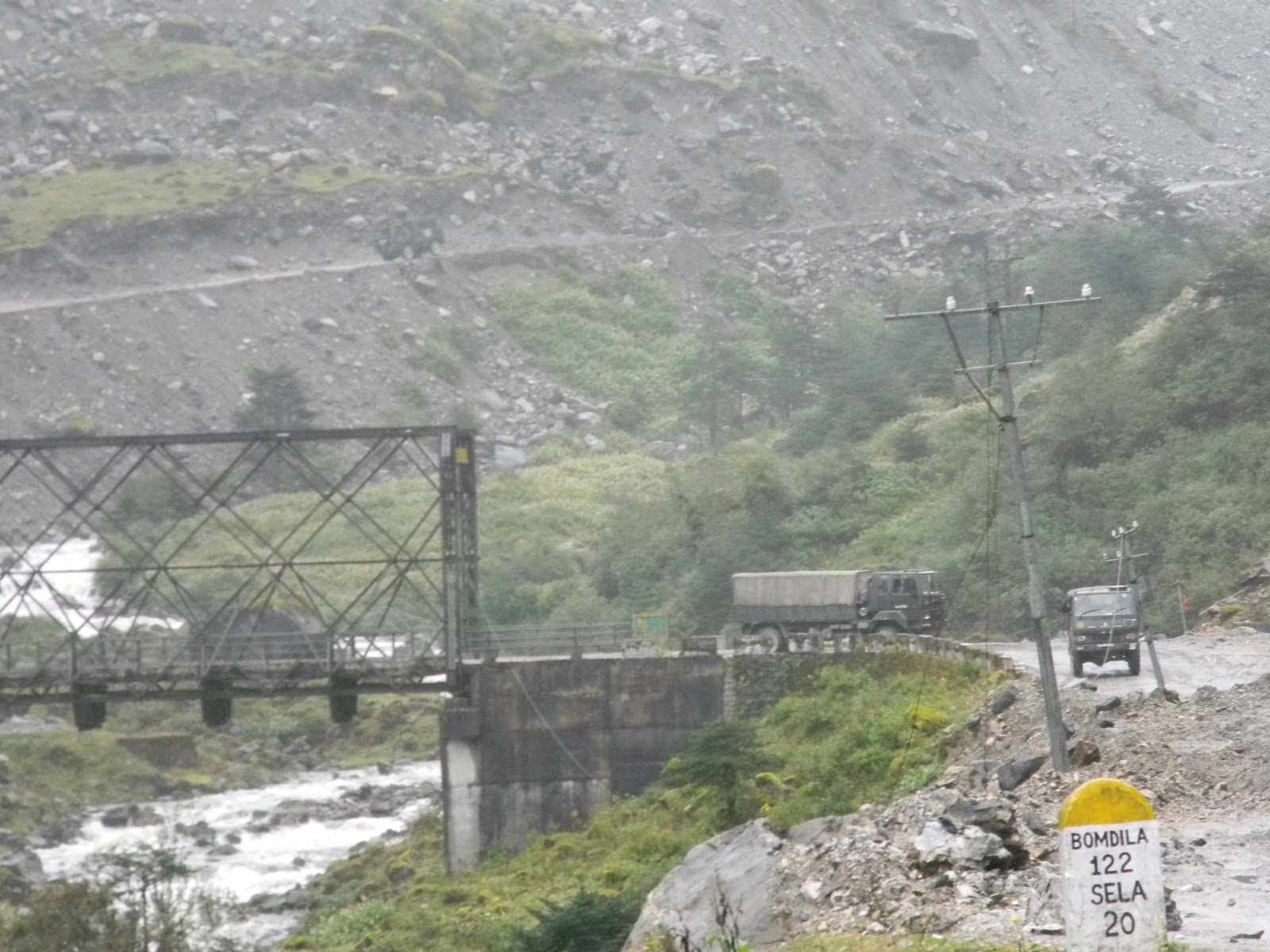
No matter what the condition of the road, Army vehicles continue to ply

Unusual site: BRO labourers taking a chess break!

Terribly slushy road

The difficult road

At the Sela zig-zag--doing a piece to camera


Chinese agression in 1962. Captured in a photo 


The Buddha statue inside Tawang monastery

Thursday, April 18, 2013

Changing Socio-economic Norms and its Impact on India’s Armed Forces

MY PIECE IN IDSA'S  JOURNAL OF DEFENCE STUDIES


The Indian Army remains rooted in an outdated, British-inherited system that is struggling to cope with the combination of challenges posed by demands of modern warfare and a society that is undergoing a great
churn. The greatest challenge has been to the famous officer–men relationship in the Indian armed forces. In the past decade, the armed forces have faced a new problem: increasing incidents of indiscipline, suicides and fratricide. Are these incidents happening because the traditional bond between officers and men, the bedrock on which the military functions, is fraying at the edges? Are there other external factors impinging upon the armed forces’ functioning and eroding some of its admirable values? The article attempts to focus on these issues and provide some basic answers.


It is the soldier, not the reporter, who has given us the freedom of the press. It is the soldier, not the poet, who has given us the freedom of speech. It is the soldier, not the campus organizer, who gives us the freedom to demonstrate. It is the soldier who salutes the flag, who serves beneath the flag, and whose coffin is draped by the flag, who allows the protester to burn the flag.1
The last time the Indian soldier featured prominently in the collective consciousness of the nation was when the Kargil skirmish broke out in the summer of 1999. As images of the conflict were beamed directly into our bedrooms for the first time, a patriotic fervour swept the nation.

As the body bags came home, a grateful nation paid rich tribute to the Indian Army and the ordinary soldier.2 For a while, names like Captain Vikram Batra, Havaldar Yogendra Yadav and Captain Anuj Nayyar became household names for their acts of bravery and ultimate sacrifice for the nation.3

Nearly 14 years after that skirmish, Kargil is but a distant memory, an annual ritual to be observed only by the Army at Drass. Since then, the nation has moved on. A generation has grown up in the new, prosperous India full of gleaming glass and chrome buildings that dot our burgeoning cities. New employment avenues have opened up.

There are more people involved in the service sector, working in malls, hospitality industry, restaurants, information technology (IT)-enabled services than ever before. Most of the jobs in India have been created in the service sector in the past decade. Economists say that the fastest employment creation has happened in sectors like financial intermediation, computer services, business services, communications and legal and technical services, followed by education, health and social work, hotels, restaurants, and other community, social and personal services.
4


With a visible shift in the nature of India’s economic activity has come the inevitable change in the composition of the society. While the size of the Indian middle class is variously estimated between 200 and 300 million, a new, ‘aspiring middle class’ is fast emerging on the periphery of the ‘Great Indian Middle Class’. This class of people (with an annual income in the range of Rs 90,000 to Rs 2 lakh) is now estimated to be roughly 34 per cent of the population, according to one study.
5


This rise in the aspiring middle class has brought about change in the age-old structure of the Indian rural and semi-urban society. Aspirations have undergone tremendous changes too. The youth, even from the rural areas, have higher ambitions, sometimes even way beyond their capacity. The hitherto underprivileged class has been politically empowered. Joint large families have mutated to become nuclear. Politics has become the new short cut to material success and power. The economic and political transformation of India over a decade-and-a-half has brought in its wake a much wider basket of career options. Soldiering as the first-choice career is being pushed down the priority list in many areas.

Although the numbers in Army recruitment rallies have not declined so far despite these alternate choices (on the contrary, the participation in the recruitment rallies in far-flung areas seems to have risen), the quality of intake is certainly deteriorating.
6 It is against this great ferment in Indian society, triggered by massive socio-economic upheaval, that this article attempts to focus on its impact on the Indian armed forces.

The Indian Soldier
Jawan as he is affectionately called, India’s soldier…represents all of India…he is a microcosmic model of India.
                                                                                                                General S. Padmanabhan, Former Army Chief
7

When the former Army Chief wrote this, the Indian Army was fresh out of the Kargil experience. Caught on the wrong foot by the intrusion by Pakistani forces disguised as irregulars in the Kargil–Batalik–Mushkoh sectors in Jammu and Kashmir (J&K), Indian Army troops fought valiantly and wrested the control of many heights occupied by the Pakistani Army. The victory came at a great cost though: 524 killed and 1,363 wounded.
8 But the fading pride in the armed forces was restored. Kargil helped cement the bond between the Indian public and the Indian soldier.

Traditionally, the Indian Army has never found itself facing a shortage of manpower in the lower ranks since many young men from agrarian societies took up the profession of arms as a means of self-actualization. The post-independence era offered very satisfactory terms and conditions of service to fulfil these needs. The monetary benefits were higher than most other professions. A military uniform guaranteed higher status in the largely feudal society. Social support for the soldier’s family was assured. The Indian soldier had the izzat that gave him more satisfaction than mere monetary benefits. Soldering meant the assurance of an early pension and long-term medical support which was unique to the military among other government services.

Even in the officer rank, the young men found recognition and approval. With proper training, the Services groomed them to become effective leaders. The pride of wearing the uniform, notions of chivalry, patriotism and national service attracted many young men from educated, well-to-do families to the officer cadre in the early years of independence. Since India was not industrialized, the band of career choices was narrow.

You either became a lawyer, a doctor, a professor or joined the Indian Foreign Service (IFS) or Indian Administrative Service (IAS). But all these professions demanded a long gestation period or higher academic qualifications. The military, on the other hand, promised early returns and decent social security by virtue of perks and pension. So, finding volunteers for India’s officer corps was never a big problem in the early years of independence.

General Padmanabhan has famously written a pen portrait of a satisfied, proud soldier. Describing a soldier’s journey from recruitment to his retirement and beyond, the former Army Chief writes through his fictional character Raj, who is now 75:
I joined the Army when I was 16 years of age. Since then, the Army has been my life and my soul. It gave me a full life, comradeship, action, adventurous life and a fair pay. It taught me all that I know and today, though I am retired and perhaps no use to my battalion, they still reach out to me…from the time I retired, till date, I have been given affection and respect by all sorts of people—government officials, politicians, fellow citizens—everyone. If a soldier serves his country and returns to this kind of affectionate warmth and enjoys it for nearly 37–38 years, what else can he possibly want? If the people remember their soldiers in normal days and are friendly with them, that is about all that I think we need…
9
The General was surely writing about the days gone by. More than a decade after that famous military triumph in Kargil, the Indian Army is once again at the crossroads.
Although from disaster relief in floods, tsunami and earthquakes to rescuing the infant ‘Prince’ from a deep tube well, and from quelling rioters in communal strife to being the last resort in internal counter-insurgency operations, the Indian Army is omnipresent, as an instrument of the state, the Army’s effectiveness is being blunted through a series of ill-advised and ill-thought out decisions.

Impact of Changing Society
The Army remains rooted in an outdated, British-inherited system that is struggling to cope with the combination of challenges posed by the demands of modern warfare and a society that is undergoing a great churn.

This has posed a great challenge to the famous officer–men relationship in the Indian armed forces. In the past decade, the armed forces have had to face a new problem: increasing incidents of indiscipline, suicides and fratricide. Are these incidents happening because the traditional bond between officers and men, the bedrock on which the military functions, is fraying at the edges? Are there other external factors impinging upon the armed forces functioning and eroding some of its admirable values?

Some studies have been initiated to get to the root of the problem after it was noticed that more than 90 soldiers were committing suicide every year since 2003, going up to an alarming 150 in 2008.10 Adding to the worry are the growing cases of indiscipline and intolerance. In 2012 alone, there were at least three cases of showdown between men and officers. At least 50–60 soldiers of an artillery unit clashed with a group of officers after a young officer allegedly beat up a jawan, leading to near mutiny among the soldiers.11 There were a couple of other instances where tension between jawans and officers boiled over, both the incidents happening in two different armoured regiments, one following suicide by a soldier. This set the alarm bells ringing in the Amy Headquarters, and although the top brass publicly maintained the issue was not as serious as it was made out to be, Defence Minister A.K. Antony in a written answer to the Lok Sabha said: ‘The incident of suicide by an army personnel on 8th August 2012 in the Samba sector of Jammu and Kashmir led to unrest.’12

A former Vice Chief of the Army Staff, Lieutenant General Vijay Oberoi, also says it is a matter of concern and it is time to take note. In a recent article, General Oberoi stated: ‘Three incidents of collective indiscipline by jawans in the last few months, reflecting a breakdown in the traditionally close officer–man relationship, are a cause for concern, especially as all three of them are related to combat units, where a stable and healthy officer–man relationship is an article of faith.’
13


Some others, however, maintain that these are isolated incidents and they should not be taken as an indication of a trend in as large an army as India’s with 1.1 million soldiers. But for a force that prides itself on its standards of training and discipline, these incidents should certainly serve as timely warnings. As I wrote in the immediate aftermath of these acts of indiscipline: ‘It’s time to ask the question—Is the Indian Army feeling the heat of being in perpetual operations? Are our soldiers’ stress levels peaking dangerously? Making them prone to acts of indiscriminate violence?’
14


There are no straight answers.

                                                               Contributing Factors
Yes, there is a problem. But the problem is an outcome of a combination of factors: erosion in the soldiers’ status in the society; prolonged deployment in monotonous and thankless counter-insurgency jobs; crippling shortage of officers in combat units; and, ironically, easier communication between families and soldiers!
A psychiatric study by Army doctors a couple of years ago on ‘Evolving Medical Strategies for Low Intensity Conflicts’ revealed the huge range of issues soldiers in such situations have to confront, contradictions between war and low-intensity conflict situations, and, particularly, the concepts of ‘enemy’, ‘objective’ and ‘minimum force’.15 Some other findings were:
• In general war, the nation looks upon the soldier as a saviour, but
here he is at the receiving end of public hostility.
• A hostile vernacular press keeps badgering the security forces,
projecting them as perpetrators of oppression.
• Continuous operations affect rest, sleep and body clocks, leading
to mental and physical exhaustion.
• Monotony, the lure of the number game, and low manning
strength of units lead to overuse and fast burnout.
Operating in a tension-ridden counter-insurgency environment does lead to certain stress among the jawans, but that is only one of the factors. The main worries are the problems back home: land disputes; tensions within the family; rising aspirations; lack of good pay and allowances; and also the falling standards of supervision from some officers. All these factors have led to major stress.

But there are many non-combat reasons that lead to stress. During my travels in counter-insurgency areas, I have often come across company commanders telling me how, for many soldiers, tensions at home create unbearable stress. Often, a land dispute back home or a family feud weighs heavily on the soldier’s mind. For the ordinary soldier, the smallest patch of land back home is the most precious property. Again, I have frequently come across a common thread where soldiers say there is no tension in the actual work of counter-insurgency. The main problem for the fauji comes from his domestic situation.

Add to it the fact that the society no longer respects the soldier and his work in protecting the nation. A local politician, a thanedar, etc., seem to command more clout in the society today. This has often led to loss of self-esteem among ordinary soldiers. A recent movie—Paan Singh Tomar—depicted, in some measure, the humiliation that a soldier faces in the civilian environment, both while serving and after retirement from the armed forces.

As a former army commander had once pointed out to me: ‘You see he (soldier [
sic]) comes from a society where he compares himself with others and when he realises that he is at a disadvantage since, acceptance wise, the kind of respect that his predecessors had, is no longer there.’16

Senior officers point out that most suicide and fratricide cases take place after soldiers return from a spot of leave. It is precisely this concern that had prompted Defence Minister A.K. Antony to write to all chief ministers some years ago asking them to sensitize district administrations in their states to the needs of the soldiers. State governments were asked to set up a mechanism at district and state levels to address soldiers’ grievances.

And yet, the Army must look within too.

Reforming the Organization
Soldiers these days are better educated and, consequently, better aware of their rights. This, coupled with falling standards of command and control among some of the undeserving officers who have risen to command units, is becoming a major cause for worry.

As the armed forces are in themselves a microcosm of India, the rising education and awareness levels in recruits is easily perceived. A sea change from yesteryears is now visible in the hordes of young men who crowd recruitment rallies across the country. Most hopefuls are the educated unemployed youth who turn towards the military for acquiring early financial and social security. Their educational qualification is Class XII on the average, many being graduates too. The stereotype of an innocent, less educated but hardy soldier is now a thing of the past. The officer base has also shifted predominantly to the middle class. This has further narrowed the gap between the ‘leaders’ and ‘followers’.

An acute shortage of officers at the cutting-edge level is the other big factor contributing to an increasing gap between soldiers and officers. Against an authorized strength of over 22 officers for a combat battalion, there are at best eight or nine officers available to the commanding officer these days.

Very often, young officers with less than two years of service are commanding companies! Even in the battalion headquarters, one officer ends up doing the job of three, given the shortage. There is no time to interact with soldiers. In the old days, a game of football or hockey was the best way to get to know each other. Not any longer.

What, then, is the way forward?
Embracing Change

The average Indian soldier remains as hardy as before but he is certainly confused with the pace of change occurring all around him. It is here that the leaders—the officers—will have to adapt themselves to the new reality. The age-old system of regimental traditions and values is robust, and serves to develop camaraderie and loyalty between the led and the leader even now. The new fashion to dismiss them as outdated ideas must be arrested. Military ethos is not developed overnight and is certainly not imbibed by pandering blindly to the changes in society.

What, however, must be done is to eliminate the overwhelming trend to be a ‘careerist’. The desire to advance one’s career at any cost, to strive for promotion even by cutting corners, and crave for awards as a means to boost chances of attaining the next rank has become a rampant practice amongst the officer class. Preservation of self has exaggerated that tendency and the advancement of career at any cost seems to have become a sine qua non for most officers.

That must change. And that change must come from the top.

A former Army Commander, Lt. Gen. C.S.K. Sabu, had encapsulated the desired change in view of altered socio-economic conditions at a seminar on ‘Leadership Challenges in an Era of Turbulence’ at the Centre for Land Warfare Studies (CLAWS), New Delhi, in June 2010. He said: ‘Such a change needs to be top-down, and be backed by the force of institutional ethics, tradition, peer pressure and group dynamics. While the Chetwode motto of the Army is everlasting, it loses focus once a soldier is beyond his CO—it lacks the guiderail required for a codified, value-based ethical conduct on the part of senior officers, which must be set right.’
Certain changes which can be considered and deliberated are:
• 360 degree assessments in the context of Annual Confidential Reports (ACRs).
• Inculcate the warrior ethos in the Army.
• Embrace the soldier’s code—Veer Senani must be codified.
• Encourage scholar–warrior ethos for the officers.
• Promoting ethics and probity in military life.
• Norms for conducting welfare activities must change—it is a

command function and must be restored to the same.
Finally, if the led are to believe the leader, the leader must walk the talk. Officers must believe in themselves and the system that they work in. They must take pride in the fact that the military is essentially different in its work culture, ethos, traditions and values from any other entity.
The Indian military, despite its recent problems, remains a very fine institution. To remain relevant and effective, it must, however, embrace change with discretion. Therein lies the trick in meeting the increasing challenge posed to the military leadership.

Notes
1. Father Dennis Edward O’Brien, United States Marine Corps, available at http://americanveteransmemorial.org/Military_Quotes.html, accessed on 24 January 2013.
2. Mehra, Sunil, ‘Last Journey Home’,
Outlook, 28 June 1999, available at http://www.outlookindia.com/article.aspx?207679, accessed on 27 January 2013.
3. Gokhale, Nitin A. and Aniruddha Behl, ‘Leading from the Front’,
Outlook, 26 July 1999, available at http://www.outlookindia.com/article.aspx?207810, accessed on 27 January 2013.
4. Eichengreen, Barry and Poonam Gupta, ‘The Service Sector as India’s Road to Economic Growth’, Working Paper 16757, National Bureau of Economic Research, February 2011, available at http://www.nber.org/papers/w16757, accessed on 26 January 2013.
5. Bhattacharyya, Pramit, ‘The Rise of India’s Middle Class’
, Mint, 31 December 2012, available at http://www.livemint.com/Opinion/ 1bdWFKo9ImvhFySfrCI3aJ/The-rise-of-Indias-neo-middle-class.html, accessed on 20 January 2013.
6. Interaction of the author with recruiting officers over the past three years. They will have to remain anonymous since they are serving officers.
7. Padmanabhan, S.,
A General Speaks, New Delhi: Manas Publications, 2005, p. 155.
8. See http://www.globalsecurity.org/military/world/war/kargil-99.htm, accessed 26 February 2013.
9. Padmanabhan S.,
A General Speaks, n. 7. 94 Journal of Defence Studies
10. In 2003, 96 army men committed suicide; in 2004, this number was exactly 100; in 2005, 92 of them took their own lives; and in 2006, 131 army personnel committed suicide. In 2007 and 2008, the recorded figures were 142 and 150, respectively. Since then, the numbers have come down but still remain over 100: in 2009 it was 111; in 2010 it was 130; and in 2011 it was 102, according to the Ministry of Defence.
11. Ganai, Nasir and Gautam Dutt, ‘How Brawl between Army Officers, Jawans at Leh Started’,
Mail Today, 12 May 2012, available at http://indiatoday.intoday.in/story/how-brawl-between-army-officers-jawans-at-nyoma-leh-started/1/188444.html, accessed on 28 January 2013.
12. ‘The incident of a suicide by an Army personnel on August 8 in Samba sector of Jammu and Kashmir led to unrest. A Court of Inquiry (CoI) has been convened by the Army to investigate the matter,’ Mr Antony said in a written reply to the Lok Sabha. PTI report quoted on NDTV website, available at http://www.ndtv.com/article/india/jawan-s-suicide-led-to-unrest-among-troops-in-samba-ak-antony-262943, accessed on 28 January 2013.
13. Oberoi, Vijay, ‘Take Turbulence in the Ranks Seriously’,
DNA, 23 August 2012, available at http://www.dnaindia.com/analysis/column_take-turbulence-in-the-ranks-seriously_1731500, accessed on 21 January 2013.
14. Gokhale, Nitin A., ‘Why is Officer–Men Relationship Declining in the Army?’,
rediff.com, 5 September 2012, available at http://www.rediff.com/news/column/why-is-officer-men-relationship-declining-in-the-army/20120905.htm, accessed on 18 January 2013.
15. Author’s interview with doctors in the Northern and Eastern Commands in 2007-08, and with scientists of the Defence Institute of Psychological Research for his NDTV documentary, ‘The Indian Army: The Battle Within’, broadcast on 12 January 2007. See http://www.ndtv.com/video/player/special-report/indian-army-the-battle-within/10690m, accessed on 22 January 2013.
16. Author’s interview with Lt. Gen. T.K. Sapru, who retired as Western Army Commander for NDTV in January 2007 (he was 16 Corps Commander that year).


Tuesday, April 16, 2013

My take on AK Antony and the Indian military


SOURCE: CREATIVE COMMONS / FLICKR/ RDECOM
Written for Fair Observer
Indian Military: Hampered By Its Own Minister
14 APRIL 2013

In March 2012, a letter written by then Indian Army Chief Gen VK Singh to Prime Minister Manmohan Singh listing out major deficiencies in the Army found its way in the media creating a flutter in the establishment and showing up starkly, the ‘hollowness’ that existed in the Army.

“The state of the major (fighting) arms i.e. mechanised forces, artillery, air defence, infantry and special forces, as well as the engineers and signals, is indeed alarming,” DNA newspaper reported the General writing to the Prime Minister. The army’s entire tank fleet is “devoid of critical ammunition to defeat enemy tanks,” while the air defence system is “97% obsolete,” he wrote. The infantry is crippled with “deficiencies,” while the elite forces are “woefully short” of “essential weapons.”

What Gen VK Singh did not write was this: the Army’s light helicopters are more than 40 years old; it has not bought new artillery guns since 1987; it is also short of nearly 600,000 hand grenades. The list is endless.

Members of Parliament, media and military observers, all were naturally alarmed.  Deficiencies are however not the Army’s problem alone. The Indian Navy too is short of conventional submarines. Its fleet of diesel-powered submarines is down to a single digit. Its lone aircraft carrier, INS Viraat, formerly HMS Hermes of the Royal British Navy, and commissioned half a century ago, is on an extended lease of life, after two successive refits. Another aircraft carrier, being built in Russia, is five years behind schedule but is likely to join service at the end of 2013.

The Indian Air Force, which celebrated its 80th birthday, last October, is down to 33 Squadrons of fighter jets against the required strength of 39 squadrons. Its six year old plan to purchase 126 new combat jets is yet to fructify although a contract negotiating committee is currently talking to French manufacturer Dassault Aviation and hopes to ink a mammoth 15 billion dollar deal by end of 2013.

A combination of bureaucratic lethargy, cumbersome systems and bad planning has combined to bring the Indian military to such a sorry state.

But the biggest factor holding back the Indian military’s quest for rapid modernisation is the country’s defence minister AK Antony. As a politician concerned solely with preserving his squeaky clean image, Antony is even ready to sacrifice the interest of the armed forces.

His record as India’s longest serving Defence minister (October 2006 till date) is a clear testimony to this. During his tenure, Mr Antony has already barred four major international defence firms at the first hint of wrong doing and bribery. They are:
·         Singapore Technologies Kinetics (STK)
·         Rheinmettal Air Defence
·         Israel Military Industry and
·         Denel

The ban on STK has meant India’s Rs 20,000 crore artillery upgrade process had to be restarted, causing a delay of at least four years in the acquisition programme. Similarly by barring Rheinmettal, Indian Army’s plan to modernising its anti-aircraft guns inventory has been pushed back considerably.  

It is no body’s case that errant firms should not be dealt with strictly. Experts however say it is better to first establish the degree of wrong-doing and penalise the firms or recover losses from their contract money rather than imposing a blanket ban on them thus limiting India’s options.

Events of the past six years have also proved that blacklisting companies from as diverse countries as Singapore, Switzerland, Israel and South Africa does not end corruption. In February this year, yet another deal—this time to buy 12 VVIP helicopters from Italian firm Finmeccanica at over Rs 3,000 crore-- has come under a cloud following revelations in Italy of bribes being paid in India and possibly to Indians among others. A thoroughly shaken Antony’s first instinct was to almost cancel the contract but so far (April 11) procedure and prudence has prevented him from doing that.

While Mr Antony’s fetish for a corruption-free Defence Ministry is public knowledge, there is another facet to his personality that is relatively lesser known: His reservations on moving too close to the US militarily.

Antony, known as a particularly cautious policy-maker, has repeatedly told his American counterparts in the past half a decade (Robert Gates, Leon Panetta) politely but firmly that India doesn’t wish to be seen as a U.S. alliance partner as Washington embarks on its Asia-Pacific ‘rebalance’ strategy.

Leon Panetta, during his stopover in New Delhi last June spelt out what US seeks from India: “I believe our relationship can and should become more strategic, more practical, and more collaborative. Our defence policy exchanges are now regular, candid, and invaluable. Our partnership is practical because we take concrete steps through military exercises and exchanges to improve our ability to operate together and with other nations to meet a range of challenges. And our defence relationship is growing ever more collaborative as we seek to do more advanced research and development, share new technologies, and enter into joint production of defence articles.”

Antony has been open to increasing bilateral engagement with Washington –India does in fact undertake a number of joint exercises across the three defence services—but the defence establishment in India, under his leadership are still wary of any military alliance, or even a formal partnership with the United States.

This attitude is partly because India doesn’t want to upset China, its main competitor in Asia, by openly embracing the United States. However, more fundamentally, Indian lawmakers and politicians like Antony continue to have reservations over the United States itself, doubts born largely from India’s perception of the past half a century that Washington has tended to side with India’s arch rival, Pakistan. 

So far, AK Antony’s stand and his deliberately cultivated keep-a-distance-from the-US posture has at best been a matter of South Block speculation but now, thanks to Wikileaks releasing hundreds of thousands of US cables, it can be said with certainty that even Washington is aware of the Indian Defence Minister’s proclivity to keep the US at an arm’s length.

In a secret cable dated 16 May 2008 US Ambassador to India, David Mulford reported to Washington that he sought  clarification on the GOI (Government of India)'s position on bilateral and multilateral military exercises from Antony who clearly told him that ‘MoD welcomed exercises with the U.S., but that political sensitivities often prevailed in India's decision making over what level of visibility to allow for coverage of the events.’

Ambassador Mulford, according to the cable, told the defence minister that lately ‘the USG (United States Government) has received mixed signals from the GOI on India's willingness to be seen with us, such as when Antony expressed surprise at the USS Cole being involved in a recent port visit, and the media not being allowed to cover the Cole's community relations events.’ The cable went on to add: ‘Antony responded that India is a complex democracy, with various parliamentary committees and political parties with competing interests.’ "We don't want to create a political controversy by proceeding in a high profile manner," Antony reasoned, adding "we have no problem with the exercises as such, but how to highlight them can be a problem."

That remark, in essence sums up the current dilemma in New Delhi over the state of Indo-US defence relationship. The need for closer defence ties with US is acknowledged as important to the possible emergence of new security architecture in Asia but also viewed as politically problematic.

The three service, meanwhile continue to suffer due to an indecisive defence minister whose foremost desire is to preserve a lily white reputation for integrity even if it comes at the cost of slow modernisation of the armed forces.

The views expressed in this article are the author's own and do not necessarily reflect Fair Observer’s editorial policy

Friday, April 12, 2013

India's combat jet negotiations still on track


On 9 April, in a rather unusual and swift move, the Indian Air Force (IAF) strongly refuted the previous day's report in an Indian publication that it was initiating 'Plan B' in case negotiations for buying 126 combat jets, currently in progress, fail.

"The CNC (Contract negotiations committee)  process for acquisition of 126 MMRCA (Medium, multi-role combat aircraft) is underway and there is no thought process for any procurement  as a ‘back up’ as reported," the IAF said.

The statement was unusual for two reasons. One it was not the Ministry of Defence (MoD), which refuted the report but the Air headquarter. Normally, MoD responds or clarifies contentious reports if they concern matters of acquisition or procurement. 

And two, this is the first time in six years that either IAF or the MoD has officially issued a press note about a planned procurement, considered one of the biggest acquisitions in recent times, pegged as it is at anywhere between 12 to 15 billion dollars. In fact, even when Dassault Aviation beat EADS in the MMRCA contract, there was no formal announcement by the MoD. It was left to the company to declare itself as the winner!

So why this unusual step? Sources say Air HQ and MoD officials wanted to scotch rumours initiated by 'vested' interests before they acquired a momentum of their own and acted as impediment to the eventual conclusion of the contract.

Dassault, the makers of Rafael fighter jets certainly have had reservations over Hindustan Aeronautics Limited ( HAL's) capacity to absorb complex technology and therefore wanted to rope in other private sector units for manufacture of the jets in India. Under the agreement, Dassault is supposed to supply the first 18 planes manufactured in its facility in France and the rest of 108 aircraft are to be manufactured in India. The Ministry of Defence has however learnt to have told Dassault that HAL will remain the lead player. And yet, according to the MoD's own estimate, at least 50 per cent of the work in India-based manufacturing will eventually be done by the private sector.

Sources involved in the negotiations point out that the process has been on for a year mainly because it involves many complex agreements that need to be hammered out between Dassault and HAL. The negotiations involve commercial factors, logistics arrangements, assessment of technological absorption capability of various divisions of HAL, supporting ancillary units and a host other small but vital aspects before a final contract is inked.

Dassault officials are in fact simultaneously and together negotiating with all divisions of HAL located in various cities. So for example, officials of  HAL's Aeronautical Research and Development Complex, Engine division, accessories unit spread over locations like Lucknow, Nashik, Bangalore and Hyderabad  are constantly talking to Dassault officials to arrive at a mutually satisfactory result.

There are many small and big hurdles to overcome too. One example quoted by officials engaged in the negotiations is illustrative of the complexities involved. The Radar on the Rafael jet is to be manufactured by Bharat-Electronics Ltd (BEL) at its facility in Banagalore. The Radome (the protruding snub nose on the aircraft), is however manufactured by HAL at its Hyderabad facility. Dassault therefore wants both the units (of BEL and HAL) co-located at one place. Until BEL and HAL come to an agreement between themselves, Dassault cannot proceed any further on that aspect!

There are many such intricacies involved. However sources are hopeful that in another six months most of the wrinkles will be ironed out. Interestingly, French and Indian government officials are simultaneously working on an Inter-Government Agreement that will provide a sovereign guarantee that Dassault will continue to supply, service and maintain Rafael over the next 40 years. This provision, included in the Request for Proposal (RFP) is an important element in the Indian Defence Procurement Procedure (DPP), designed to ensure manufacturers don't renege on their commitment no matter what the circumstances. 

The MMRCA contract, considered one of the biggest in terms of value in recent times, is seen as a test case that will determine how India proceeds to handle its mammoth procurement plans in the next decade. With India set to spend over 100 billion dollars in buying different weapons and platforms, it is absolutely essential, military and civil officials feel, to set a benchmark that will serve as a future guide for all such cases.

Wednesday, April 10, 2013

The five Indian martyrs in South Sudan

Lt. Col. Mahipal Singh

On Tuesday five Indian peacekeepers were killed while escorting a United Nations convoy in Jonglei, the hub of tribal infighting in South Sudan.

The dead included a Lt. Colonel, one junior commissioned officer and three jawans while five were injured including an officer. Those killed were part of the Indian battalion attached to the UN Mission in South Sudan (UNMISS). 

Currently, there are around 2,200 Indian Army soldiers comprising two battalions, one based in Jonglei and the other in Malakkal, Upper Nile, on the border with Sudan.


Nb Sub. Shiv Kumar Pal
An inquiry will of course be held into the circumstances in which the ambush took place . Will have check out what exactly went wrong.
For the the moment all that we can say is, Rest in Peace, brave hearts. Salute!


LNk Nand Kishore Joshi

Hav. Heera Lal

Hav Bharat Sasmal