Thursday, August 1, 2013

Mountain Strike Corps or 3 Carrier Strike Groups? One need not come at the cost of the other!

A fortnight after the government gave an in-principle clearance to raise a Mountain Strike Corps, a debate over the efficacy of the decision to spend over Rs 64,000 crores on the new accretion has begun. Noted Strategic Affairs expert, former Rear Admiral Raja Menon writing in The Hindu has in fact categorically asserted: "A geographically limited one axis offensive will not destabilise the PLA, but a flotilla of nuclear submarines and a three carrier air group in the Indian Ocean can economically cripple mainland China." 

Others have also weighed in with their opinion essentially making the point that India should invest more in its Navy than sinking money in troops-intensive mountain strike corps. 

The nub of this argument is: a powerful blue-water Indian Navy can choke the sea lines of communication (SLOC) so vital for China by strategic interdiction on the high seas and therefore the Indian Navy's capability to enforce a blockade must be strengthened. This theory assumes that India can unilaterally do so in case China assumes a belligerent posture across the Himalaya. If push comes to shove, India will certainly be forced to look at this option but the SLOCs are not an exclusive preserve of either India or China and the international community is therefore bound to intervene to keep the passage free to enable trade and commerce to function normally. A selective blockade of China-centric sea traffic is realistically difficult to implement even if on paper the prospect looks alluring.

However if a conflict between India and China breaks out in the high mountains, the world is not going to be overly bothered for a while. India therefore needs to be prepared to meet this threat all along the 4,000 km long boundary with China. The likelihood of a limited skirmish in the mountains is much more than a confrontation at sea simply because the border remains un-demarcated and prone to frequent misinterpretation and misunderstanding.

The need to have more forces for the northern frontier cannot be overemphasised. This does not mean it should come at the cost of preventing the Indian Navy from expanding. Going by the information available in the open domain, the Indian Navy is in the middle of one of its most ambitious modernisation programmes. Apart from the planned—even if delayed—induction of INS Vikramaditya, the aircraft carrier built in Russia and currently under sea trials, 47 ships of different types and capability are on order in various Indian shipyards. India’s first indigenously built nuclear-powered submarine is also scheduled to embark on its first sea acceptance trial around end-August. The first Indigenous Aircraft Carrier (IAC) is scheduled to cross a major landmark two weeks from now. The design and concept for the second IAC is also more or less finalised. So the Navy is doing just fine. With the Navy’s long-standing emphasise on acquiring indigenously-built platforms, Indian shipyards can cope only with these many numbers for at least another 10 years.

After that, if more money is required, India can always find resources to fund further expansion of the Indian Navy. 

But to get back to the creation of a Moutain Strike Corps. According to available information, it is just the first step in what is needed urgently –the addition of 40,000 new troops to the Indian Army. The budget of Rs 64,000 crore for the new corps  is to be spent over seven years –- which is just as well since raising new formations as large as a Corps is not an easy task. It is further difficult to make that formation capable of mountain warfare. For mountains gobble up troops; they take a heavy toll on man and machine. 

The decision on 17 July is somewhat reminiscent of a similar choice exercised by the UPA government almost exactly four years ago.

The then outgoing UPA-I government's Cabinet Committee on Security (CCS) was meeting for the last time before the results of the 2009 general elections were to be announced. The sole item on the agenda: Enhancing India's military preparedness against China.
According to insiders present at that meeting, some of the members of the CCS wanted to leave the decision to the next government but better sense prevailed and days before Prime Minister Manmohan Singh's first UPA government went ahead and sanctioned raising of two new Mountain Divisions for deployment in India's north eastern State of Arunachal Pradesh, an area claimed by China as South Tibet. In addition, the Indian Air Force was given the go ahead to reactivate half a dozen Advance Landing Grounds (ALGs) spread all along the Arunachal-Tibet portion of the Line of Actual Control (LAC) between the two countries and base additional squadrons of Sukhoi-30 combat jets in Assam.

The goal was to plug existing gaps in India’s preparedness along the Arunachal Pradesh-China frontier. The two new divisions were to include a squadron of India’s armoured spearhead—Soviet-built T-90 tanks--and a regiment of artillery. 

Now four years later, the two mountain divisions have completed their recruitment, equipping and orbatting in the North-east. One of them--the 56 Mountain Division--after being raised in Nagaland's Zakhama area has been placed at Lekhabali, north of the Brahmaputra adding teeth to Indian Army's presence in East and Central Arunachal Pradesh. The other new Division--71--headquartered at Missamari in the plains of Assam, will enhance troop deployment beyond Tawang in West Arunachal Pradesh in addition to the 5 Mountain Division already stationed at Tenga.

However one lacuna continues to persist. Road links to forward areas remain tenuous. The China Study Group (CSG), which controls India's policy on China had sanctioned 72 tactically important roads to be built in the tough, mountainous terrain along the China border in the Eastern and the Western sectors. The roads are being built by the quasi-military Border Roads Organisation to enhance connectivity. But a combination of lethargic BRO, obstructionist state governments and ministry of environment and forests has meant that these roads are nowhere near completion. Similarly, the half a dozen ALGs in Arunachal Pradesh are also stuck in red tape.

The recent incursion by Chinese troops in Ladakh's Depsang area should serve as a timely reminder to the government that timelines for infrastructure development along the Chinese frontier and plans to boost military capability do not have the luxury of slippages.
Diplomacy and timing (cancellation of Chinese Premier's visit over the border standoff would have been a loss of face for Beijing) helped end the face off this time but New Delhi will do well to remember such incident is not going to be one off. The Chinese will continue to nibble at the un-demarcated border and test India's response as they have done for over 50 years.

What will be crucial for the new corps is cooperation and coordination between all stake-holders:  The Defence, Finance and Environment Ministries, as well as the Army, Air Force and Border Roads Organization. 

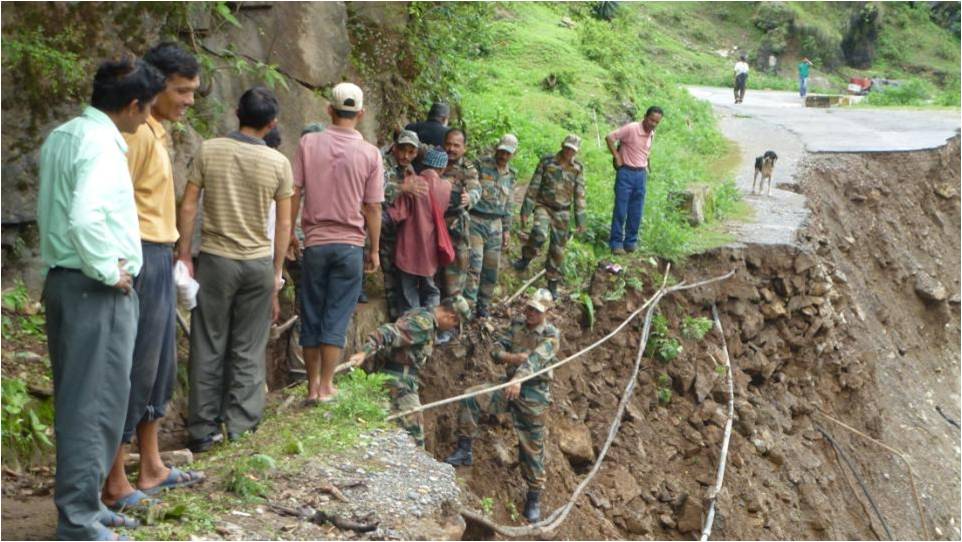
In the recent past, objections from the Environment Ministry have impeded upon the construction of crucial roads in Arunachal Pradesh, Sikkim, Himachal Pradesh, Ladakh and Uttarakhand. In the last case, the lack of connectivity was driven home brutally when torrential rains ripped open the state last month, leaving thousands stranded. 
It is nobody's case that the environment should not be protected but a balance needs to be struck in caring for the environment and national security imperatives. The state governments will need to back the plan by facilitating the speedy allotment of land in remote areas. 

The climate in most of these states means that the Border Roads Organization can leverage, at best, a four-month season to deliver new routes. 
Similarly, establishing permanent infrastructure for troops, including hubs that supply ammunition and deciding strategically-placed artillery gun positions is a long -term and complicated process. 

Finding the right contractors with the right skills and willingness to work on isolated, remote areas is another big challenge. The Indian Air Force, for instance, has been trying for three years to sign contracts that will lead the upgrading seven Advanced Landing Grounds or ALGS, crucial for the ability to quickly airlift troops to strategic parts along the China border.  But the deals have not been closed because expert contractors find it difficult to work in these areas. 

The new mountain corps will require light artillery which can be easily transported, even airlifted in the highest mountains. Given India's painfully-slow process of weapons acquisition, empowering the Mountain Strike Corps quickly will be a big challenge. 
It is all the more necessary for the government to walk the talk in making the new formation a reality by adhering to timelines.

Simultaneously, India must re-look and re-tweak its China policy. 

For instance:

• Insist with Beijing the need for exchanging maps for all sectors immediately so that each side knows the other's claimed LAC and border negotiations can resume

• Instead of pushing for operational control of the Indo-Tibetan Border Police (ITBP),    the Army should step up and assume responsibility to protect the disputed border.

• Ensure timely and effective information sharing mechanism with Indian media and through them the Indian people rather than let different stake holders speak in different and sometimes discordant voices during times of crisis.

• Educate and prepare the Indian people on the need for give and take on border negotiations in the future.


Policy makers in India must be mindful of the fact that military preparedness and trying to improve diplomatic relations are not necessarily mutually exclusive.

Sunday, July 21, 2013

8 Mountain Div: Forever in Operations: A tribute

Fifty years ago, the Indian Army raised a new formation, primarily to combat insurgency in the north-east. Today, not only it has accomplished its missions in the north-east along with Jammu and Kashmir, but more importantly, won the Kargil conflict for India in 1999.

This is the story of the formation, the 8 Mountain division, which is 'Forever in Operations'.


(Video is here:http://www.ndtv.com/video/player/ndtv-special-ndtv-24x7/the-kargil-victors-8-mountain-division-forever-in-operations/283886?pfrom=home-lateststories)
 
Headquartered in Khumbathang behind a huge mountain feature, the 8 Mountain Division, ever since it was raised in 1963, has mostly operated in the mountains and delivered results every time. There are numerous tales of valour and dedication of the Indian Army, but what makes 8 Mountain Division stand out is its adaptability.
 

Under Major General KV Krishna Rao, who later became Chief of Army Staff, the Division moved to fight in east Pakistan to help create Bangladesh. Besides General Rao, this division has produced two more Army Chiefs--General BC Joshi and General VP Malik.
 
For the first 27 years, it operated in the states of Nagaland and Manipur combating insurgencies, earning the soubriquet - 'Forever in Operations'.
8-mountain-division-295.jpg 
As trouble erupted in Kashmir in the late 80s, the Army headquarters decided to fall back upon the 8 Mountain Division. Major General VP Malik moved it to the Kashmir Valley, making it the spearhead of the counter-insurgency operations.
 
However, the formation is equated with the 1999 Kargil conflict. Captain Vikram Batra, Anuj Nayyar, Vikrant Thapar and many other became household names for their daring exploits at impossible heights.
 
During this month 14 years ago, last of the Pakistani intruders were evicted from the heights of Kargil-Drass and Batalik underlining the importance of 8 Mountain Division. Hastily rushed into this sector from Kashmir Valley, it took the might of the Bofors guns and the raw courage of the soldiers to earn a hard-earned victory in the forbidding mountains.

8-mountain-division-1-295.jpgIts current General Officer Commanding, Major General Shokin Chauhan, says: "The posts are high, the altitude is difficult, the mountains are treacherous, the wind is bad and we have an enemy on the Line Of Control, which has not yet stabilized. So all in all it makes for a very difficult job for our boys to do, but they do it commendably. And I hope, very strongly, that people will recognize the valour of the soldiers of 8 mountain division and accept that the Indian Army soldier is better than the best." 
 
The 1999 conflict was also one of those rare battles in which the infantry soldier and artillery guns played almost equal role in overcoming the adversary. At such altitude, the artillery will remain a vital element of warfare.

While the 1999 war may never be repeated, it is essential to keep the memory of those who made the supreme sacrifice alive. Every year on July 26, the Indian Army remembers its heroes, who won the Kargil conflict.

Thursday, July 18, 2013

Only money for a Mountain Strike Corps in not enough

After the initial euphoria, the reality check.

The financial sanction given by India's Cabinet Committee on Security (CCS) on Wednesday to raise a Mountain Strike Corps specifically aimed at launching offensive operations against China--if need be--is but a first step in what promises to be a long haul in adding 40,000 new troops to the country's 1.3 million strong Army.

The figure of Rs 64,000 crore (roughly 11 billion dollars at 1$= Rs 60 rate), remember, is to be spent over seven years which is just as well since raising new formations as large as a Corps is not an easy task. It is further difficult to make that formation capable of mountain warfare. For mountains gobble up troops; they take a heavy toll on man and machine. Living at altitudes upwards of 12,000 feet going upto 22,000 feet and being fighting fit is no child's play. The Himalaya--along which the entire 4,000 km China frontier is spread out--is an unforgiving terrain. So just 'sanctioning" money will mean nothing.

A sustained effort by all stakeholders--MoD, Ministry of finance, Army, IAF, Border Roads Organisation and most importantly the Ministry of Forest and Environment along with respective state governments--will have to be on the same page if the wish to have a Mountain Strike Corps is to be translated into a reality.

Why do I mention all these ministries? Because in the recent past, the 'Green Brigade' has proved to be a big obstacle in building strategic roads in Arunachal Pradesh, Sikkim, Himachal Pradesh, Uttarakhand and Ladakh. It is nobody's case that environment should not be protected but a balance needs to struck in caring for the environment and national security imperatives. The state governments will need to back the plan by facilitating speedy allotment of land in far flung areas.
Building roads in the higher reaches if these states is a painstaking process with the working season available to the Border Roads barely limited to three or four months. Similarly establishing permanent infrastructure for troops, creating a stable logistics line, putting in place ammunition and supply hubs besides strategically placed artillery gun positions is a long term process. Nothing is going to be easy.

The Defence Ministry will have to work in close coordination with the Finance Ministry to release required funds on time.

Finding the right contractors with the right skills and willingness to work on isolated, remote areas is another big challenge. The IAF for instance has been trying to finalise contracts to upgrade seven advanced landing grounds (ALGs) in Arunachal Pradesh to enhance its ability to airlift troops rapidly all along the China frontier for the past three tears but is still to a find a satisfactory solution.

Infrastructure apart, equipping mountain troops with the requisite wherewithal is a complicated task. Purchasing special winter clothing, imparting high altitude warfare skills to troops is easier than acquiring mountain specific weapons platforms is not.

The new mountain corps will require to have inbuilt airlift capability, light artillery which can be easily transported, even airlifted in the high mountains. Given India's painfully slow process of weapons acquisition, empowering the Mountain Strike Corps quickly will be a big challenge.

Given these difficulties, Beijing will not be unduly bothered although it will certainly make the mandatory noises may be by describing the Indian decision as provocative. 

It is all the more necessary for the government to walk the talk in making the new formation a reality by adhering to the timelines.
 
 
And this:
 

Sunday, July 14, 2013

Forever in Operations: Story of 8 Mountain Division

The Formation sign
Travelling to Kargil and Drass from Srinagar has never been easy. For years since 1999, that is what I have felt despite making at least two dozen trips. Last week was no different. The challenge posed by the might Zozilla, the traffic, the terrain everything is different than one normally encounters.
A glimpse of various operations by 8 Div

Between Monday and Saturday, me and cameraperson colleague Tariq revisited the Kargil-Drass-Batalik sector to make a programme on the 8 Moutain division AOR (Area of Responsibility). Why 8 Mountain Division? 


8 Mountain Div in action
One because I have had an old association with this remarkable formation, raised half a century ago to combat the Naga insurgency. This has been the Indian Army's "go-to" formation in every major military campaign since the mid-1960s. 

In every crisis, it has been called upon to deliver. In 1971, in the middle of combating a tough Naga insurgency, the Division was called upon to take on the Pakistanis in the 1971 war which it did with great elan and played a major part in India's greatest military victory.


The magnificent Drass War Memorial
Back in the North-east after the East Pakistan campaign, it took on the responsibility of combating Meitei and Tripura insurgencies in the 1970s and 1980s. When Kashmir erupted in 1989, Army HQ selected the 8 Mountain Division to move to the valley. Again it proved its worth by chalking up major successes in the CI operations between 1990-99. 

In the summer of 1999 Pakistani intruders caught the Indians napping in Kargil-Drass-Mushok-Batalik sectors. Once again, 8 Mountain Division was drafted to evict the  intruders from those impossible heights which it did--at a major cost to lives and limbs of gallant soldiers. Since then 8 Div has been stationed in this area.

While I will be writing a more detailed account of the division whose motto is FOREVER IN OPERATIONS, one fact needs to be mentioned here: 8 Mountain Division has given the Indian Army 3 Chiefs in the past and the next likely Chief has also had the distinction of commanding it! The 3 Chiefs in the past were: Gen KV Krishna Rao, Gen BC Joshi (who is no more) and Gen VP Malik. The next likely chief is Lt Gen Dalbir Singh Suhag, currently India's Eastern Army Commander. Here's a small glimpse into the sector.


On the road to Kargil
Crossing the Zozilla is never easy

Morning prayers at Army's Goodwill school at Kumbathang, the HQ of 8 Div

The Indus before it enters Pakistan

The road to Batalik


BRO road sign
A local woman collecting Apricot on the road!


Only in Drass: Sun peeping out from the clouds


Mohd. Razzak, who gives a scintillating commentrary at the War memorial
One of the high passes in the area


With a filed gun battery at Ganasok
Kargil town, now a flourishing trade centre


The trainees at the Kargil Battle School
A soldier stands guard at Biamah

With soldiers at Gumri, gateway to Zozilla

The formidable Zozilla
Zozilla: Always a challenge to man and machine

Friday, June 28, 2013

Many tales of duty and dedication from Uttarakhand

Sitting amidst Indian Air Force helicopter pilots less than 36 hours after they had lost five of their buddies in the Mi-17 crash, provided an object lesson in putting duty before self.

Grieving they certainly were over the loss of close friends and colleagues but the sorrow was channelised in doing the job at hand with renewed zeal and dedication.
Gaurchar airstrip
The Gauchar airstrip
Rescue operations did not stop for a moment; neither did the easy banter. But underneath the surface calm was a lurking fear of the unknown, brought about by the inclement weather. So leaders were constantly keeping a close watch on which helicopter was where. Even a five minute delay in schedule take off or landing prompted immediate queries: "Find out where 846 is? Has he taken off? Which valley route is he taking?" ; Tell 631 not to take off right now, there's a small patch of rain in the Badri valley," the leader would ask the juniors even while he looked up in the sky and gauged the thickness of the fog and moving cloud from the ground at Gauchar. 

The professionalism and dedication to duty was embodied by Honanry Flying Officer Satinder Singh. Less than a month away from retirement, this veteran 'flying gunner' volunteered to come and work in Operation Rahat, the name given by IAF to its rescue mission. For the last 10 days, he has barely slept. In a month, he says, there will be plenty of time to rest - he retires then."I feel proud to be here for this mission at the end of my long service of 38 years," the Hon Flying Officer tol me . "This is one the biggest relief operations that I have been a part of," he said as he stood in a green jumpsuit in front of the Mi-17 helicopter.
The Badrinath Valley


He was brought to Gauchar from his unit at Hindon in Uttar Pradesh. "My message to all air force warriors, is this - Do your duty, someone will surely recognise your work, he told me as he went about his work. Even officers were not far behind. Group Captain Ajay Shukla, posted in Dimapur, was on leave at hoime in Dehradun when the calamity hit. He volunteered his services. Though not allowed to fly at the moment, as a senior officer, Group Captain Shukla was drafted to be a ground operations coordinator. Even a senior officer like Air Vice Marshal SRK Nair, Assistant Chief of Staff (operatrions) atthe Air HQ camped at Gauchar to lend leadership at a crucial stage.

In these parts of the country dotted with imposing mountains and scary valleys, fickle weather is the helicopter pilot's greatest challenge. In the monsoons, the weather is the biggest adversary. It can change within minutes; a helicopter takes off after getting reports of a clear passage to Kedarnath valley but by the time it gets to Gaurikund (halfway to the shrine), the clouds close in, forcing the chopper to turn back. For the past fortnight now, the IAF's brave pilots are battling the vagaries of weather and terrain to pull out stranded piligrims, drop relief material, transport troops and act as an air bridge to cut off areas. 

From the helicopter
Its difficult to say if this is the world's biggest peace time helicopter operation, but with 44 helicopters of the IAF deployed at one time is certainly ONE of the biggest in the recent memory. The operation, based out of a rarely used airstrip at Gauchar, is conducted without any basic support. The ATC is in a makeshift tent, seniormost officers sit out in the open, regulating traffic. For the first few days in absence of local administration and police bandobast, the airstrip resembled the Inter-state bus terminus! Apart from IAF's 44 helicopters,there were at least half a dozen Pawan Hnas and private helicopters landing in and flying out of the 4,000 feet airstrip; rescued yatris, aid workers, and state government officials were being ferried in endless sorties without any manifest or record.


It was only after last Tuesday's crash in which 20 men from IAF, ITBP and NDRF vanished that it dawned on the local administration to impose some kind of order by barricading the all-important airstrip and controlling the access to the operational area.

There were other coincidences.
One of the many rivers in Uttarakhand


Back in 2007, the 75th year of IAF, I was filming a documentary on Making of India's Air Warriors at the Air Force Academy by following the lives of four cadets through the year. One of them was Khushboo Gupta, a smart young lady passionate about flying. 

Six years later, Fl Lt Khushboo is part of Operation Rahat, the relief mission launched by the Air Force in Uttarakhand, easily its largest peace time deployment in recent decades. As a pilot of the ageing Cheetah and Chetak helicopters, Gupta and her husband, also a helicopter pilot, have launched near-impossible sorties, flying between high mountains, in valleys full of thick clouds to pull out thousands of pilgrims from the pilgrimage centres of Kedarnath, Badrinath, Gangotri and Yamnotri.

The Air Chief at Gauchar
The Air Force employed its largest helicopter, the Mi-26, the newly acquired C-130 J Hercules aircraft and over 44 helicopters drawn from as far off places as Shillong, Bagdogra and Hyderabad. All the aircraft together carried over 235 tonnes of relief material, rescued over 13000 pilgrims, a stumpendous task by any standard.


The army too put in more than 8500 men on the ground, recovering people from dense jungles through special force troops, looking after them in camps for over a fortnight and escorting them through difficult terrains. Over 31000 pilgrims owe their return home to the Army. 

The Army's para-commandos, the best special forces India has, helped in the toughest rescue acts, helping the Air Force Commandos--Garuds-- to negotiate their way through trecherous terrain where the Mi-17 crashed, and recover the bodies of the dead soldiers. Central Army Commander Lt. Gen Anil Chait, leading from the front visited the area a number of times and also walked a 12 km strech with stranded pilgrims between Badrinath and Pandukeshwar to inspire them.

Lt Gen Anil Chait negotiating tough mountains
The Indo-Tibetan Border Police (ITBP) deployed in the higher reaches of Uttarakhand also rose to the occasion. Its personnel worked in close coordination with the Army and the Air force to  make sure many lives were saved by timely medical attention and providing food and shelter to the stranded yatris.


The heroic acts came at a price though.  On 25 June a Mi-17 helicopter, carrying 15 ITBP, 5 NDRF men and 5 IAF crew crashed in bad weather killing all of them on instantly. The accident brought home the stark reality of pushing safety limits for the sake of saving lives. 

Undeterred by the tragedy the forces carried on the good work without a break. Air Chief Air Chief Marshal NAK Browne personally flew down to Gauchar and told his men and women to carry on with the task saying the greatest tribute to the fallen heroes was to complete the task at hand.

The difficult terrain and uncertain weather--the biggest enemy for rescuers--also meant that the forces adopted innovative methods and employed out of the box solutions. The Army for instance dropped  18 teams of 5-man each all along the most difficult stretch of on the Kedarnath axis in order to locate all those  stranded there. The Special Forces teams were self contained and capable of scouring the jungles for a week at a stretch. These teams eventually located 1000 people, who had lost their way! 

Joshimath
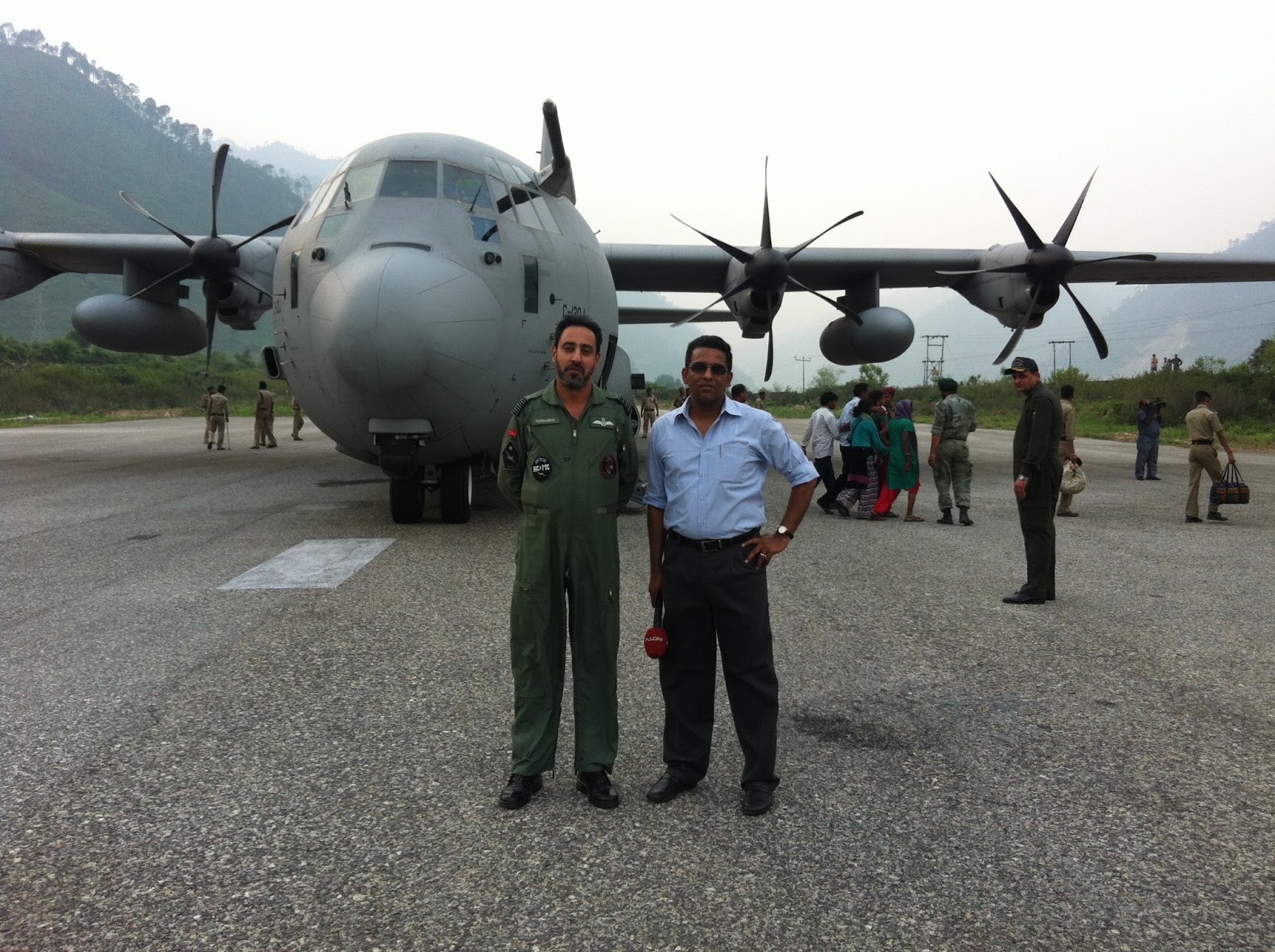
The Air Force too thought of new systems. It fully utilises the versatility the C-130 aircraft provides. When the forward staging base at Dharasu was running short of fuel for rescue helicopters, the Hercules carried 8000 littes of extra fuel, downloaded it in a bowser that was transported from Chandigarh in the Mi-26 helicopters--the world's largest! Till now such a big plane had never landed at the short airstrip at Dharasu which has a only a 3,300 feet runway. The C-130 J was also employed to make weather sorties through its electro-optical infra red sensors that fed accurate real time weather data to the helicopter pilots which enabled them to avoid tricky areas. 

With Army Para commando and Army Aviation officers


The mammoth rescue effort however brought home a bitter truth: India still doesn't have an effective framework for disaster management despite the setting up of the the NDMA almost 8 years ago. Instead, the men and women of the armed forces and paramilitary organisations continue to be the first responders and main saviours in any natural  calamity that hits the country. 

Saturday, June 22, 2013

Why C-130 J's flight to Dharasu is a breakthrough for the Indian Air Force

In a very innovative, yet daring move, the IAF today virtually established an aviation fuel supply bridge at Dharasu to give greater impetus to rescue operations which were severely restricted due to non availability of aviation fuel in the upper reaches of Uttarakhand.
With the road connectivity to Uttarkashi completely broken down, bad weather adversely affecting launch of flying operations from Jollygrant airfield of Dehradun and under the renewed threat of bad weather likely to hit the state on on 24 June, there was no way out but to think of an out of the box solution with a singular aim of continued rescue operations. 
Going by the lay of the land it was decided to examine the possibility of using the small air strip at Dharasu to establish a forward launch base for rescue operations. However, apart from weather, challenges were many. The length of the air strip was only 1300 meters, the mountainous terrain posed a great danger to the Aircraft  making an approach for landing in the prevalent inclement weather conditions.
Moreover there was no infrastructure to support flying operations of the sophisticated aircraft like the C-130 J at Dharasu. But with a true professional approach and calculated risk management a decision was taken to go ahead with theidea.
After a quick SWOT analysis of terrain, weather and capability of aircraft and aircrew, the the aircraft was launched from Hindan air base and objective was achieved, despite the inclement weather, when the first C 130J aircraft made an historic landing at Dharasu in the early morning on 22 Jun 13. 
In a first of its kind, after landing,  the aircraft offloaded 8000 litres of fuel into an empty bowser, airlifted the previous day from Sarsawa by the heavy lift Mi 26 helicopter, which further put life into the helicopters which were starved of fuel till then. 
With the availability of fuel at Dharasu, rescue operations picked up pace and within no time commenced nonstop flights and by evening established a firm launch base. 
The C 130J crew was given a new task of airlifting the pilgrims from Dharasu to Hindan on their return trip. To start with, 35 stranded pilgrims, some of them needing immediate medical assistance, were put onboard and brought to Hindan. Having achieved the first objective, the IAF quickly embarked upon a mission to establish a virtual fuel supply bridge and use the return trips to rescue the stranded pilgrims into safer locations. The second trip off loaded 8000 kgs of fuel at Dharasu and picked up 101 passengers (80 adults+21children, including two on stretcher) and brought them back to Hindan. 

Having transferred the required fuel at Dharasu, the third trip of the day was used to airlift the Medical Team of the IAF to provide immediate medical assistance to the needy passengers awaiting airlift at Dharasu itself. This writer and a cameraperson colleague was on this third flight. 


22 June 2013 will remain a significant milestone in IAF's history