Thursday, March 7, 2013

How India secretly helped Lanka destroy the LTTE

Today (7th March 2013), BJP leader Yashwant Sinha, during a discussion in the Lok Sabha on the Lankan Tamils' issue, read out a couple of paragraphs from my 2009 book: Sri Lanka: From War to Peace. Ever since then I have been receiving a number of messages from friends and acquaintances asking for details and what exactly the book contained. 

Here are the details and a relevant excerpt carried by Rediff.com in 2009. Read on.


( http://news.rediff.com/slide-show/2009/aug/20/slide-show-1-how-india-helped-lanka-destroy-the-ltte.htm#8)


Bibliographic information

Nitin Anant Gokhale, NDTV's Defence and Strategic Affairs Editor, has been reporting on military affairs and militancy from hostile terrains like India's north-east, the Kashmir valley and the Naxal heartland since 1983.

His latest book Sri Lanka: From War to Peace is based on his reportage of the 33-month civil war in Sri Lanka. Gokhale chronicles the details of an unprecedented military campaign by the Sri Lankan armed forces and analysis the reason for the Liberation Tigers of Tamil Eelam's decline.
In this exclusive excerpt, he details how the Indian government, bound by domestic political compulsions, covertly helped the Sri Lankan army and navy to scour out and destroy the LTTE.
By the end of November 2008, the script was no longer in LTTE chief Vellupillai Prabhakaran's hands.
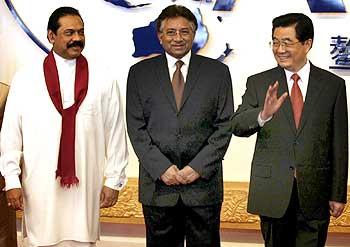
It was being written by the Sri Lankan forces tacitly supported by India and openly assisted by China and Pakistan.
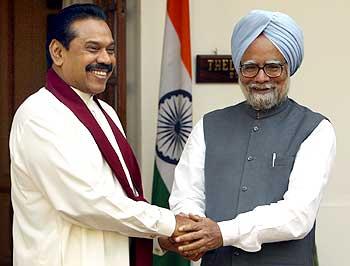
Since December 2005, when Mahinda Rajapaksa made his first visit to New Delhi less than a month after he took over as Sri Lanka's president, India was aware of his intention to take the LTTE head on.
Although in the initial days he was advised to seek a negotiated settlement with the Tigers, New Delhi saw merit in Rajapaksa's argument that the LTTE was only biding its time to regroup and rearm itself and that war was inevitable sooner than later.
And if the LTTE was preparing for a showdown, Rajapaksa did not want to be caught off guard either. His armed forces needed to be ready for any eventuality.
The president therefore sent his brothers Basil and Gotabaya to New Delhi with a shopping list for essential weapons and equipment that the Sri Lankan armed forces needed. The shopping list included air defence weapons, artillery guns, Nishant unmanned aerial vehicles and laser designators for precision-guided munitions.
Initially, New Delhi was non-committal.
Top officials involved in the talks on either side told me that in its typical bureaucratic style, New Delhi neither said yes nor said no to the visiting Sri Lankans. So the two brothers went back slightly disappointed but were still hopeful of getting Indian help.
Outwardly, India did adopt a hands-off policy vis-a-vis the Sri Lanka conflict. But that was because of domestic political compulsions born out of the fact that the ruling United Progressive Alliance government in New Delhi was dependent upon the Dravida Munnetra Kazhagam party from Tamil Nadu for its survival in Parliament.
Aware of DMK chief M Karunanidhi's soft corner for Prabhakaran, the UPA did not think it politically prudent to annoy the DMK patriarch by openly supporting the Sri Lankan government against the LTTE.
So, publicly India maintained that it would not give Sri Lanka any offensive weapons.

New Delhi didn't want to annoy the DMK


Yet, in early 2006, India quietly gifted five Mi-17 helicopters to the Sri Lankan air force. The only Indian condition was: These helicopters would fly under Sri Lankan air force colours. New Delhi clearly did not want to annoy UPA's Tamil Nadu allies like the DMK unnecessarily.
The Mi-17s were in addition to a Sukanya Class offshore patrol vessel gifted by the Indian Coast Guard to the Sri Lankan navy in 2002.
Sri Lankan defence sources later told me that these helicopters played a major role in several daring missions launched by the Sri Lankan air force to rescue the army's Deep Penetration Units and the eight-man teams, whenever they were surrounded by LTTE's counter-infiltration units, or when injured soldiers had to be airlifted from deep inside LTTE held territory.
As a senior Sri Lankan army officer confided in me, "Our soldiers operating behind enemy lines functioned with greater degree of confidence and efficiency in Eelam War IV since they knew these helicopters were always on hand to come to their rescue whenever necessary. This was surely one of the key factors in our Special Forces delivering spectacular results."
But hampered by domestic compulsion, New Delhi could not go beyond such meagre and clandestine transfer of military hardware. And publicly all that India was willing to acknowledge was the supply of low-flying detection 'Indra' radars to the Sri Lankan air force since this equipment was considered a defensive apparatus.
Colombo, on the other hand, was becoming increasingly restless since an all-out war with the LTTE looked inevitable. Domestic political pressure had also stalled the signing of a Defence Cooperation Agreement between India and Sri Lanka. Although both sides had publicly committed themselves to such an accord in 2004 itself, the DCA never materialised.
Insiders in Sri Lanka's defence establishment reveal that India's insistence on securing exclusive rights to the use of Palaly air base in the Jaffna peninsula was the most contentious point between the two delegations.
Colombo saw this demand from India as downright insulting and symptomatic of India's hegemonistic mindset. So the DCA never got off the ground. Ironically, three months after the Eelam War IV ended, India decided to fund the repair and restoration of the Palaly air base in north Sri Lanka.

Sri Lanka needed India's support


Next


The Rajapaksa regime was nothing if not shrewd. It knew the past history. It was aware of the dynamics that determined India's domestic politics in the context of Tamil Nadu. It was also conscious of India's anxiety in losing strategic space in Sri Lanka.
But above all, the Rajapaksa brothers were pragmatic enough to realise that Sri Lanka needed India's support in the prosecution of the war against the LTTE, total support from China and Pakistan notwithstanding, simply because India was Sri Lanka's next door big neighbour. Colombo could ignore India but only up to a point.
So Mahinda Rajapaksa hit upon an idea of setting up an informal exchange mechanism between New Delhi and Colombo. The president nominated both his brothers Basil (a member of parliament and presidential adviser) and Gotabaya, the defence secretary, along with his own secretary, Lalith Weeratunga, as members of an informal yet powerful delegation that would update the Indian government on the latest developments as frequently as possible.
India too reciprocated immediately.
India's National Security Adviser M K Narayanan, Foreign Secretary Shiv Shankar Menon and Defence Secretary Vijay Singh formed the Indian trio. The two teams interacted frequently both on the phone and by visiting each other. The Sri Lankan trio in fact visited New Delhi at least five times between 2007 and 2009. The Indian delegation made three return visits in the same period.
Most of the interactions were low-profile and discreet except the Indian team's June 2008 trip to Colombo that attracted huge attention mainly because of its timing. That time Sri Lanka's military operation was pushing the LTTE out of its north-western coastal areas in the Mannar district.
And two months later, Sri Lanka was supposed to host the 15th summit of the South Asian Association for Regional Cooperation.
When Narayanan, Menon and Singh arrived in the Sri Lankan capital in a special Indian Air Force plane, almost unannounced, military analysts, both in India and Sri Lanka, were speculating a massive retaliatory strike by the LTTE.
Indian intelligence agencies apparently had credible information that such a counter attack could be aimed at the 15th SAARC summit that Colombo was hosting on August 2 and 3.
The Indian officials wanted to ensure foolproof security for the summit. New Delhi in fact persuaded the Sri Lankans to accept India's help during the summit. After much persuasion and even a veiled threat that India may stay away from the summit if New Delhi's suggestions on a security upgrade in Colombo was not met, Sri Lanka reluctantly allowed Indian naval ships, anti-aircraft guns and helicopters to be deployed in and around Colombo for the duration of the meet.

Conclude Eelam war before polls
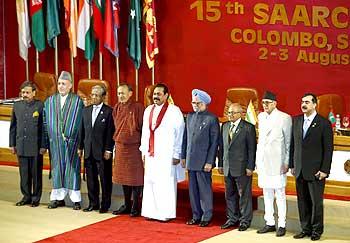


I happened to be in Colombo as part of the media delegation that traveled with Prime Minister Manmohan Singh. I had never seen such tight security in Sri Lanka. The Sri Lankan capital was indeed locked down in a tight security grid for the duration of the summit.
The Indian prime minister and all top Indian officials were transported in Indian Air Force helicopters from the Bandarnaike International Airport to the heart of Colombo. All roads used by the VIPs were shut hours before they traveled on them. In fact, I remember friends in Colombo having left town to avoid being inconvenienced by the stifling security arrangements.
The SAARC summit did pass off peacefully although, as usual, its focus was hijacked by the hyped meeting between the Indian and Pakistani prime ministers.
But security at the SAARC summit was not the only point of discussion that India was interested in. The top Indian officials, according to sources in Colombo, also wanted detailed briefing on the on-going operations in the north. This was readily done at the ministry of defence by both the commander of the army, General Fonseka and commander of the navy, Vice Admiral Karannagoda.
The Indian delegation, I was told by an insider, once again raised the issue of increasing Chinese and Pakistani involvement in Sri Lanka's military campaign, but was quietly reminded that it was India's refusal to supply lethal weapons that had compelled Colombo to look elsewhere, primarily to China.
But the most important political message was delivered by the Indian delegation to President Rajapaksa. He was told to try and conclude Eelam War IV before the summer of 2009 when India was expected to hold the general election.
The ruling Congress party obviously did not want the shadow of Sri Lanka's ethnic conflict to fall on the politics of Tamil Nadu and needlessly complicate matters during the election campaign. President Rajapaksa did not commit himself on the deadline, but promised to expedite the operations. The trio returned to New Delhi perhaps with a mixed feeling of achieving only part of its objective.
Colombo may have been ambivalent about meeting Indian requests to end the operations before the general election, but the Sri Lankan leadership once again gratefully acknowledged the Indian Navy's contribution in locating and destroying at least 10 'floating warehouses' owned by the LTTE.
These warehouses or ships of varying sizes were used by the LTTE to store arms, ammunition and even armoured personnel carriers. These ships, which had no names or identification numbers, used to remain on high seas for months on end. They were brought near Sri Lankan shores whenever the LTTE needed the arms. Smaller ships and craft were used to transport these arms to the Sea Tiger bases on the east and the west coast.

Well-coordinated operations by the two navies
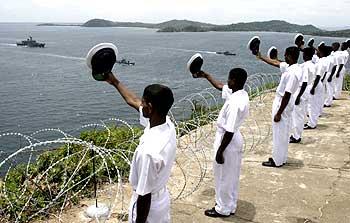


Indian and Sri Lankan navy sources revealed that well-coordinated operations by the two navies between 2006 and 2009 actually broke the backbone of the Sea Tigers.
The Indian Navy, the Sri Lankans said, helped in various ways.
For instance, the Indian Navy's Dorniers based at Ramnad in Tamil Nadu flew regular reconnaissance missions over the seas around Sri Lanka. These Dornier aircraft, fitted with high-powered radar, scoured the area for ships with suspicious movement and cargo.
Whenever such a ship was detected, the Indian Navy passed on the information to the Sri Lankans. The real time intelligence helped the Sri Lankan navy track and then destroy LTTE arms consignments.
Once the rogue ships were located, Sri Lankan navy's Offshore Patrol Vessels (OPV) would go after these floating warehouses and destroy them. The Sri Lankan navy destroyed the first warehouse ship on September 17, 2006, about 120 nautical miles east of the island. Three more such ships were sunk in early 2007.
Moreover, under an agreement between the two countries, the Indian Navy and the Coast Guard frequently sent out ships to patrol the Palk Strait and the Gulf of Mannar. The presence of warships and Indian Coast Guards's OPVs acted as a firm deterrence against the Sea Tigers.
Indian naval ships traveling between the east and the west coast and those going on overseas deployment were also told to look out for rogue vessels. Frequent exchange of information between the two navies resulted in a fine-tuned system that enabled quick remedial action.
Sri Lanka's navy chief Admiral Wasantha Karannagoda praised the Indian Navy's role. 'Cooperation with India has been extremely successful in countering the LTTE. Every year, the Indian Navy with the Indian Coast Guard and the Sri Lankan navy, holds four bilateral discussions. We are conducting coordinated patrols with the Indian Navy as well,' he said in early 2008.
'The navy has destroyed almost all LTTE vessels that could have assisted the Tigers in attacking the armed forces,' he said. 'Within one year, we have destroyed eight floating warehouses, which had carried more than 10,000 tonnes of war-like material including artillery, mortar, dismantled parts of three aircrafts, bullet proof vehicles, underwater delivery vehicles, scuba diving sets, and radar, among other things.

India's hidden hand in 'whacking' the LTTE
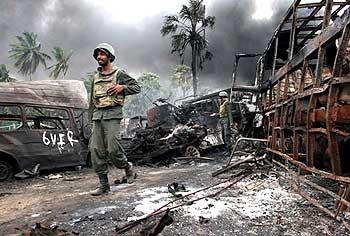


In one instance, accurate intelligence enabled the Sri Lankan navy to sail nearly 1,600 nautical miles southeast of the country, close to coasts of Australia and Indonesia, to destroy three ships in September 2007 and a fourth ship, which had escaped the initial action, three weeks later on October 7, Admiral Karrannnagoda said.
One of the LTTE weapons smuggling vessels was intercepted and destroyed by naval task units after a long pursuit in the high seas 1,700 km off Dondra Head, the southern extremity of Sri Lanka. At least 12 Tamil Tigers on board were killed in the attack.
'We went near Australian waters and whacked the last four vessels,' Vice-Admiral Karannagoda told Jane's Navy International in March 2009. 'Yet we are not a big navy; we had to improvise and use innovation and ingenuity to get our job done. The Sri Lankan navy does not possess any frigate-sized ships, so we used offshore patrol vessels and old tankers, merchant vessels and fishing trawlers as support vessels.'
What he left unsaid, according to sources in both Indian and Sri Lankan navies, was India's hidden hand in providing vital intelligence and operational support to identify and locate these ships.
In March 2009, the Sri Lankan naval chief deliberately avoided mentioning India's crucial contribution since electioneering in Tamil Nadu was picking up speed and Eelam War IV was in its final stage that month. Any public admission of India's hand in destruction of LTTE assets would have created a furor in Tamil Nadu and further strained the already delicate relationship between Sri Lanka and India.
But the fact remains that in late 2007, the Indian Navy's Southern Command deployed three fast attack boats and a missile corvette that patrolled the Palk Straits, searched and caught hold of LTTE fugitives.

'India is the big power in the region'
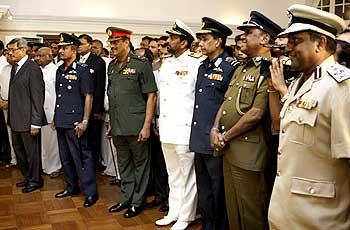


The 'sea denial' and 'naval blockade' by the Indian Navy started after a daring attack by the Sea Tigers on the Delft Island near Jaffna.
Delft Island, the largest inhabited island of the Jaffna peninsula, is located almost equidistant from Rameswaram in Tamil Nadu and Jaffna. The Sri Lankan navy used the island to monitor sea and air movements not only towards Jaffna but also between Mannar and Tamil Nadu coast.
In May 2007, the Sea Tigers mounted a daring attack on the naval attachment posted at Delft Island and after killing seven naval personnel, took away two anti aircraft machine guns, two machine guns, one RPG launcher and eight rifles.
Some reports said the Sea Tigers also took away functioning radar from the island. Jolted by this setback, the Sri Lankan navy requested India for operational help. The assistance was immediately given, but both sides had decided to keep quiet about the details.
Despite such a close working relations between the two navies, India was not happy with Colombo's increasing dalliance with China and Pakistan. New Delhi was acutely aware of the deep inroads made by Pakistan and China in India's backyard.
A worried Narayanan had bluntly declared in May 2007: 'It is high time that Sri Lanka understood that India is the big power in the region and ought to refrain from going to Pakistan or China for weapons, as we are prepared to accommodate them within the framework of our foreign policy.' Which in effect meant India could only supply 'defensive' equipment to Colombo.
Narayanan's statement in fact reflected the dilemma that New Delhi faced. The crisis was, of course, purely India's own making.
Crippled by the iron grip wielded by the DMK and other smaller Tamil parties on the UPA coalition at the Centre, New Delhi could not even openly approve of Colombo's determination to exterminate the LTTE.
Colombo understood India's predicament but had no other option but to shop for weapons and ammunition from elsewhere once India refused to comply with its requests.

Pakistan and China in India's backyard


Prev


Army Commander Sarath Fonseka admitted as much in an interview to me, "It is only after India told us that it cannot supply offensive weapons that we looked at other options. We first tried western countries but their weapons are expensive. Also, the Western countries cannot be depended upon to continue the supplies when it came to the crunch as it happened with us in the middle of the war, when certain countries blocked supply of spare parts for our airplanes and helicopters. So we turned to China which offered us arms immediately and on favourable terms. They gave us five-year long credit line. We bought armoured personnel carriers, artillery pieces, basic infantry weapons and some ammunition from them. As for Pakistan, we only bought some emergency ammunition from them."
Even Defence Secretary Gotabaya Rajapaksa had a similar story to relate.
Little wonder then that Beijing and Islamabad took full advantage of India's quandary.
By February 2007, Gotabaya Rajapaksa had concluded several defence purchase agreements with China.
One of the earliest agreements in Eelam War IV was a $37.6 million deal with China's Poly Technologies in April 2006 to supply its defence forces with ammunition and ordnance for the army and navy.
Another company, China National Electronics Import Export Corp supplied a JY 11 3D radar for $5 million.
According to the UK-based Jane's Defence Weekly the Sri Lankan navy's requirement, valued at $2.7 million, includes a range of ammunition including 100,000 14.5 mm cartridges, 2,000 RPG-7 rockets and 500 81 mm airburst mortar shells was met by the Chinese.
According to the authoritative Defence Weekly, other arms included 50 Type 82 14.5 mm twin-barrel naval guns, 200 Type 85 12.7 mm heavy machine guns, 200 Type 80 7.62 mm multipurpose machine guns, 1,000 Type 56-2 7.62 mm submachine guns and 1,000 Type 56 7.62 mm submachine guns.
China was not alone in supplying arms to Sri Lanka.
A high-level defence delegation from Islamabad visited Sri Lanka in January 2008 to sell weapons to Colombo.
Pakistan Ordnance Factories (POF) chief Lieutenant General Syed Sabahat Hussein held detailed discussions with Sri Lanka's security officials, including the defence secretary. The delegation included senior POF officials, Export Director Usman Ali Bhatti and General Manager Abbas Ali.
POF is Pakistan's largest conventional arms and ordnance facility and its 14 factories and four subsidiaries produce several varieties of armaments for export. These include infantry weapons, tank and aircraft ammunition, anti-aircraft and artillery ammunition, rockets, aerial bombs, hand grenades and mortars.
Getting China's and Pakistan's backing was important for the Rajapaksa government but it also needed to get its own act together at home. So the government and especially Defence Secretary Gotabaya Rajapaksa got down to the task of reorienting the Sri Lankan air force and the Sri Lankan navy, always considered the weakest link in previous military campaigns.


Excerpted from Sri Lanka: from War to Peace, by Nitin Gokhale, HarAnand Publishers, 2009, with the publisher's permission.

Sunday, March 3, 2013

When Kennedy drove Manekshaw!

Re-posting a piece I wrote barely a month ago if only to celebrate unarguably Independent India's greatest soldier--Field Marshal Sam Manekshaw. Over the next one year starting today--3rd April 2013--the Indian Army, if not the Indian government, has promised to organise various functions and events to commemorate the centenary of the legend that was Sam Manekshaw.

The proof of the pudding is in eating, they say. We will wait to see how,if, our politicians--past masters at paying lip service--rise to the occasion; if any one really cares to remember him. If the Defence Minister did not find time to attend the man's funeral in 2008, one expected him to lead the three service chiefs in launching the centenary year of Sam the soldier. Alas, there is no sign of  that.

We will wait of course for the military's grand plans to fructify. Meanwhile, here's a tribute to the man, the legend, through the eyes of some one who served him towards the end of his illustrious life. 


Today, Field Marshal SHFJ 'Sam' Manekshaw would have turned 100. He however passed away 5 years before his centenary.

But in Wellington, the quaintly beautiful cantonment town in the Niligiris, where the Field Marshal retired to, his memories live on.

Each year when I go for my annual lecture to the student officers at the Defence Services Staff College located in Wellington not very far from Coonoor and Ooty, at least one anecdote about Sam Bahadur, the Legend gets added to my stock. In 2012 I garnered more than my usual quota because I came twice in close succession!

Nothing prepared me for my trip this time though!

As I came out of the Coimbatore airport, an LO (Liaison Officer) in his crisp Madras Regiment uniform was as usual standing with the customary placard to receive me. As we walked to the Black Ambassador Staff Car, shining in the bright 30 degree sun, a tall man, his hair neatly combed and parted, wearing the Chauffeur's khaki uniform, greeted me: "Good Morning Sir! I am Kennedy!"

I wished him back distractedly since I was busy looking at messages on the mobile after a two-hour long flight.

As we started our drive to Wellington, Kennedy asked: " Shall I put the AC on Sir?"
After replying the affirmative, just to be polite I tossed a remark: "Have we met before, Kennedy?"

He said: "No Sir but I have seen you on TV and last year I also saw you at the function in the Field Marshal's honour!"

Impressed and flattered at the same time, I ventured to ask Kennedy how well did he know the Field Marshal. His instant reply was: "Sir I drove him and Madam around for 22 years!"

My mind snapped back to attention from the numbness that a long flight induces.

Here was a variation of a situation that I encounter almost every fortnight: the talkative taxi driver who wants to impress you with his knowledge and wisdom. But this was different. 


Here was a man who saw the Field Marshal closely for over two decades!

You would be foolish to let go of this opportunity Nitin, I told myself.

And the planned short nap be damned.

The inquisitive reporter in me was now wide awake!

So what is your most significant memory of the Field Marshal, I shot off the first question, my pen poised over the small notebook I fortunately still carry in my shirt pocket!

"Oh so many of them Sir," Kennedy replied in his heavily Tamil accented English. I wanted to immediately ask a counter-question: which one is most precious but years of training as a print reporter made me hold back.

After a minute or two, Kennedy, who was perhaps trying to recollect his memories, said: "Whenever I went to his house with the staff car from the college (Defence Services Staff College), the first thing he would tell Solai (the Field Marshal's Batman), Kennedy ko chai pilao, bread mein jam lagao, butter lagao! Each time, without fail, the Field Marshal would make me eat the bread-butter and drink tea," an emotional Kennedy reminisced. "The Field Marshal had cows at home. The household made its own cheese," he added.

And how often did you go, was my next question.


"Definitely once a fortnight. He was very particular to use the Staff Car only for official purposes," Kennedy revealed.

Now there was no stopping Kennedy.

"Very often Madam (the Field Marshal's wife, Silloo) would drive Sam to the market in her Maruti 800. Sam would purchase the essentials from the market himself--vegetables, meat-- he loved doing that," Kennedy recalled.

"You know something Sir, he bought the plot of land in 1960 when he was commandant of the Staff College but even as a Major General, he did not have enough money. He himself told me once 'Kennedy I had to take out money from my provident fund to buy this land."

Kennedy knew he had a captive audience of one in me now. The poor Madras Regiment soldier was just a mute spectator.

As we left behind the plains of Mettupalayam and started the gentle climb up the Niligiris, Kennedy was in full flow.

"The Field Marshal never said it openly but Madam and and other family members often made it clear that they were never happy with the way the government treated Sam after retirement. They gave him the baton, 5 stars and nothing else," Kennedy said. "Not even a dedicated car," an angry Kennedy recalled.

Now this was interesting and little disconcerting. Was this man sharing what he himself heard and saw or was he making it up mixing facts with gossip and innuendo?

Yes, one knew about the cold shoulder Sam got from successive governments but would he, even if he was unhappy, give that impression to anyone, leave alone his chauffeur?

I wasn't sure, so just to change the subject, I asked him is Kennedy you real name?

"Real name Hridayraj Sir but was I born in November 1963 the same month when President Kennedy was killed. My father (we are Christians by the way Sir) thought Kennedy was a good man so he gave me the name Kennedy. Everyone knows me as Kennedy around here Sir," the chauffeur who was unlike any other driver told me.

To bring him back to the Field Marshal's memories, I asked him, "what else do you remember about Sam?"

"He was a pucca soldier,Sir. He would never eat his breakfast without getting fully dressed. Also Sam always used to deliver the last lecture for the staff course," Kennedy revealed.

"Many senior officers, including Chiefs from Delhi and elsewhere would go and meet the Field Marshal whenever they came to Wellington. Often I would take them to the house. You know something Sir, (the most oft-repeated sentence in our one-way conversation!) I have driven more than 500 three star officers in my 27 years of service. I have been a driver to so many chiefs--Gen Rodrigues, Gen Sundarji (after his retirement Sundarji settled in Wellington), Gen Malik, Gen JJ, Gen VK, Gen Kapoor..." Kennedy was unstoppable now. He also knows which former chiefs' father was a JCO!

Kennedy even had an opinion on one chief who he thought didn't deserve the top post but became chief through political maneuvering in the first decade of this century!

Kennedy may sound opinionated but he certainly has phenomenal memory and information.

"You know Sir (that term again) Gen (KM) Seth, who was Governor of Chattisgarh and Tripura, was a CI (Chief Instructor,Army) here in 1992-1993? Later both his sons, one in the Army and the other in the Navy, did their staff course here. I was expecting the Army son to come here as DS (Directing Staff) but that didn't happen!"

We were by now nearing Coonoor.

He was digressing. "Tell me more about Sam the father and husband," I gently prodded him.

"Oh for him Madam's word was final ( for which husband wife's word isn't, I wanted to ask him but didn't, since he was in a trance). The Field Marshal was a loving father and grandfather. One of his grandsons looked exactly like him. Long nose, tall and fair. I never saw him scold any one. And he was always kind to people like us. When Madam passed away, Sam was a broken man. We knew he wouldn't last long without his biggest strength," Kennedy said in a voice that was clearly choking.

"You know Sir, President Kalam was the one who gave Sam more dignity than any one else. I drove the President to the hospital where the Field Marshal was admitted," Kennedy recalled.


A young Kennedy with the Field Marshal
Kennedy was however extremely angry at how the government treated Sam in his death. "No chief came for his burial. Defence Minister Antony sent his junior minister, some Raju. Is this the way we treat our heroes Sir," he asked. 


Posing before a '4-starred' car 
I had no answer.

As we neared the Staff College, all that I could ask Kennedy to do was to share some photographs of his with the Field Marshal.

And sure enough, later that evening, he came with the photos.

Over the next two days Kennedy drove me to the college, to the market and to dinners, coming up with one anecdote or the other about Sam the legend.

As he dropped me back to the Coimbatore airport on Saturday evening, I couldn't help but envy him a bit for having had the privilege of seeing the legendary soldier so up close.

Kennedy has a decade more to serve in his job but nothing will perhaps be as exciting for him as his years with the Field Marshal.

Wednesday, February 20, 2013

The nation wants to know!

Last year, when Arvind Kejriwal and Prashant Bhushan were about to form a new political party, the duo had, in one of their frequent press conferences, distributed a set of papers that had collated a number of letters, emails and contract papers between an American Attorney C. Edmonds Allen and a known operative in defence circles--Abhishek Verma.

The spat between the two had resulted in several set of papers becoming public. There was no way of authenticating those papers and contracts. So despite possessing those papers, one was wary of depending on them for any news item. Today I dug out those papers from the bottom of the pile on my desk.

On Pages 114-117 of the document found an interesting detail. Photocopies of those four pages are placed in this blog entry.
You would wonder why:


Tonight a very popular news programme went berserk with its "new," "exclusive" and "explosive" investigative details that "unmasked" the sinister designs of Abhishek Verma and the deep inroads he had apparently made in the heart of Indian defence and political establishment in order to secure defence contracts for his foreign clients.

There was and is no way to confirm if the programmes mentioned in these pages were attended by the people that they list out. Even assuming that they attended these receptions and cocktails, the people purveying this news have been economical with the truth at best and downright untruthful at worst.

For this media outlet to say it has investigated and found these explosive details is... err... stretching the reality too far. I am wondering if the news outlet's reporters and its head honchos also investigated a certain MP mentioned in this agenda paper!

The nation may want answers every night, but the answers must come  through genuine leg work of journalists and not depend on handouts distributed by others, leave alone by a fledgling political party.

See, read and judge for yourself.


India's defence sector: from 'buy global' to 'go slow'


The Indian defence sector, forever beset with procedural delays and long trial periods in testing new equipment is now starting at further slowdown in decision-making following the AgustaWestland helicopter controversy last week, officers in the ministry of defence and the three service headquarters say.

Recent cuts in both its capital and revenue budget (capital budget is for buying new platforms and weapons and revenue budget funds service the recurring needs) running into Rs 14000 crore has put the defence ministry in a tight spot.

The new controversy in which middlemen are alleged to have pocketed up to 51 m Euros in the AgustaWestland deal to supply 12VVIP helicopters to the Indian Air Force, India's plans to replace its 1970s and 80s era equipment used by its three armed forces with modern arms sourced from wide ranging suppliers as against its over-reliance on the erstwhile Soviet Union and now Russian manufacturers has only serve to magnify Indian defence sector woes.

Defence Minister AK Antony warned on Tuesday morning: "Don't raise a doubt for every purchase. India has a volatile neighbourhood and the Indian military needs to modernize fast." But sources say the CBI probe ordered by the government in the AgustaWestland helicopter issue has turned India's acquisition process from "buy global," into  a "go-slow," mode. If AgustaWestland gets blacklisted or banned following the probe, many planned purchases would be in trouble.

The Indian Navy, among the biggest spenders on Defence acquisitions in the past five years is likely to be the hardest hit, sources say. Navy is in the price negotiation stage to acquire 16 Multi-role helicopters--MRHs under a plan to spen about 2 billion dollars on their acquisition.

In contention are Sikorsky and NATO Helicopter Industries (NHI), a consortium of AgustaWestland and Eurocopter among others. If Agusta gets blacklisted, then the 13-year old process will have to begin again. These helicopters are supposed to replace the 1990s vintage Sea King helicopters. These MRHs were to be deployed on different ships. Assigned to carry out multiple tasks, including the crucial anti-submarine role, these helicopters are to be used on the new ships that are either being built in India or imported from Russia. Without them even the latest ships are protection less.

Its not just the acquisition of multi-role helicopters that would be hit. The Indian Navy's has plans to buy 56 new Naval light utility helicopters and Agusta Westland was supposed to be competing for this tender.

Then there is the Army's requirement for 197 light utility helicopters hanging fire for the past five years

According to an estimate, India is planning to spend over 100 billion dollars in buying new weapons from the across the globe over the next decade.

India's original defence budget for fiscal 2012-13 was pegged at 36 billion dollars before Finance Minister P. Chidambaram forced a cut of 2.5 to 3 billion dollars owing to a huge funds crunch. Yet, by 2020, India's defence budget is estimated to climb to about 65 billion dollars.

But with at least four international firms from as diverse nations as Singapore, South Africa, Germany and Israel  having been banned for one wrong doing or the other, Indian Defence Ministry is fast running out of options to source its equipment from.

Although Defence Minister AK Antony lamented: "I am sad, in spite of taking all precautions ... we blacklisted 6 companies for bribery. I thought that will be a warning to everyone. Still, greedy people are working around the world," the grim reality is defence manufacturers across the globe have concluded that in India no contract can be won without paying bribes.


Wednesday, February 13, 2013

The VVIP helicopters' procurement saga


For the Indian Air Force, the Augusta Westland controversy could not have come at a more inopportune time. 

Its has plans to induct 300-350 aircraft, including combat jets, transport aircraft and helicopters over the next decade. But the scandal that has erupted around supply of 12 VVIP helicopters is likely to cast a shadow on its plans, at least in the short run.

This is for the first time an Air Chief's name has cropped up in scam of any kind. Whether former chief Air Chief Marshal SP Tyagi has received the bribe mentioned in the Italian prosecutors report will have to be proved after a thorough investigation both in Italy and India. In absence of any concrete proof I would like to withhold any judgement although ACM Tyagi has himself demanded a speedy probe and denied any wrong doing. 

The controversy has however stunned the air force fraternity.

Former Air Chief Air Chief Marshal PV Naik, speaking to me from Pune this afternoon said as much. He pointed out that the Air Force has never been involved in any scam before.  "I think all the IAF deals are very transparent. All procurement is signed through ministry of defence, finance etc," he pointed out.

 Although the defence ministry has not yet made it clear if the Rs 3750 crore deal with the Augusta Westland company will be scrapped or the deliveries of the remaining nine helicopters will be delayed indefinitely, ACM Naik was clear that any delay will be costly in terms of operational requirements.

"The helicopters should come to the air force as soon as possible. The IAF really needs it. The deal should not be delayed, according to me," he said. The probe can go on, he added.

Later talking to different sources in the government, I have tried to piece together the entire sequence of events in this long drawn out contract process. This is what I have managed to learn so far. There could be gaps in information though.

2000: Aware that Mi-8 VVIP helicopter fleet had only 10 years to go before being phased out, IAF suggests to the PMO and to the MoD that there is a need to look for suitable and modern replacement. The MI-8s are typical Russian product: sturdy, dependable but with very little comfort level to offer. 

(Air Chief Marshal AY Tipnis was the Air Chief then)

A request for proposal (RFP) is floated. Six companies respond. One of the key requirements in that RFP was the competing helicopters must be able to fly at altitudes around 6,000 metres with full load.

After trials, only one helicopter, Eurocopter's  EC 225 was able to fly at that altitude. 

In 2003, the IAF sent its evaluation report to the PMO. Brajesh Mishra, National Security Adviser (NSA) and Principal Secy to Atal Behari Vajpayee, asked the Special Protection (SPG) that guards the VVIPs for its comments. The SPG apparently said the EC-225 was not suitable because its cabin height was too short (at 1.39 metres) and that neither the VIPs nor the SPG personnel would be able to stand upright inside such a short cabin.

Mishra then wrote to ACM S. Krishnaswamy who had taken over from Tipnis in 2001 expressing concern on two points: A single vendor situation had arisen because of the specification that said the helicopters must be able to fly at altitudes around 6,000 m and that SPG's inputs were not taken. Having seen that letter briefly, I remember a couple of lines. It said, in parts: "It is unfortunate that SPG wasn't taken on board... I suggest you and the defence secretary work out the specifications in consultation with the SPG..." Mishra's point was the competition must be broadened and SPG's requirements must be met

So the Air Force in consultation with the SPG drew up the entire Air Staff Qualitative Requirement (ASQR) once again. That was in 2003 itself. The new specifications said the helicopters must be able to fly at an altitude of 4,500 metres and that its cabin must be at least 1.80 m in height.

Meanwhile, Air Marshal Tyagi took over as Air Chief in 2004. Hoever, it took the Air HQ and MoD's acquisition wing another three years to issue a fresh RFP. That was in 2006. 

The NDA government had been ousted. UPA was in power. The new RFP which went by the specifications finalised in 2003 was issued to six different vendors when Pranab Mukherjee was the Defence Minister.

Three companies--makers of Mi-172, Sikorsky which made the S-92 helicopters and Augusta Westland's AWA101-- responded to the RFP.

Meanwhile the MoD had put in place a new concept--the Defence Procurement Procedure (DPP)--which lays down stringent rules and regulations. Under the DPP all companies that bid for contracts above 100 crore rupees have to sign an integrity pact which binds the companies to give an undertaking that no bribes would be paid or agents would be used in the contracts.

The Russian company that makes Mi-172 withdrew from the competition at an early stage refusing to sign the integrity contract!

That left Auguta Westland and Sikorsky in the race. By now this was late 2007. 

Fali H. Major, himself an ace helicopter pilot had meanwhile taken over as the Ar Chief after ACM Tyagi superannuated in 2007.

The evaluations and trials of S-92 and AW101 began ad continued over the next couple of years (2008-09). According to Air Force sources S-92 was found to be non-compliant on 4 counts: 

1. It could not reach 15000 feet without maximum power

2. Its 'hover out off ground effect' wasn't sufficient

3. Its drift down altitude was not meeting the requiremt

4. Missile airborne warning system wasn't up to the mark

Augusta Westland with its three engines was a bonus, according Air Force test pilots since one engine failure still meant it had two to fall back upon.

Some time in 2009, Air HQ sent its recommendation to the Defence Ministry and after all going through the stringent financial and technical requirements mandatory under the DPP, a contract was signed in February 2010.

By this time, ACM Naik was the Air Chief.

The first of the AW 101 arrived in India in late 2012. Two more followed in quick succession.

Even before the deliveries had started, reports had begun appearing in Indian media about some underhand dealing. 

Early this week the manure hit the fan and by now every one is an expert on who has got what and how much money has changed hands. 

Politics has also begun on the matter.

Over the next few days, the controversy will remain in the headlines.

Then we will discover some thing new to outrage over and move on.

Whether or not a former Air Chief received a kickback will remain a matter of investigation.

One is just hoping that this episode (and the last word is yet to be heard on this) will not further slow down India's overall defence acquisition process

Sunday, February 10, 2013

Perfidious attempt to give away Siachen is on


Outlook has a cover story on Siachen and Kargil. I have a column in it, pasted below.

OPINION
The Wages Of Peace
Kargil was actually about Siachen. India must remember that.

http://outlookindia.com/article.aspx?283856
Last July, sitting in Dras in the middle of a two-day celebration of India’s 1999 Kargil military victory, I was interviewing Lt Gen K.T. Parnaik, who leads the Indian army’s northern command. Among other issues, the general, one of the seniormost military leaders of the nation, spoke candidly of the 2010 unrest in Kashmir, the presence of Chinese troops in northern parts of Pakistan, India’s ongoing efforts to improve infrastructure along the China border and, towards the end of the interview, about the growing demands for the withdrawal of Indian troops from the Siachen glacier, the world’s highest battleground.

One sentence in the general’s elaborate answer to the question on Siachen struck me as particularly significant. “Don’t forget, Kargil happened because of Sia­chen. Why did they do Kar­­gil?” he asks. “If you per­­use their records, which are now out in the public, one of the major objectives of what they did in Kargil was to force us to vacate the Siachen glacier. Now, if that is their intent and that is their credibility, it is up to you to judge whether we should be really vacating the glacier or not.”

Seven months down the line, a former general of the Pakistani army, Lt Gen Shahid Aziz, who headed the analysis wing of Pakistan’s spy agency, the infamous Inter-Services Intelligence (ISI), in the summer of 1999 when the Kargil conflict was playing out, has confirmed what Parnaik said last July. Aziz has also blamed former president and military dictator Pervez Musharraf for having kept the nation in the dark on his pet project, the Kargil incursions. Undeterred, Musharraf has described the Kargil conflict as a huge military success. He says the Pakistani army would have “conquered” 300 square miles of Indian territory if then Pakistani prime minister Nawaz Sharif “had not visited the US and succumbed to pressure from then US president Bill Clinton to withdraw Pakistani troops from Indian territory”.

Musharraf, unwanted in his own country and shunned by most senior military and political leaders there, is now using his erstwhile aides and confidants to shore up some support for his favourite operation. Col Ashfaq Hussain, a former aide to Musharraf, writes in his book Witness to Blunder that Musharraf himself crossed the Line of Control (LoC) between India and Pakistan in a helicopter on March 28, 1999. He spent a night on the India-controlled side to boost the morale of his troops.

In a recent conversation, Gen V.P. Malik, who was India’s chief of army staff during the Kargil conflict, admitted that Indian troops had received reports of Pakistani patrols crossing over into Indian side of the LoC sometime in February 1999 even as prime ministers Atal Behari Vaj­payee and Nawaz Sharif were discussing the peace process and Vajpayee was taking the bus ride to Lahore. He reckons that Musharraf, who had already planned the incursions into Kargil by irr­­e­gulars and troops, thought it fit to visit the forward areas immediately thereafter to reassure the troops that the operation he had enga­ged them in was indeed to continue as planned.

Whatever the reality, recent revelations from Pakistan have ensured that the Kargil conflict is back in the headlines again. The revelations have also triggered a new debate on who gained what and who lost what in the longest military engagement between India and Pakistan so far.


During Kargil, the Pakistanis had the advantage of high positions. Our troops had to throw them out inch by deadly inch.
Pakistan’s military planners are now weighing the real cost of the Kargil operation. For months, indeed years after Pakistani troops were evicted by the Indian army and the air force from the rugged heights of Kargil, the Pakistan’s military leadership has been in denial. It tried to maintain the facade that the intruders were mujahideen, freedom fighters really, trying to liberate Kashmir from India’s clutches and that the Pakistani military was merely providing those motley groups some moral support. In trying to keep up with the fiction, the Pakistani army even disowned its soldiers, refusing to receive their bodies. Irrefutable evidence, in the form of paybooks of regular Pakistani soldiers, their photographs and letters written by them to families, however, forced Pakistan to grudgingly accept that soldiers of its Northern Light Infantry were also involved in the intrusion into Kargil.

That a professional army could abandon its own soldiers so callously was shocking, but more embarrassing was the folly of launching an operation that seemed without any tangible political objective. Musharraf’s reckless and seemingly aimless military misadventure dented the Pakistani army’s stock considerably in global circles.
Did we succeed? Two cover stories that told the truth in war season
The Indian army, and indeed all other agencies tasked with providing intelligence, were initially caught unawares by the intrusion despite advance warnings and inputs by its frontline commander (see Outlook, Aug 2, 1999, and the subsequent coverage, right up to September 2000). That its young officers and soldiers fought back valiantly and wrested control of all the heights and peaks that the intruding Pakistanis had occupied is well documented. What is however not sufficiently discussed is the fact that even through his misadventure, Musharraf managed, in the long run, to extract quite a cost out of the Indian army.

Till the conflict broke out and ratcheted up the tension, the Kargil-Dras sector was held by a single brigade, of some 3,000 men.

Today, a full mountain division is deployed to keep vigil on the sector. The 8 Mountain Division, which will be celebrating its golden jubilee this year, was raised in the Northeast for counterinsurgency operations, before it was moved to the Kashmir Valley in the 1990s. It was rushed to the Kargil-Dras sector in the May-June 1999. Since then it has stayed on. Before the Kargil conflict happened, during the harsh winter months, the weather meant that many posts there would be vacated; the assumption was that the enemy troops would face the same problem and would prefer to withdraw. No longer.

Now, even in the severest of winter, the Indian army has to compulsorily hold those posts by stationing men there. Lt Gen Kishan Pal, who was the 15 Corps commander based in Srinagar and technically the man who led the Indian field formations during the Kargil conflict, believes that India may have won a tactical battle but lost strategically. In an interview to me in May 2010, Pal said, “Well, for 11 years I did not speak at all...I did not speak because I was never convinced about this war, whether we really won it.... We did gain some tactical victories, we regained the territories we lost, we lost 587 precious lives. I consider this a loss of a war, because whatever we gained from the war has not been consolidated, either politically or diplomatically. It has not been consolidated militarily.” In a way, the Pakistani military achieved an unintended result in tying down a full Indian army division in Kargil. The original Pakistani objective of cutting off communication and supply lines to Siachen, the Shyok and Nubra valleys in Ladakh, however, remains unfulfilled.

Having failed to wrest control of the Saltoro ridge, which dominates the Siachen glacier and acts as a wedge between the Chinese-controlled Shagsham valley and Pak-occupied Kashmir, a Track II attempt is being made to “resolve” and “demilitarise” Siachen and get India to withdraw troops from the Saltoro ridge.

By involving senior and not-so-senior retired Indian military officials in a backchannel dialogue and getting them to agree that Siachen, along with the Sir Creek dispute, is a low-hanging fruit in the India-Pakistan bilateral dialogue, a perfidious effort is currently on to get Siachen vacated through non-military means. The principle on which Musharraf launched Kargil operations has thus not been abandoned completely. The Indian establishment has, however, repeatedly failed to see through the Pakistani army’s designs. Many civil society activists in Pakistan, however, say all stakeholders, including the Pakistani army, now genuinely want peace with India. The question is: is the shift in the Pakistan mil­itary’s thinking a tactical or strategic one?

Hopefully, Indian political and military decision-makers, having learnt their lesson from the 1999 conflict, will wait to get a clear answer before reciprocating the peace overtures from Islamabad. This is the least that New Delhi owes to the young officers and men who sacrificed their lives through those months to reclaim the icy heights from intruding Pakistani forces and irregulars.

(The writer is NDTV’s security and strategic affairs editor and had reported the Kargil conflict for Outlook.)

Friday, February 1, 2013

Kargil, LoC and Gen Musharraf


Former Pakistani president General Pervez Musharraf, unwanted in his own country and shunned by his own fraternity there, is fighting a desperate battle for survival. Under attack from some of his own Army colleagues for having kept large parts of the Pakistani establishment in the dark over the Kargil operation of 1999, General Musharraf through his aides and confidantes, is making new revelations about the 1999 India-Pakistan conflict.
On a TV programme aired on Geo TV on Thursday night, a former Pakistani colonel revealed that Musharraf had crossed the Line of Control in March 1999, a couple of months ahead of the actual Kargil conflict, which lasted two months.   Colonel (retd) Ashfaq Hussain alleged that General Musharraf entered 11 km inside Indian border to survey the area.
In his book ‘Witness to Blunder’, Colonel Hussain has written that Musharraf  himself crossed the LoC in a helicopter on March 28, 1999 and spent a night on  the Indian-controlled side.  
General VP Malik, who was the Indian army chief during the Kargil war, told NDTV: " The Indian Army had reports that the first Pakistani patrols had crossed over into Indian side of the LoC some time in February even as Prime Ministers Atal Behari Vajpayee and Nawaz Sharif were discussing the peace process and Vajpayee had taken the bus ride to Lahore.  Gen Musharraf, who had already planned the incursions into Kargil thought it fit to visit the forward areas immediately thereafter to assure the troops that the operation was going ahead as planned. It is therefore possible that Musharraf went there in March 1999 but whether he crossed the LoC or not, I cannot say."
In his book, Colonel Husain says the Kargil 'misadventure'  was masterminded by Major General Javed Hassan, General Mehmood and General Aziz. They made then president Musharraf agree to the plans, which later lead to a limited conflict between India and Pakistan.
However, General Musharraf, in an interview to Pakistan’s Geo TV,  said the Kargil conflict was a huge success militarily. He claimed that the Pakistani Army would have "conquered" 300 square miles of India, if  then prime minister Nawaz Sharif had not visited the US and succumbed to pressure from  then US President Bill Clinton to withdraw Pakistani troops from Indian territory.
Clearly nearly 14 years after the conflict, Kargil continues to make headlines.

http://www.ndtv.com/article/india/did-general-musharraf-cross-the-loc-ahead-of-kargil-conflict-325108?pfrom=home-lateststories