Friday, November 16, 2012

Reporting war without media. Israel kicks up a debate


Can the armed forces, engaged in a real time conflict, also take on the role of journalists reporting the developments themselves while the battle is still being fought? This week, the Israeli Defence Forces have shown, it can do without the media by live blogging and live tweeting an attack on Hamas guerillas in the Gaza strip and uploading video of their rocket blasts to YouTube. (For a detailed analysis on what exactly the IDF did, read this: http://gigaom.com/2012/11/14/when-armies-become-media-israel-live-blogs-and-tweets-an-attack-on-hamas/)

This experiment (and thankfully for the media, it still remains an experiment), may trigger a new debate on the likely diminishing role of media in reporting conflicts across the world. With social media gaining ground and providing a readymade platform hitherto unavailable to the military, armed forces may well be tempted to direct and decide the discourse of a conflict, gradually reducing the role of the media and eventually ending it altogether.

A far-fetched scenario?

May be at the moment such a possibility looks absurd, but in the rapidly changing media landscape, it may not take too long for the military to latch on to this option and keep the media’s involvement in a conflict to a bare minimum.

For years, in fact close to two centuries in the modern war history, the media and the military have shared a love-hate relationship, each critical of the other and yet both acutely aware that neither can do without the other. Starting with William Howard Russell of the London Times, who reported the Battle of Crimea to the present day combat journos, reporting from the world’s hot spots has been one of the more glamorous and sought-after assignments in the media world.

The military has however variously regarded the media as a “necessary evil”, an “intrusive devil” and have even called media practitioners “those newly invented curse to armies who eat all the rations of the fighting man and do no work at all.” (Filed Marshal Wolsely talking about William Howard Russell!)

Even as far back as in 1863, Gen Robert Lee commented during the American War of Independence: “It appears we have appointed our worst generals to command our forces, and our most gifted and brilliant to edit newspapers! In fact, I discovered by reading newspapers that these editor-geniuses plainly saw all my strategic defects from the start, yet failed to inform me until it was too late. Accordingly, I’m readily willing to yield my command to these obviously superior intellects and I’ll, in turn, do my best for the cause by writing editorials—after the fact.”

Then there are others like Gen Andrew Goodpaster, Supreme Allied Commander in Europe during WW II who had a more balanced view. He had said: “While there is—or should be—a natural convergence of interests in providing to the public accurate information about our armed forces and what they do, there is at the same time an inherent clash of interests (especially acute when men are fighting and dying) between military leaders responsible for success in battle and for the lives of their commands, and a media intensely competitive in providing readers and viewers with quick and vivid ‘news’ and opinion.”

The fact is: military and media continue to have an uneasy relationship despite so many decades of operating together. Military leaders have often painted a scary picture of the media. For instances, Napoleon had an occasion to say: “Four hostile newspapers are more to be feared than a thousand bayonets.”

Or see what Gen Colin Powell, an American military hero and later Secretary of State once told his commanders: “Once you have all the forces moving and events have been taken care of by the commanders --turn your attention to television because you can win or lose the war if you do not handle the story right.”

In the Indian context too, the military has largely been wary of the media, the relations between the two often guided by personalities at the top rather than by an institutionalized media engagement policy. Absence of a pro-active approach has meant that the Indian armed forces are often seen to be playing “catch-up” in a crisis situation. While the Americans, singed by their bruising experience in dealing with media in Vietnam, evolved a new media engagement policy, in India, the armed forces are still struggling to come up with a coherent, responsive and in-tune-with-the-times media policy.  They are partly hampered by the archaic rules that govern their public conduct. The iron control that the MoD exercises over Service Headquarters also contributes to the flat-footed response that the armed forces come up with in their media handling.

Although of late there have been concerted efforts within the services to train and equip middle- and higher-level officers in media handling, the armed forces need to urgently review their existing policy and come up with a more modern and responsive strategy to harness media’s reach and influence.  That’s the least one should expect at the moment even as countries like Israel continue to break new ground in power and media projection.

(Also read my 2010 piece: http://nitinagokhale.blogspot.in/2012/05/embedded-reporting-pros-and-cons-of.html)

Friday, November 9, 2012

India set to ramp up involvement with Afghanistan


This weekend, Afghanistan's President Hamid Karzai is travelling to Delhi to confer with Prime Minister Manmohan Singh. Several agreements are expected to be signed. 

One of the important pacts will be on training of Afghan soldiers by the Indian Army. On Thursday me and colleague Amitabh Revi reported on what the exact plan is. Here's the report along with a link to the video of our discussion.

It is particularly gratifying to see that the plan, first envisaged by both governments in 2011 and reported by us in November 2011 (the link is at the end of this blog entry), coming to fruition.

India has a lot at stake in Afghanistan and therefore an important area to watch out for.

(Video link) http://www.ndtv.com/video/player/left-right-centre/is-training-the-afghan-army-a-high-stakes-game/216277?vod-related

From NDTV.com

India has agreed to train upto 600 Afghan Army officers every year in India under a pact that President Hamid Karzai is expected to sign with India early next week, highly placed sources have told NDTV.

The program is the first concrete follow-up on military-to-military cooperation under the umbrella of the Strategic Partnership Agreement that was signed between Kabul and New Delhi in 2011 when Afghan President Hamid Karzai was given a grand reception in India.

Under the agreement, India, which has the world’s third-largest army, agreed to train, equip and build the capacity of the Afghan forces.

Sources in the Indian security establishment familiar with the contours of the detailed schedule say Kabul and New Delhi have identified three areas to focus on, namely increasing the intake of officers in India’s premier training institutes; providing specialized training to middle and higher level officers already operating in the Afghan National Army (ANA); and training soldiers in counter-insurgency and counter-terrorist operations. 

Over 200 Afghan cadets will be training at the National Defence Academy, the Officers' Training Academies and the Indian Military Academy every year. This is over and above the 600 serving Afghan National Army (ANA) officers who will undergo a variety of courses.

In addition, company level (100-strong) contingents of ANA will be trained for four weeks at the Counter Insurgency and Jungle Warfare School located at Vairangte in Mizoram.

NDTV had reported on these plans in December 2011. It has taken almost a year for New Delhi and Kabul to firm up the details.

India however has no plans to send or deploy its troops in Afghanistan as of now.

President Karzai is also likely to sign a pact on allowing India and Indian companies to mine that country's vast natural resources. Indian companies are planning to invest over 11 bn dollars in the mining sector over the long term in Afghanistan.

New Delhi has also decided to supply vehicles, information technology and sports equipment, a move seen as a paradigm shift in India’s approach to Afghanistan.

So far, India has concentrated on using “soft power” in the development sector, such as helping with the building of roads, hospitals and even the parliament building in Afghanistan. But by offering extensive training facilities for ANA, India has decided to ramp up its involvement, although it’s currently stopping short of supplying any military hardware. New Delhi has also decided not to send training teams to Afghanistan in view of the two attacks on its embassy in Kabul.

The Indian security and strategic establishment has been wary of discussing the Indo-Afghan military-to-military relationship, not least because of Islamabad’s sensitivities. Pakistan sees the growing relationship between New Delhi and Kabul as denying “strategic depth” to its army, and even as an Indian attempt to encircle Pakistan.

President Karzai arrives in Mumbai on Friday and later travels to Delhi.

Video link: Nov 2011: http://www.ndtv.com/video/player/left-right-centre/is-training-the-afghan-army-a-high-stakes-game/216277?vod-related

Wednesday, November 7, 2012

What Obama's re-election means for Indo-US defence ties

President Barack Obama's re-election on Wednesday may mean different things to different people but for decision makers both in Washington and New Delhi it provides continuity in their quest to take the Indo-US defence and strategic partnership to the next level.

Both have come a long way from their frosty relationship in the immediate aftermath of India’s twin nuclear tests in the summer of 1998 when Washington imposed severe restrictions against Indian defence and scientific entities. A decade and a half later, US have been actively seeking to establish a much deeper defence and strategic partnership with India to fulfil its own vision for Asia over the next half a century. India is now undoubtedly a major player in US calculus designed to recalibrate its own engagement with Asia.

US effort to woo India as a counter-balance to a more assertive and rapidly rising China is multi-pronged but in the past five years, it has mainly concentrated in providing the Indian military more hardware than it did in the previous 60.

For instance the Indian Navy signed a contract to import the long-range maritime reconnaissance (LRMR) Boeing P8i aircraft; it bought a worn out amphibious ship INS Trenton (since renamed INS Jalashwa). The Indian Air Force has bought the C-130Js medium lift transport aircraft and is awaiting induction of the heavy-duty C-17 aircraft, both from US. US military majors Boeing and Lockheed Martin may have lost the massive 15 billion dollar contract to supply combat jets for the IAF but they are steadily winning substantial orders in India. Chinook and Apache helicopters, the M-777 howitzers are all likely to be inducted into the Indian military in coming years.  The Indian armed forces have increasingly undertaken joint exercises with the US military with troops from both sides now even attending several courses in each others’ training institutions.

In President Obama’s second term, Washington may redouble its effort to bring India firmly in the US fold but officials in the strategic and defence establishment are surely aware that such a plan is easier drawn up on paper than implemented in practice given India’s historic reluctance to be seen as a close ally of the United States.

So far New Delhi has adopted a cautious approach to US overtures. India is clearly not in favour of a formal military alliance with the US. That is why US Secretary of Defence Leon Panetta on a stopover in Delhi in June during his swing through Asia could not get any commitment out of India’s ultra-cautious defence minister AK Antony.

Panetta had then made a strong pitch for a new beginning for the Indo-US defence partnership. Speaking to an audience at an Indian think-tank, he had said: ““While the U.S. military will remain a global force for security and stability…it will of necessity rebalance towards the Asia-Pacific region. We will also maintain our presence throughout the world. We will do it with innovative rotational deployments that emphasize creation of new partnerships and new alliances.”

As strategic analyst C. Raja Mohan wrote recently: “An alliance with Washington, then, would seem natural for Delhi. But India is concerned about the inconstancy of American policy towards China, the fiscal and political sustainability of the pivot to Asia in Washington. Delhi is acutely aware of the dangers of a potential Sino-U.S. rapprochement that could leave India exposed. It therefore seeks simultaneous expansion of security cooperation with the United States while avoiding a needless provocation of Beijing.”
Apart from unspoken desire in Washington to use India as a counterweight to China, the United States particularly wants New Delhi to get more deeply involved in Afghanistan even as it prepares to draw down from there. India does not mind training more Afghan forces in India but is wary of any military deployment in Afghanistan.

As a result, even as India has agreed to scale up training for Afghanistan’s armed forces, it has refused to openly back the U.S. lines on the South China Sea and the Indian Ocean. Although India is aware (and wary) of China’s increasing assertiveness in both expanses of water, it prefers to work with smaller countries in the region – such as Vietnam, the Philippines and Indonesia – as well as China to resolve regional tensions.

More fundamentally, the Indian establishment continues to have reservations over the United States itself, doubts born largely from India’s perception of the past half a century that Washington has tended to side with India’s arch rival, Pakistan. 
And yet, India’s military realises that it needs Washington’s help in acquiring and mastering more modern military platforms as well as reduce its traditional dependence on Russia for most of its weapons supply. Realising India’s dilemma, Washington has worked overtime to keep India engaged at different levels and has shown patience in its dealing with New Delhi.

The new administration is unlikely to alter this fundamental approach but Washington is sure to quicken the pace of engagement in the months to come even as it finds ways to fine tune its rebalance strategy for Asia amid leadership change in Beijing.

Why India will not withdraw from Siachen

In July, Northern Army Commander Lt. Gen KT Parnaik spoke to me at length on issues relating to India's northern borders, Pakistan's continuing attempts to stir trouble in Kashmir, China's increasing footprints in Gilgil-Baltistan and most importantly why India must NOT withdraw from or demilitarise Siachen. 

In the light of a controversy stirred by a Track II dialogue between a group of  retired military officers from India and Pakistan over Siachen, it is important to understand that the OFFICIAL MILITARY ESTABLISHMENT is so far steadfastly opposed to any dialogue on any proposal to demalitarise Siachen. Army Chief Gen Bikram Singh, Gen Parnaik's course-mate from NDA and IMA, is also on record that the Indian Army has no plans to give up its advantage in Siachen. This reality needs to be understood.

Read full transcript and view the full video of the interview here:
VIDEO: http://www.ndtv.com/video/player/ndtv-special-ndtv-24x7/kargil-war-happened-because-of-siachen-lt-general-kt-parnaik/240954


FULL TRANSCRIPT

Nitin: 
13 years ago, it was this month, when the last of the Pakistani intruders were evicted from this area, Dras and Kargil. You are back here for the 13th Anniversary celebration of the Kargil Vijay Divas in Dras. It is also fortunate we have with us the Northern Army Commander, Lt General KT Parnaik here in Dras-Kargil sector to celebrate and join the troops in the celebrations of Vijay Divas. In that busy schedule he has found time to talk to NDTV, and answer some of the questions. Sir, Thank you for your time. You are here in Dras. When you look back to 1999 and the situation in the last 13 years, what is your assessment of the current situation in this sector?

Lt General KT Parnaik: I would say there is a marked improvement in the situation that exists today, because in the wake of the Kargil war, a large number of steps were taken by the Army to ensure we never have a situation like this. And amongst them was our ability to guard these borders in a much more determined and deliberate manner. So you are aware that the additional troops that came here, to fight and reclaim and regain these areas, continued to stay here. So today, the defensive posture in the Dras-Kargil sector is very formidable. And I don't think that any repeat of Kargil can really take place here. To that extent the situation has improved considerably. We have continued to have the similar population with us. And they helped us during the Kargil war and at the same time suffered because of heavy shelling here. So we have ensured that their families and people are looked after, and we continue to take care of their means, because they are far away from civilisation here, so they are being looked after. So the situation is fairly in control as to what we are doing here. And the situation has highly stabilised here.

Nitin: Coming to the Kashmir Valley, which is always under scrutiny, summer is here, so, what is your assessment for this summer as far as the Kashmir Valley is concerned?

Lt General KT Parnaik: Let me start with the events that took place in 2010. In recent times, I can call it as a watershed of a very planned methodology by the adversaries to try and balance terrorism with political defiance. Because of their worries on the Western borders, because of their inability to put enough attention this side, they embarked on this strategy to ensure that whatever was happening inside Kashmir, should be made to look as if it was indigenous. And to that extent they masterminded the protest and the protest led to political defiance, which unfortunately led to many deaths, because the forces trying to deal with the law and order situation were not adequately equipped and the situation went out of hand. But once we retrieve the situation, by end of 2010, then in a synergised manner, the security forces, along with the administration, managed to chalk out a strategy, to pre-empt anything that would happen as in 2010. There were 3 main ingredients. One was to ensure that there were no triggers, because from 2007-08 to 2010, incidents rolled out in the valley based on triggers, whether it was Mattoo or any other. So we understood that we could not afford to have a trigger here. The second our ability to synergise our activities and preempt any effort made by the people who generated hysteria of political defiance; and that also helped us, to prevent them from reenacting what they did in 2010. The last point I wish to make is that we seriously looked at the centre of gravity as the population, and in the population, the youth. So engagement of youth was one of the most important factors in our strategy to ensure that this kind of defiance does not trigger.

Nitin: And how was the response?

Lt General KT Parnaik: The way we went about was, that we started looking at perception management in a more deliberate manner. We understood that a lot of activity that was generated in the Valley was through the cyber, and it was instigations from across. And the mentors, they used the large part of the separatists, the UGWs, the terrorists, to generate that kind of hysteria. But once we were on cyber ourselves, we could gauge the mood, we could prevent things from happening. That changed the whole situation. We engaged the youth in a lot of activities. In fact the conduct in Kashmir primarily, was one such move that proved to be fruitful in trying to engage them in sports instead of throwing stones. We were also able to appeal to the good senses. We took some of the stone pelters on a tour and we thought we could get them to be integrated as the rest of the children. That also paid us some dividends. And lastly, today we are engaged with them in the manner, that we invite them to attend our seminars, we have interactions, they are open to discussions; there is transparency. And we have even helped them in the sense that we have opened these youth registration centers, which allows them to understand what is the future for them, and we can assist them. So a large number of programmes have been unleashed. 2011 slowly changed the situation, and because of little or no human right violations, I think the situation came under control. So 2012, as it's almost halfway through, so far has been on the right lines, as we have expected and it was as per our plans. But we do understand that the people across are watching and studying the activities. At one stage there were notions that they could create disturbances here on the basis of the colour revolutions that took place in North Africa and other regions. The situation and conditions being different, we did not let that happen. I see 2012 also, likely to pass the way 2011 has. The only worry is that there are desperate attempts now being made from across, to try and engineer incidents. We are looking at incidents in the past 2 months, whether it was activation of South Kashmir, the threats that went out to these sarpanchs, the targeting of the police. We also had an incident where they targeted the Army too and we had a casualty. Now these haven't happened for a long time, and more recently you see there are very unfortunate incidents of the burning of the mosques. I see this as a pattern of trying to create a trigger.

Nitin: Is there is a pattern?

Lt General KT Parnaik: I don't know whether it's a pattern or not. Incidents, which occur now, will tell us whether it is a pattern or not. But for sure I can tell you that the people, who sit across the border, have not been so successful in trying to infiltrate as they have been in the past few years. The infiltration figures have come down. But that is not to say that there is no infiltration. There are desperate attempts of trying to infiltrate right from the time the snow levels have receded, and even before that. As you know that there are a number of launch pads across the LoC, there could be anywhere around 400-500 terrorists waiting to be infiltrated. These are figures confirmed by the intelligence agencies. I think from the beginning of the year, about 40 attempts would have been made, and in 3-4 cases, we clearly defeated these attempts. We had encounters with the terrorists, and we were able to neutralise quite a few of them. In a large number of the attempts, we were able to detect them and deter them from infiltrating to our areas, so they had to run back. However, I would still put a figure of about 30-40 terrorists that would have successfully infiltrated over the last few months. Some part of it is corroborated by the encounters we have had in the so-called reception areas. And that confirms that these were infiltrating groups. But with the strategy that we have to counter infiltration, we have very aggressive patrolling, we have good surveillance, and we are also ensuring that there is a deployment from LoC backwards, to ensure that we do not allow them to succeed in the manner that they would want to. That is why their attempt to use other borders, to infiltrate from say, Nepal and others, it is suspected that they would try to use these borders.

Nitin: But there is a very noticeable thing, as far is 2012 and 2011 is concerned, there is a difference between 2011 and 2012, is the concerted attempts to get the AFSPA withdrawn from certain areas. That has suddenly died down and we don't hear or read about it. What is your assessment of that?

Lt General KT Parnaik: See, we have always said it's a matter of security. The need of the hour in J&K is synergy and joint operation. As much as we may see the peace indicators in the terms of tourists, economic activity, which is a good sign, and we fully support it, we cannot be complacent in allowing things to drift. In the sense that even those areas, which seem to be peaceful, we need to continue to dominate them. And I think one or two incidents that have taken place, and please substantiate what I'm saying, and let's say the South Kashmir issue that the threats and the targeting of police and all, indeed in some places where things were quite peaceful, we had scaled down the activities, which was the requirement. But having seen that it has suddenly risen in toll of aggressive and violent incidents, we have re-commenced our operation, and the effects are there for us to see.

Nitin: The people have understood that the AFSPA...

Lt General KT Parnaik: See, it's a question of, the population always wants security, and I have a feeling that as long as the Armed Forces conduct themselves in a manner befitting of their ethos, and they do not carry out any human rights violation, which is what has caused the major change, I think the rest of the matter would settle itself. But once again I want to state that I have no issue in the respect with the Govt. or anybody, and it is a totally professional advice that we continue to give, and the decisions are with the Central Govt, to make.

Nitin: In that context again, if you remember there was this case, fake encounters, and you have the Army in both the cases. People are still confused as to how the Pahtribal case is going to proceed from here. They are going to be court martialed or they are going to be tried again, so if you could just throw a little light on it.

Lt General KT Parnaik: Subsequent to the Honorable Supreme Court's judgement on the issue of these legal cases, we have applied for trial under the Army Act, Section 125, and taken over the cases of both encounters. Pathribal is an old case Machil is recent. Now as far as the procedures that will follow, the Army Act and the Army rules lay down the method of conducting inquiries, summary of evidences and court martial. So we will go through this entire process. In case the Army enquiry has already been held, that is Machil, we will go for summary of evidence and after deducing the evidence that is available the next step will be taken. Therefore, similarly, as far as the Pathribal case is concerned you are aware that the inquiry was done by the CBI and unfortunately our witnesses had not deposed. So as per the provisions of the law, we have given a chance to our witnesses also to depose in the enquiry, through the summary of evidence and then, as and how the charges emerge, purely based on evidence, and keeping the legal aspects correct, the third step of the court martial will take place as a consequence of the summary of evidence.

Nitin: Will you be calling the civilian witnesses?

Lt General KT Parnaik: Yes, very much, in both the cases, the Army will call all those involved, whether they are Army, they are other security forces, they are civilians, everybody. So the trial will have to be a fair one, so that everybody gets to state his case. We have a provision of applying Army Rule 180, which gives the privilege to the accused to defend himself. There are four things he can do during the investigation. He can give any evidence he wants, he can make a statement, he can cross-examine any other witness who deposes in the investigation, and he has the right to peruse all the documents, which are being produced.

Nitin: The feeling of getting over with this tomorrow or day after, it will take its own course?

Lt General KT Parnaik: Yes, we would ensure that it does not get delayed on account of our procedures. We would ensure that it is conducted in the proper manner, in the transparent, open and keeping matters in place. The only delays that take place, as per our experience, are when the witnesses are either not available or they are not willing to come and depose, or we have to secure their presence for deposition. In the Pathribal case, a large number of people have retired or they are in other places. But this process of gathering witnesses has already begun. While our attempt would be to try and wind up these cases as soon as possible, but for sure we will have to follow the legal procedure, and legal procedures have their own methodology, to that extent, some time will definitely be taken.

Nitin: The other two enquiries are one, the rebellion in unit of Ladakh, which took place and a senior General who has alleged to have been involved in corruption. How are both the cases?

Lt General KT Parnaik: Both these cases, the artillery regiment in Nyoma and also the officer, they are complicated cases. As far as the regiment is concerned, because of the manner in which events have taken place, it has taken long to identify who all were involved and to what extent they were involved. So today we have a situation where a large number of people are under investigation. The numbers have exceeded 40-50 because they're officers, JCOs, they're men, and there's material evidence to, to indicate what could have happened and what has happened. As I mentioned to you, about the Court of Inquiry, it is essential that when you are looking at the character of a person being, you know; then he has to be placed under Army Rule 180. Now, in this inquiry, imagine there are 30-40 people sitting in court at any one time. Now one witness who comes as a new witness to depose, all of them have the right to cross-examine. All of them can make a statement after that; and all of them can produce evidence against what he says or doesn't say. So, procedurally, it is taking a lot of time. And when you have 20-30 people asking questions in a different way for the presiding officers and the members, it takes time to, you know, to get and stitch together what must be happening at that time. So it is this factor that is taking time. So I think this inquiry will take a little more time and the idea is to get to the truth. So, we do not want to hurry up things, for the want to get it done quickly. We do not want that justice is denied where it needs to be given. Now, as far as the other case is concerned ...

Nitin: And the Unit?

Lt General KT Parnaik: See the unit continues to be where it is. The Commanding Officer has changed. The erstwhile Commanding Officer has been attached for the inquiry. New Commanding Officer has come. Some new officers, JCO's, and men have been posted to the Regiment and it is functioning normally. As far as people under investigation is concerned, depending on the charges framed upon them, based on the evidence that is deduced, then we will proceed against them. There could be some that could be court martialed. There would be some who could be given administrative punishments. But all that will happen only after the Court of Inquiry gives its findings and it is brought to the higher authority for the decision to be made. 

Nitin: And the corruption charges?

Lt General KT Parnaik: About the other enquiry, because of the nature of the charge, it is essential that we secure the presence of a large number of civilians in this, a large number of them being contractors and his acquaintances and all. And since Northern Command is a large command, there are a large number of contractors that operate here for ration supplies, transport, etc. So some time is being taken to secure their presence and to, you know, investigate them. Similarly, he has the rights of cross-examining and making his own evidences. Thirdly, a lot of documentary evidence is also required. Now some of it is available, some of it needs to be procured and there are processes and procedures, officially, to procure these things. But it is progressing well, I would say. 

Nitin: How are we as far as the border with China goes? Are we okay with it? What is the situation there?

Lt General KT Parnaik: The LoC border is quiet and under control. The usual activities of transgressions, which are an annual feature, continue, like in previous years, this year also. The number of transgressions generally remains the same, apart from a variation in that some areas they come up and some areas they go down. So if you have the Aksai Chin areas in the north and the lake areas, Pangong Tso, and you have the Demochok Pokche areas, they keep fluctuating in terms of numbers at the times that they visit the areas. Basically, it is nothing else but the Chinese, the PLA, and all who are patrolling the borders. Since the borders are not demarcated, there are some perceptional differences on where it runs from. And we continue to visit those that we perceive to be ours, and they do the same. And it is in some of these areas, which have now been, we start calling them 'disputed areas' because of lack of clarity on those issues; when we visit those we term them as transgressions to the Chinese. We have had no unusual activity on the Chinese border. Therefore, I would continue to confirm to you that the borders are quiet; that there is usual activity and we continue to have border personnel meetings and other interactions with the PLA, as per the norms of the PTPA, the Peace and Tranquility Treaty that exists, and the existing orders on these issues in the mechanism. 

Nitin: What is our worry as far as the China front is concerned? Because we always think that China is worry that we will face in the future ... 

Lt General KT Parnaik: See, we need to be concerned about our security. For one, the Chinese have got a very good infrastructure in Tibet; and infrastructure flaunts capability. It enables them to quickly move forces, concentrate them, posture them and then use them. I'm not suggesting that this is what they're doing. Far from it, they're carrying out their usual activities like training and patrolling. But the availability of infrastructure in their side of Tibet is a cause of worry. And therefore our priority also, in addition to managing the borders, is seeing how our infrastructure can be speeded up. We need to get our roads and tracks up to the borders. We need to make sure that the forward-line areas are available to us because the areas get cut-off because of roads. We need to ensure that logistically and operationally, we are facilitated. The other domain is a matter of surveillance. You know, it's a vast area devoid of any cover, so this requires not only human, but it requires technical intelligence also, imagery intelligence also. So we are paying a lot of attention in trying to update our surveillance so that we are able to have a look-see and be warned up to our area of interest. And that has to be done through technical means, so that is the other aspect. Once we get our surveillance right and once we get our infrastructure right, I don't think we have anything to fear.

Nitin: How are you looking after that aspect, the PLA working in PoK?

Lt General KT Parnaik: It is true that a large number of Chinese are working in PoK. Now basically there are 3 issues. One is they have already put across the Karakoram Highway, which runs through Khunjerab Pass, so they are responsible to ensure that it is maintained. To ensure that the infrastructure stays intact the Chinese have been invited by the Pakistanis to take care of the infrastructure. In addition to this, they are also engaging in maintaining other infrastructure in the Northern areas. So, you see, a large number of construction companies and others, who are engaged in maintaining the infrastructure, maintenance and development. The third aspect is, in addition to the infrastructure, they have also taken on installation of hydel projects. Now some of these hydel projects are in river valleys that are very close to our Line of Control- like the Neelam River. Now that's where we can practically see their activity across the Line of Control. As far as these activities are concerned and PLA is concerned, it is quite possible from those who are present there they could be from PLA also, because PLA has construction companies and other things. The concern is that we have two unsettled borders with our two neighbours. Now to have this other neighbour also present at this unsettled border, diplomatically and in terms of security, it raises questions. We have sensitized the government on these issues and I have a feeling that these issues will be taken up through these channels. But we are keeping a check to the extent that we can and ensuring that there are no unusual activities taking place, otherwise we do hope that, at the highest level, these issues will be addressed. 

Nitin: What is it that Indian Army is concerned about with respect to Siachen?

Lt General KT Parnaik: You see, to understand Siachen, I think one needs to be geographically oriented to the region. And let me simply put it, because I'm telling you without a map, but the Siachen Glacier is bounded by the west by the Saltoro Range, which is a very high range and to the east by the Karakoram Range and the Nubra River. So, per se Siachen Glacier is a sort of iced river, which flows in between them. The Saltoro Range actually provides domination of the entire area. If we do not stay on the Saltoro, I won't go into the history of the demarcation of this thing, and how the area north of 9847 was left to the imagination, when they said that the LCA runs northward thence. Now northwards, if you literally and practically take northwards, it is along the Saltoro Range. The Pakistan's contention is that actually northwards means that it runs through the Karakoram Pass. Karakoram Pass is almost, I would say, 45 degrees from 9847. But the issue was that in '80s and '70s and late '70s and '80s, when we realized that a large number of expeditions were being conducted by Pakistan, we did perceive that, if in the excuse of expeditions they come and occupy that area, it would cause a lot of threat to us. So we occupied it in '84. There is a strategic implication of the Saltoro Range and the implication is you have the Pakistanis sitting in the northern areas, which we keep saying is an illegally occupied, it's a Pakistan occupied Kashmir. Now out of the other areas that they have occupied, they have illegally seeded the Aksai Chin and the Shaksgam Valley, Shaksgam Valley lies to the north of the glacier. And if Saltoro Range was held by them, it practically enables them to bridge this Aksai Chin and northern areas gap, which is with China, and also exercise complete control over the Karakoram Pass. Therefore, strategically, it is an important area. And we feel, by holding these areas, would effectively deny approaches to Kargil and Leh. Now, in security parlance, for the country it is of strategic importance, that is one reason. Second reason is that we have had a number of rounds of talks on this. A large number of solutions have been offered. One of the biggest issues that has not been resolved yet is that we insist that for anything to happen in Siachen, the Pakistanis must first accept the actual line of ground position and delineate the line along the positions that are being held by the troops today, both theirs and ours, as is, where is. They do not seem to be amenable to this sort of a thing. They continue to say that we should go back to '71 and '53, when this whole area was not demarcated, so you should vacate it. Don't forget, Kargil happened because of Siachen and why they did Kargil. If you peruse their own records, which are now public, the Kargil War in Pakistan is now in a public domain. And one of the major objectives of what they did in Kargil was to force us to vacate the Siachen Glacier. Now if that is their intent and that is their credibility, it is up to you to judge whether we should be really vacating the Glacier or not. 

Nitin: Does the Government understand these strategic implications?

Lt General KT Parnaik: The government fully understands the strategic implications and they are absolutely with us. And all through these talks, they have always projected this issue in the manner that I've told you. 

Nitin: And the offer made by Pakistan on Siachen talks?

Lt General KT Parnaik: See, the offer that was made by the Pakistan Army Chief, probably in wake of the tragedy that took place in Gayari, if they find it difficult they are most welcome to withdraw to safe places. And let me assure you Indian Army has no evil designs to set across for those areas and capture those territories. And this aspect is also well known to our leaders. So that is where it rests.

Nitin: Thank you for your time and being so frank about such contentious issues. We have the borders in your safe hands.

Monday, October 22, 2012

Yash Chopra as a creator of angry characters


Much before he came to be known as "King of Romance", Yash Chopra was a man who made suspense thrillers like Ittefaq and perhaps India's first multi-starrer Waqt. And not to forget Deewar which more than any other movie, consolidated Amitabh Bachchan's angry young man image.

For a self-professed romantic at heart, Yash Chopra had a pretty good grip on 'hard edged' subjects like Deewar and Trishul. Although the main credit of creating "Vijay" in Deewar must go to Salim-Javed, it was Chopra's no-nonsense direction and small little touches that made Deewar into a cult film. For instance, giving the coolie's badge with the number "786," to Amitabh's Bachchan's character and how parting with the badge hastens his downfall, or for that matter creating a new kind of heroine. Parveen Babi's Anita smoked, drank openly and had no qualms about living with her man without marrying him. Till then these roles were reserved for vamps mostly played by Helen or Shashikala. 

Very often Prakash Mehra and Manmohan Desai have been credited for creating Amitabh Bachchan, the legend but I would like to think that it was Yash Chopra who gave Amitabh the biggest boost. If Deewar carried forward Vijay from Zanjeer, Kabhie Kabhie, Trishul and Kala Patthar allowed Amitabh to explore different facets of the Angry Young Man Image.

The Eighties saw a spate of some mindless multi-starrers( like The Burning Train, directed by Yash Chopra's elder brother Baldev Raj) but Yash had already experimented with that genre in Waqt almost 2 decades earlier. Even in Waqt, actor Raj Kumar's Raja had an 'angry with the world' streak that the director used to the best possible effect! So much before he was slotted as a man who brought back "frothy romance" to Indian Cinema, Yash Chopra had an anguished and angry and streak in him too!

Today's generation might associate Yash Chopra's films with exotic foreign locales, great music and candy floss romance but his versatality had allowed Yash Chopra to experiment with a song less movie like Ittefaq or a socially relevant subject like Dhool Ka Phool, Dharputra and  Mashaal.

In today's era of instant judgement and instant hits, Yash Chopra is being lionised as a super successful producer director but like every other creative persons he too had setbacks. Vijay, a mish mash of a multi starrer, bombed miserably at the box office. Many have called Lamhe Yash Chopra's best work but for all his boldness, Chopra did not carry the theme to its logical conclusion!

Yash Chopra's legacy of making romantic, picture perfect movies shot at exotic locales in Holland and Switzerland will surely be carried forward by his talented son Aditya but I would like to see Aditya make films like Deewar and Trishul rather than just Mohabbatein and Dilwale Dulhaniyan Le Jayenge. That will be the best tribute his son can pay Yash Chopra./

India-China standoff: A journey to Tawang recalled

In the backdrop of the current faceoff between India and China in Ladakh, I thought it would be useful to recall my travel to the Eastern front--to the Kameng Sector--to commemorate half a century of the 1962 war. So here it: Still pictures, a half hour documentary, several articles. Its a longish post. Take a look for whatever it is worth.


September 2012 was a busy, educative and humbling experience for me. 

In trying to piece together the story of the 1962 border war between India and China, half a century later was not easy.

 In the end however, all the trouble--physical and mental--has been worth it. 

In the process, several discoveries were made: The biggest was that most of contents of the over-hyped Henderson Brookes Report on the military aspects of India's biggest and only defeat since 1947 was already in public domain courtesy the Official History of the 1962 war co-authored by Col (retd) Anil Athale. Col Athale had that report in his physical possession for two years! He has quoted extensively from that report! So much for secrecy, scoops and claims about the HB Report.

My travel to Tawang was a different experience altogether. Missed deadlines, half done work, shoddy planning on the infrastructure front was really saddening.

Another disheartening fact was the Indian Army's blockade of information and access to areas along the China border. Half a century later, the Army should have been proudly talking about the changes it has brought in terms of both preparedness as well as mindsets. It would have been appropriate for the Army to showcase the difference between 1962 and now. But the Brass told journalists that areas under Eastern Command and Eastern Ladakh are out of bounds for them. The logic was: Why up the ante against the Chinese? Still under confident? Afraid of the Chinese? Or pure and simple obduracy?

I have never been able to understand the logic.

Nevertheless, here's the sum total of my small effort to bring the 1962 war back in focus. The links below:


http://www.ndtv.com/video/player/the-big-fight/50-years-after-indo-china-war-is-india-now-better-placed-militarily/251537?hp&video-featured


and the latest write up.

http://www.lowyinterpreter.org/post/2012/10/22/Remembering-the-India-China-border-war.aspx

(details below)


Remembering the India-China border war

By Nitin Gokhale - 22 October 2012 12:33 PM

Nitin Gokhale is Security and Strategic Affairs Editor with India's leading broadcaster NDTV.
On Saturday, India observed the 50th anniversary of its comprehensive military defeat in the brief border war with China in the winter of 1962. It is important to look back at the events leading to the skirmish before attempting to assess what the future holds for the relationship between the two Asia giants.

In a way, the origins of the border war can be traced to two unrelated events in 1959. In March that year, Tibetan temporal and spiritual leader Dalai Lama fled to India through Arunachal Pradesh (then known as North-East Frontier Agency or NEFA) following a Chinese crackdown in Tibet. New Delhi's decision to grant the Dalai Lama political asylum did not go down well with China although Beijing did not make its annoyance too obvious.

The second event was India's discovery of a road, connecting China's mainland to the restive Sinkiang, built by China through the Indian held but unmanned Aksai Chin area in Ladakh. That discovery triggered the ill-thought 'Forward Policy', initiated by India's first Prime Minister Jawaharlal Nehru in consultation with his cousin Lt. Gen BM Kaul, a non-combat officer.

Under that policy the army was ordered to establish posts with less than  dozen soldiers in areas that were neither connected by road nor had any strategic value just to show that the land belonged to India. The establishment of these 300-odd 'penny packets', as one general later described them, led China to believe that India was preparing for a showdown over the border. Nehru, under pressure from the opposition and the people, was goaded into ordering a reckless plan to 'evict' the Chinese from Aksai Chin and NEFA against the professional advice of his military brass.

The so-called Indian provocation apart, Mao Zedong by some accounts also wanted to teach India a lesson since India and China were both competing for leadership position in Asia of the time. Mao seized the opportunity by coinciding the attack with the Cuban missile crisis. Col (ret'd) Anil Athale, who co-authored the official history of the 1962 war for India's Ministry of Defence says Mao used the tension between the US and the USSR to launch the offensive against India.

'The Chinese were aware of the impending Cuban missile deployment and calculated that the US would be engaged in a major confrontation with the erstwhile USSR to come to India's aid. The Chinese methodically built up its supplies and troops in Tibet to wait for the onset of the Cuban missile crisis. That opportunity came on 20 October when the US decided to confront the USSR on Cuba,' Athale told me.
Fifty years after that bloody confrontation in which India lost over 4,000 soldiers, much has changed on the ground. Indian deployment all along the line of actual control, as the de facto boundary is called, is sufficiently strong although border infrastructure on the Indian side is still below par. 


A repeat of 1962 is unlikely but tension between the two countries over the unresolved border issue continues to simmer despite rising bilateral trade ($US73 billion last year).

The intense India-China geopolitical rivalry is playing out in both South and South East Asia. China is making big inroads into India's neighbourhood by increasing its presence in countries like Sri Lanka, Bangladesh, Nepal and Myanmar. Beijing's long-standing relationship with Pakistan continues to be a constant threat to India; the increasing Chinese footprints in the Gilgit-Baltistan province of Pakistan, abutting Ladakh, worries India no end.

The rivalry, in a way, also extends to South East Asia as New Delhi gets sucked into the South China Sea and East China Sea disputes Beijing is involved in. China is wary of India's rising defence and economic ties with Vietnam, Thailand, Indonesia, Japan and Australia. But the biggest irritant between New Delhi and Beijing in coming years will be in the form of growing bilateral ties between the United States and India. Strategists in Beijing think Washington is cosying up to New Delhi to balance China's preeminent position in Asia.

As India looks back at the 1962 border war, its leadership will do well to realise that an increasingly assertive power like China will strive to keep India 'off-balance' by what can rightly be described as 'creeping tactical belligerence' on all fronts even while it seeks to develop economic and cultural ties with New Delhi.

In the final analysis, New Delhi must learn to look after its own national interests even as it attempts to deal with its increasingly powerful China.

Photos courtesy DRP, Govt of India.

With Neten Tashi, a SIB spy in 1962 who escorted
the Dalai Lama from Khinzamane to Bomdilla in 1959


With my closest friend, travelling companion, fellow journalist
Samudra Gupta Kashyap at the Tawang War Memorial

Doing a Piece to Camera at Tawang War Memorial
Tezpur to Tawang--a pictorial journey
Pelting rain greets us

At Bhalukpong on the border of Assam and Arunachal

BRO labourers at work


Jimmy Jesibo, a local activist based in Bhalukpong, a town on the Assam-Arunachal Border  is  very angry. The reason: the abysmal condition of the road going right upto Tawang and beyond along the China border.

Bearing the brunt of resentment is the hardworking staff of the Border Roads Organisation (BRO), entrusted with widening and improving the roads. Enraged residents, unable to bear the hardship any more, have attacked BRO officials, destroyed their vehicles and have thrown heavy tippers and bulldozers down the steep valleys in the past six months.

Half a century earlier, this was where the marauding Chinese routed the Indian army, pushed into a war it was not prepared for in a tough terrain it was not used to. 


Today the soldiers are definitely better looked after and unlike in 1962, they  are well-trained to fight in the high-altitude terrain of Arunachal Pradesh.


But five decades down the line, infrastructure, especially the main arterial road connecting Tawang to  the rest of India remains a major worry.

Jimmy Jibeso says, "Since the 1962 war, this route is very important for the north-east due to the Indo-china border. If the condition of the road is bad then how will Bofors reach the border in case of an attack. What will we do then? One needs good and big roads for Bofors. This is our main concern. Second concern is that medical help is not good up in Tawang and other places. If a patient has to be taken to Tezpur, Guwahati and other places, the road is so jerky and bad that the patient dies on the way. So we want good roads."

The Army, more than anyone else really requires this axis to be an all-weather road.  Since 2010, it has inducted a full new division - over 20,000 additional soldier -for  this sector.


Deteriorating roads

The majestic Kameng
The Border Roads Organisation, a quasi-military organization is entrusted with building and maintaining these strategic roads. Come rain or winter, labourers of Border Roads Organisation work to keep the only road link to Tawang open through the year but at the moment they are fighting a losing battle. The fault lies not with them but with people higher up who planned  the widening of the only road without building an alternative.

Constant landslips, frequent blockades are a recurring challenge. But landslides apart , BRO officials tell us that they are plagued by a shortage of labour in this sector. Earlier, large groups from Jharkhand and Bihar made their way to these parts.  No longer, since now plenty of work is available in their home states. Excruciatingly slow environmental clearances both by the central and state governments add to the delays.

Many such waterfalls by the road. Koyla was not shot here though

Landslides are a common phenomenon

Once a journo, always a journo!

A BRO labourer


For most of the 300 km, the road is as rough as this

My colleague Nirmal hard at work


One of the lesser known war memorials

Clouds just before Sela

Sela behind me

At Sela--13700 feet

The lake after Sela
The War Memorial at Tawang

Archival pix at the War Memorial. Indian PsOW

A Monpa man

A young monk taking a break in the Tawang Monastery


School children at Jang

At Jaswantgarh--the most famous War Memorial in this sector

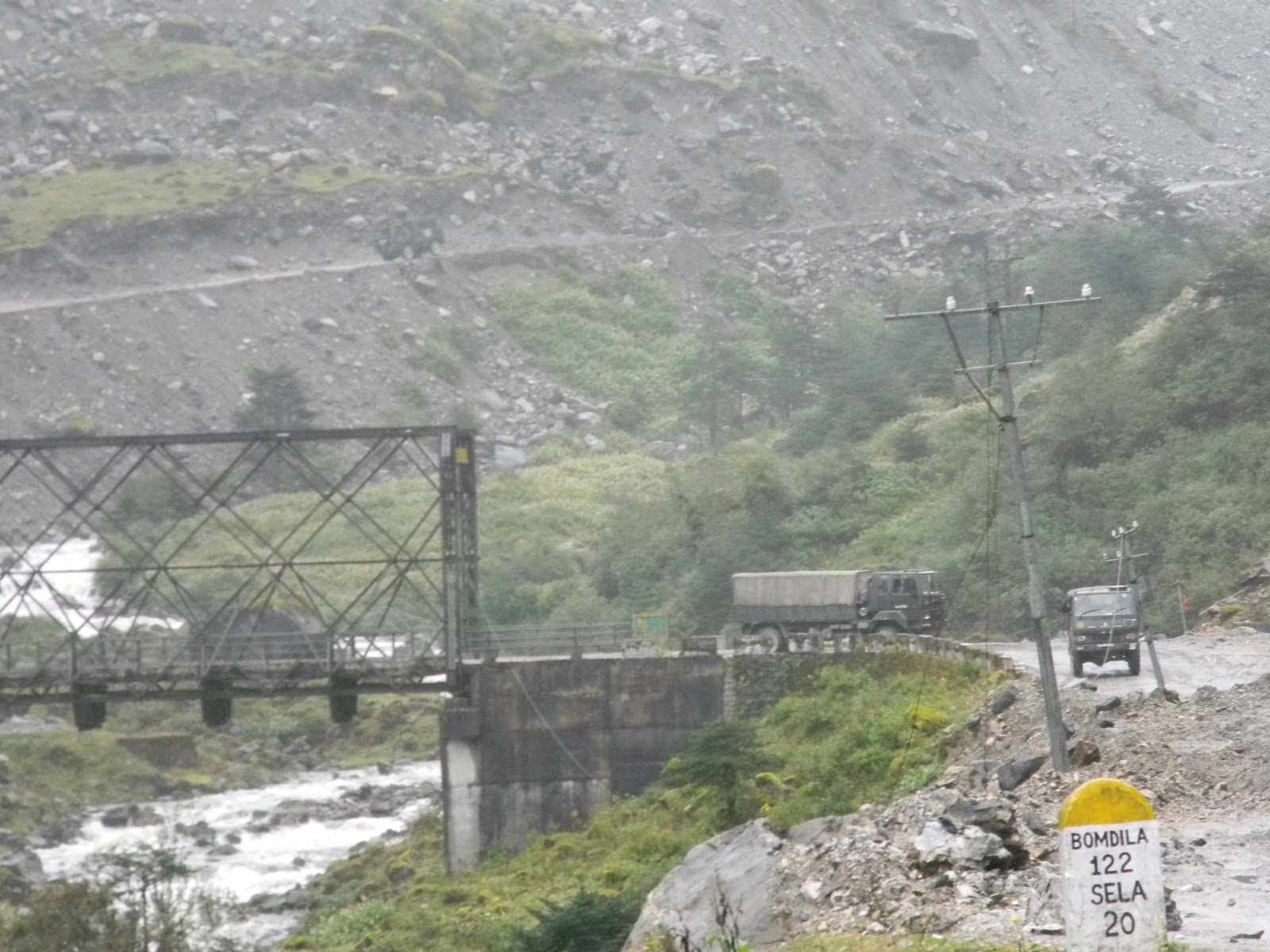
No matter what the condition of the road, Army vehicles continue to ply

Unusual site: BRO labourers taking a chess break!

Terribly slushy road

The difficult road

At the Sela zig-zag--doing a piece to camera


Chinese agression in 1962. Captured in a photo 


The Buddha statue inside Tawang monastery